

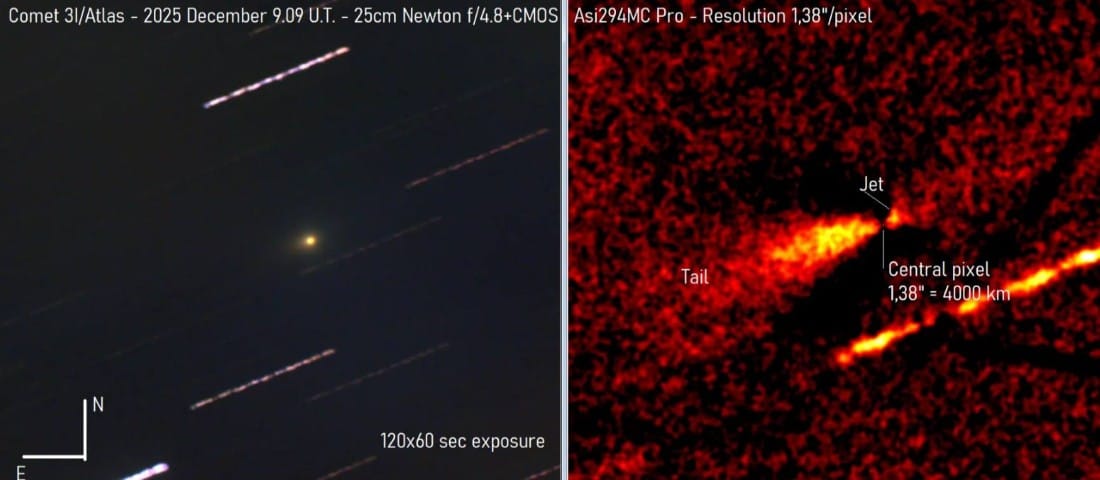
A comet of interstellar origin called 3I/ATLAS crosses the solar system in 2025, marking the third object of its type confirmed by science. Detectado in July by the ATLAS system in Chile, the cosmic visitor offers a unique opportunity to study materials and star formation processes from distant regions of the universe. NASA and Agência Espacial Europeia deployed advanced telescopes and space probes to record every detail of its trajectory and chemical composition.
The 3I/ATLAS flyby allows researchers to collect crucial data about objects traveling between the stars. Sua’s approach to Sol, reaching perihelion in October, intensified the comet’s activity, making it an even more valuable target for detailed observations. On December 19, the comet will make its closest approach to Terra, at a distance of 170 million kilometers, allowing in-depth analyzes of its structure and behavior.

Descoberta and Intergalactic Visitor Identification
Comet 3I/ATLAS was identified on July 1, 2025 by the Asteroid Terrestrial-impact Last Alert System system, operated by Universidade of Havaí with funding from NASA. Naquele at the time, the object was positioned approximately 420 million kilometers from Terra, on the approach route to Sol. Analysis of its orbit and speed confirmed its interstellar origin, distinguishing it from objects born within the confines of the solar system.
The ATLAS system was designed to scan the night sky and detect objects close to Terra, including asteroids and comets that may pose a risk. The early detection of 3I/ATLAS made it possible to plan monitoring campaigns that lasted for months, from its identification to its closest approach.
Esforço global observation and monitoring
The mobilization of resources by NASA and ESA to observe comet 3I/ATLAS was extensive and coordinated. Telescópio Espacial Hubble captured images on November 30, revealing the comet as a bright spot amidst a dense star field, providing crucial data about its morphology. The Juice probe, on its journey towards Júpiter and its moons, recorded the comet on November 4, when it was 41 million kilometers from its position.
- SPHEREx spacecraft Observatório analyzed the comet’s chemical signature between August 7 and 15, confirming the presence of water ice and carbon dioxide.
- ExoMars mission, in orbit of Marte, obtained photographs in October, highlighting the brightness of the comet’s nucleus.
- Satélites PUNCH, Lucy probe and Perseverance rover on Marte also contributed observations and data.
- Telescópio Gemini South, located at Chile, offered detailed views of the comet’s high-activity phase.
Essas observations from different points in the solar system offered varied perspectives on the object’s behavior. Collaboration between several observation platforms allowed for significant data collection on the comet’s tail and its increasing activity as it approached Sol.
Composição chemistry and complex structure
Comet 3I/ATLAS has a complex structure with an extensive coma formed by gas and dust released from its nucleus. Observations revealed the existence of two distinct tails: a plasma tail, made up of ionized gas, and a dust tail, made up of solid particles. The comet’s activity peaked in October, when it passed perihelion, the point in its orbit closest to Sol.
Essa’s proximity to the central star intensified the sublimation of volatile materials, resulting in greater release of gases and dust, which lengthened their tails and increased their brightness significantly. The chemical composition of 3I/ATLAS, although similar to that of some comets in the solar system, reinforces the hypothesis of its formation in a distinct stellar environment, outside our galaxy.
Raridade and scientific importance of interstellar objects
The passage of comet 3I/ATLAS represents a notable scientific milestone given the extreme rarity of confirmed interstellar objects. Antes from him, only two others have been identified: Oumuamua in 2017 and 2I/Borisov in 2019. Cada detection offers unprecedented window to understand composition and dynamics of stellar systems beyond our own.
Detailed analysis of their chemical composition and behavior patterns provides valuable insights into conditions prevalent in exoplanet formation and distribution of elements in the universe. Observar getting up close and personal with these messengers from other stars is critical to expanding knowledge about cosmic diversity and the interconnectivity of the cosmos. Este event reinforces connection between our solar system and vast unexplored regions of the galaxy.
Próximas research phases and scientific legacy
ESA has plans to release a new set of data collected by the Juice probe in February 2026, which promises to provide even more detailed information about the internal structure and evolution of the comet. NASA will maintain continuous monitoring of the object with Hubble and other instruments as it moves away from the solar system. Acompanhar exit trajectory is critical to refining orbital models and understanding how its interaction with the interplanetary environment affects its activity.
The visit of comet 3I/ATLAS solidifies the importance of detection programs like the ATLAS system, crucial for identifying transient celestial objects. The data and images collected during its passage significantly expand human knowledge about the formation of distant star systems and the composition of interstellar comets, serving as a reminder of the complexity and beauty of the universe.