

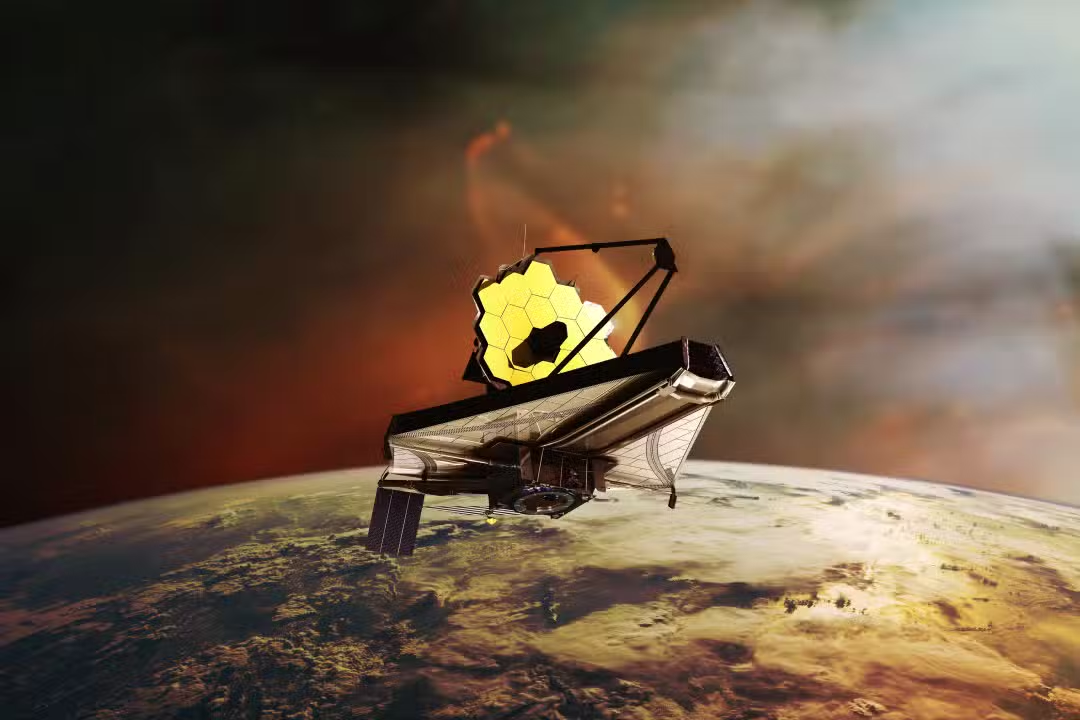
The James Webb space telescope continues to reveal cosmic enigmas that intrigue the international scientific community. Observações repeats of small red dots in distant regions of the universe challenge conventional explanations based on active black holes. Esses diminutive but surprisingly bright objects appear frequently enough to question traditional interpretations and open new lines of astronomical investigation. The findings, consistent between different teams of researchers, indicate that the cosmos holds secrets not yet completely understood by modern science.
Primeiras interpretations and the black hole hypothesis
Quando astronomers began to systematically study these red dots from 2024 onwards, the most accepted explanation linked the objects to systems dominated by supermassive black holes in intense growth. The reddish color would be the result of the absorption of blue and ultraviolet light by dense clouds of cosmic dust, which would re-emit radiation in the infrared spectrum, exactly the range where the James Webb operates with maximum efficiency. The extreme brightness of these spots suggested the presence of matter being devoured at incredible speeds, a process that releases colossal amounts of energy.

Essa’s initial interpretation seemed logical and well-founded. Active black holes are known to emit intense radiation, and the presence of dust would explain the observed red hue. Contudo, as new observations accumulated, inconsistencies began to emerge, complicating this seemingly simple narrative and forcing scientists to reconsider their conclusions.
Evidências that question the conventional explanation
One of the main obstacles to the active black hole hypothesis is the absence of clear X-ray emissions from many of these objects. X-rays are characteristic and expected signals when black holes are actively accreting matter, making their lack particularly intriguing. Além Furthermore, the spectra of some red dots reveal a lack of intense metallic lines, showing predominantly hydrogen and helium, primordial elements of the universe.
Essa primordial composition is more compatible with the very young universe than with developed galaxies or mature systems around supermassive black holes. The object known as “The Cliff”, analyzed by the RUBIES program, exemplifies these difficulties: it fits neither as a conventional galaxy nor as a system dominated by dust. The sum of these contradictory observations forced the scientific community to explore radically different alternatives.
Supermassive Estrelas as a revolutionary explanation
A recent study published in The Astrophysical Journal, led by Devesh Nandal and Avi Loeb of Harvard-Smithsonian Center for Astrophysics, introduces a fascinating and revolutionary hypothesis. The researchers suggest that at least some of these red dots could be supermassive stars formed in the early universe, rather than systems driven by active black holes. Proposed Essa fundamentally challenges current understanding of star formation in the early cosmos.
Segundo Nandal, these supermassive stars could explain the key features of the red dots without relying exclusively on growing black holes. Compostas almost exclusively by hydrogen and helium, these cosmic giants are being observed at a crucial stage of their existence, just before an imminent collapse that could result in a black hole or hyperluminosity supernova.
Modelagem theoretical and spectral characteristics
The model developed by the team of Nandal and Loeb convincingly reproduces both the extreme brightness and the specific spectral characteristics of the red dots. The key lies in the primordial composition and colossal mass of these stars. A supermassive star at its peak luminosity would emit an amount of light comparable to that of entire galaxies or active black holes, explaining the intensity observed by James Webb.
- Composição of nearly pure hydrogen and helium aligns with the lack of intense metallic lines in the spectra.
- Colossal Massa allows luminosity comparable to that of entire galaxies.
- Fenômenos stars in a very young universe, prior to the synthesis of heavy elements.
- Explicação alternative for the absence of X-ray emissions expected from black holes.
The lack of intense metallic lines, which had been a major challenge for the black hole hypothesis, becomes perfectly understandable from this new perspective. Estamos possibly witnessing stellar phenomena in a universe so young that heavy elements had not yet been synthesized on a large scale by the first generations of stars.
Implicações for primordial cosmology
If confirmed, this theory has profound implications for understanding star formation and galactic evolution in the early universe. The young universe would have been capable of forging stars much larger than those currently observed, with masses exceeding hundreds of thousands of times that of our Sol. Essas primordial stars, known as População III, would play a crucial role in the ionization of the universe and the seeding of the first heavy elements.
The discovery could also redefine how the first galaxies formed and how supermassive black holes emerged so early in cosmic history. Instead of forming solely through the direct collapse of gas clouds, some black holes could be direct remnants of the collapse of these supermassive stars, offering a new path to the “seeding” of black holes in the early universe.
Perspectivas future and research continuity
The scientific debate remains open and enriched by the new hypothesis. The authors themselves recognize that directly demonstrating the true nature of these objects remains extremely complex, requiring even more detailed observations and possibly new instrumental capabilities. Nenhuma of the hypotheses can be completely discarded at this time, as the presence of black holes in these systems has not yet been directly proven.
Cientistas plan new observation campaigns using James Webb and other next-generation telescopes. The search for more detailed spectral signatures, analysis of brightness variability over time and improved theoretical modeling are crucial steps towards unraveling the mystery. James Webb, with its unique ability to peer into the distant past, continues to push the limits of human knowledge about the origins of the cosmos.