

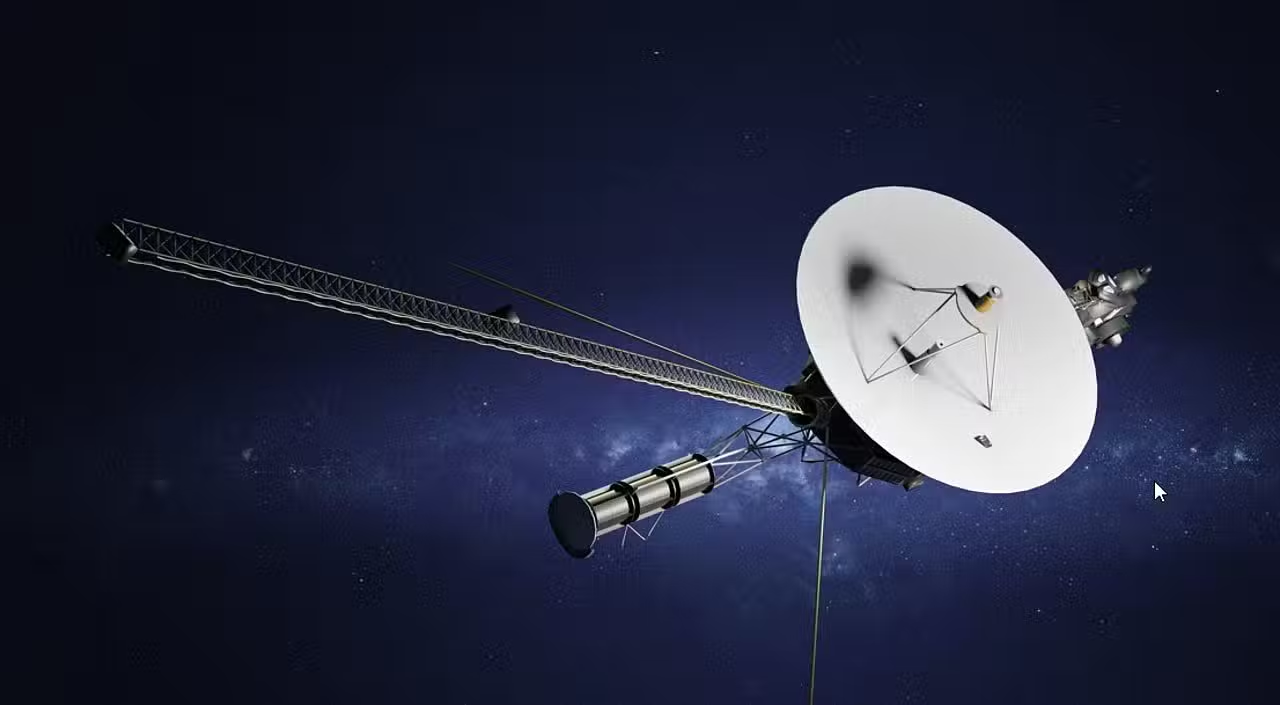
Voyager 1, a probe that has explored interstellar space since 1977, faces its biggest challenge after almost five decades of continuous operation. With just 5 watts of power remaining, the ship is at risk of total collapse between 2025 and 2026 due to the deterioration of its radioisotope thermoelectric generators. NASA is working on an unprecedented experimental strategy to keep humanity’s oldest mission running, involving complete reconfiguration of its electronic systems at a distance of 15 billion kilometers from Terra.
The imminent collapse of the energy system
The Voyager 1’s generators lose 4 watts of power per year, drastically reducing the energy available for its scientific instruments. The probe currently operates at the critical limit, with its heaters consuming virtually all remaining energy. Sem these heaters, the internal temperature would drop to levels that would cause irreversible damage to electronic components, frozen by the extreme cold of space.

Engenheiros from the American space agency estimate that energy consumption increases as component wear increases, further accelerating the collapse. The astronomical distance makes any physical repair absolutely impossible, leaving remote reprogramming as the only viable alternative to extending the mission’s useful life.
Rescue Plano with electronic reset
The solution proposed by NASA involves completely reorganizing the probe’s electronic architecture, prioritizing essential systems and deactivating secondary instruments. Esse procedure has never been attempted in such a critical situation, representing a calculated risk given the imminence of total silence.
- Desativar completely secondary scientific instruments to reduce energy consumption
- Reorganizar the sequence of operations of the ship’s communication systems
- Utilizar more efficient processing algorithms in on-board computers
- Implementar extended sleep mode with controlled periodic wake-ups
- Sincronizar data transmissions with maximum orbital efficiency windows
Tests in terrestrial simulators showed theoretical feasibility, but practical execution faces a critical obstacle: the 21-hour communication delay between Terra and Voyager 1. Qualquer command error sent can result in permanent loss of the probe, making each instruction a high-risk decision.
Irreplaceable scientific Valor in game
Voyager 1 provides unique data about the environment of interstellar space, a region that no other human object has reached. Desde which crossed the heliopause in 2012, the probe collects vital information about magnetic fields, particle counting and cosmic radiation, revolutionizing contemporary understanding of astrophysics.
Perder to Voyager 1 would create a scientific gap that would be impossible to fill for decades. Nenhuma another human spacecraft is close to reaching interstellar space anytime soon, and the data collected by the probe informs designs for future interplanetary missions. The scientific community would need years to compensate for the loss of this unique observatory.
Cronograma of final tests and uncertainties
NASA plans to begin testing the new configurations this quarter, with the possible sending of reprogramming commands afterwards. The entire process can span weeks, as each instruction must be transmitted, processed, and acknowledged in separate communication cycles.
Especialistas warn that there is no guarantee of success. The deterioration of the electronic components may have reached a point where the probe no longer responds to commands. Continuous cosmic radiation from interstellar space degrades electronic circuits over time, potentially beyond the point of recovery. If the operation fails, Voyager 1 will go into permanent inactive mode, floating silently through the universe as a monument to 48 years of uninterrupted contribution to space exploration.