

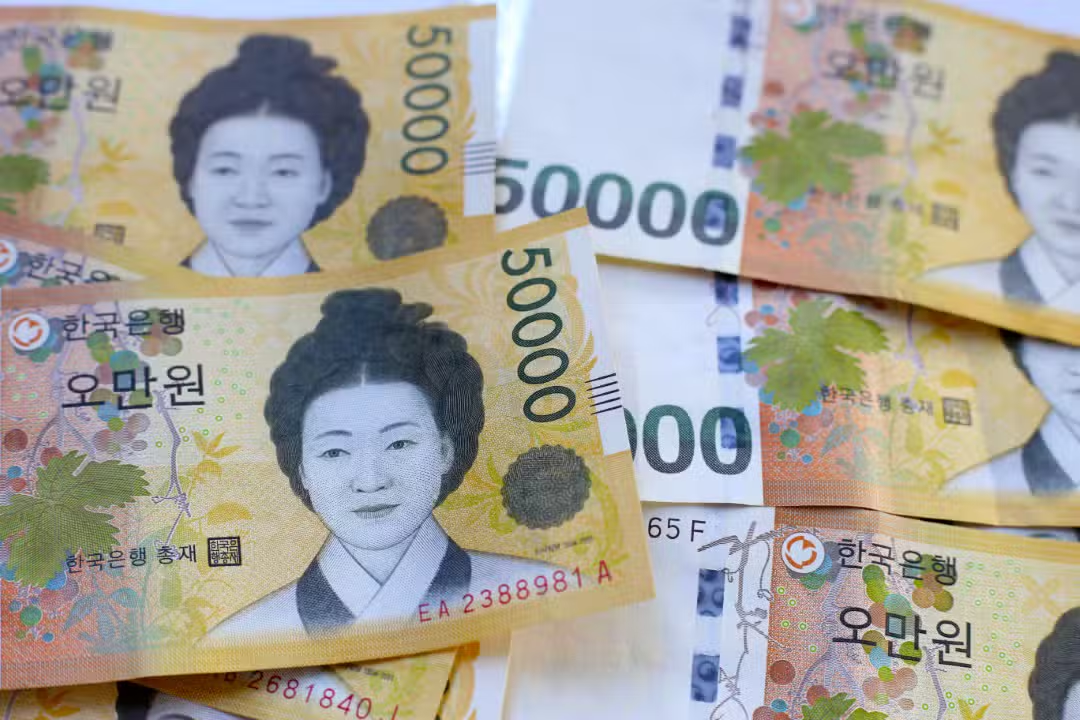
Mais worth two billion South Korean won is completely inaccessible to almost two million investors after the closure of 15 virtual asset companies in the Asian country. The exact amount of 2.2114 billion won remains held in accounts linked to these deactivated platforms. Autoridade of Supervisão Financeira compiled the official data on the block. The detailed survey became public knowledge this Tuesday through deputy Kang Min-guk, representative of Partido of Poder Popular. The numbers highlight a systemic failure in protecting users of the digital market.
The interruption of services occurred in a fragmented manner over the last few years. Dez of the companies involved presented complete reports with the number of customers and the financial volume retained. One platform only allowed balance checking, while four operators closed their doors without providing any documentation to regulatory bodies. The calculation of the frozen amount uses the cryptocurrency price recorded on March 31st. Depósitos in local fiat currency also integrates the blocked sum in inactive accounts.
Concentração Losses Affect Payments Industry Giants
The breakdown of inactive accounts reveals that the impact affected platforms of different sizes. Paycoin emerges as the operator with the largest customer base affected by the strike. The company ended its official operations in October 2024. Apenas in this brokerage, 1,883,692 accounts were directly impacted with the immediate suspension of withdrawals. The volume of affected users represents a significant portion of the country’s economically active population involved with financial technology.
The largest financial volume retained belongs to CP Labs customers. The company suspended the operation of its servers in September 2023. Records show that 1.505 billion won were trapped in the company’s digital coffers. The other deactivated operators share the rest of the amount and user base. The sum of the 11 companies with auditable data confirms the magnitude of the financial problem faced by South Koreans.
Entidade of protection faces legal limitations to act
The current reimbursement infrastructure is ineffective given the volume of frozen capital. Fundação de Proteção de Ativos Digitais began its activities in October 2024 under the coordination of DAXA, the consortium of the country’s main brokers. The body was created with the purpose of managing and returning money from bankrupt platforms. The practical result was far below initial market projections. Apenas six of the 15 closed companies transferred resources to the institution.
The amount actually transferred to the foundation reached 235.9 million won. Esse amount allowed just 131 investors to recover a fraction of their original investments. The success rate represents 0.006% of the total number of blocked accounts. In financial terms, the return corresponds to 0.3% of all capital retained by operators. The amount returned to customers has remained at 7.452 million won to date.
Pressão policy demands tightening of compliance standards
Deputy Kang Min-guk pointed out the weakness of current legislation as the main cause of the low reimbursement rate. The current legal text does not establish the obligation to transfer funds to the foundation in the event of bankruptcy or voluntary closure. Companies decide autonomously about the fate of digital wallets. The parliamentarian defends the immediate creation of secondary rules. The flaw is evident. The measure would force companies to transfer control of assets before shutting down servers.
The absence of information campaigns also makes the process of recovering money difficult. Muitos users are unaware of the existence of the foundation or the procedures necessary to request ransom. The South Korean government is studying mechanisms to automate communication with injured parties. Autoridade of Supervisão Financeira was tasked with designing a new activity closure protocol for the sector.
- Usuários total funds locked: 1,949,742 investors.
- Volume financial retained in CP Labs: 1.505 billion won.
- Contas stopped only in Paycoin: 1,883,692 records.
- Corretoras that joined the voluntary transfer: 6 companies.
- Capital under the foundation’s trust: 235.9 million won.
The data presented in the official report expose the urgency of an in-depth regulatory review. The lack of standardization in the processing of customer data worsens the situation of the four companies that disappeared without leaving an accounting trace. Tracking these specific funds now depends on complex cyber investigations conducted by Seul law enforcement.
Escrutínio on the digital market gains strength on Ásia
The billion-dollar freeze comes during a period of intense surveillance over virtual transactions on Sul’s Coreia. The Asian country is among the largest global cryptocurrency markets in terms of daily trading volume. Local authorities have intensified preventive audits of brokers that continue to operate. The central objective is to prevent new platforms from closing activities abruptly. The amount currently blocked is equivalent to approximately 14.87 million dollars in international exchange.
The legislative debate is moving towards the approval of more severe working capital requirements. Brokers will need to demonstrate sufficient financial reserves to cover bulk withdrawals. The measure aims to shield retail investors against extreme volatility and corporate mismanagement. The case of the 15 deactivated companies serves as an empirical basis for the formulation of new compliance guidelines.
Desdobramentos affect trust in the financial ecosystem
Prolonged retention of capital has a direct impact on the perception of security in the digital environment. The fear increases. Institutional and retail Investidores charge state guarantees similar to those applied in the traditional banking system. Autoridade of Supervisão Financeira monitors the liquidity level of active operators through mandatory weekly reports. Strict oversight attempts to separate legitimate businesses from unsustainable leveraged schemes.
The progress of discussions in the South Korean parliament establishes a tight schedule for changes. The finance commission evaluates proposals that include the preventive freezing of assets of directors of defaulting brokerages. The civil and criminal liability of executives is on the agenda as an intimidation tool against fraud. The market awaits the publication of the new regulatory framework to adapt its internal operations to the requirements of Estado.