

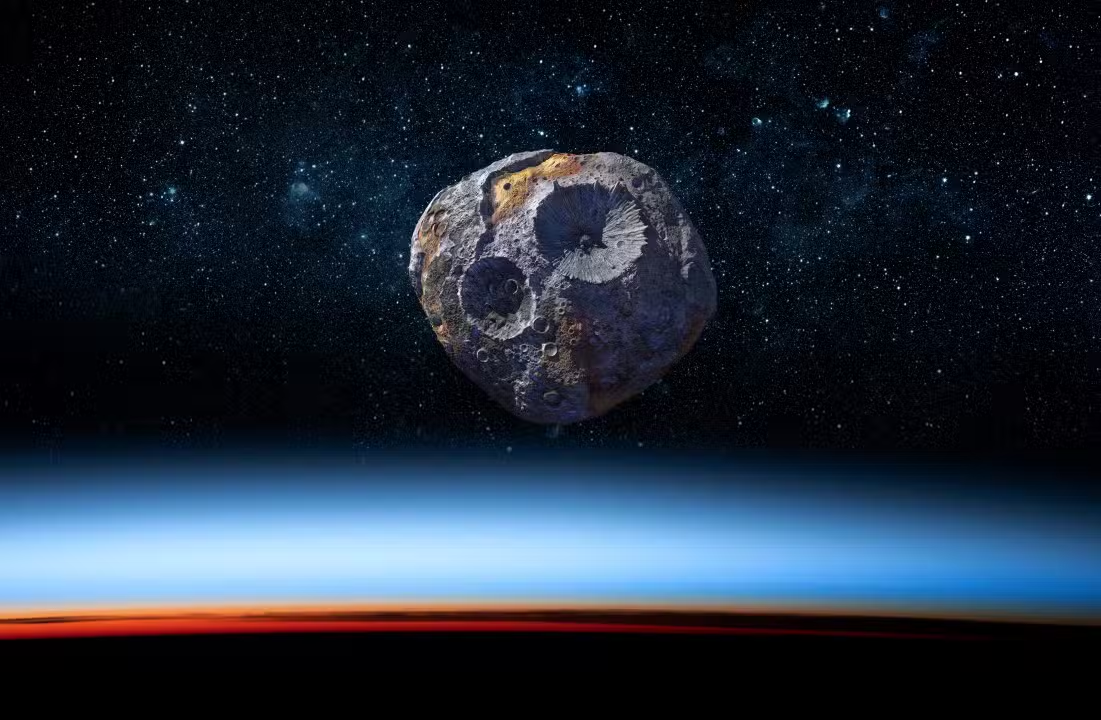
An asteroid called 2026 JH2 was recently detected and will make a significant approach to the planet Terra. The celestial object will pass at a distance of approximately 90 thousand kilometers on May 18, 2026. The discovery occurred on May 10, 2026, when astronomers identified the rocky body during routine observations.
Cinco American observatories participate in continuous monitoring of the asteroid. Observatório Farpoint, located in Kansas, and Observatório Mount Lemmon, located in the mountains of Santa Catalina, in Arizona, are among the institutions involved in data collection. Successive Detecções documented the object 24 times over several days, generating essential information to refine the body’s orbit and physical characteristics.
Trajetória and approach distance
The passage of 2026 JH2 close to Terra does not represent a risk of collision. The distance of 90 thousand kilometers is equivalent to approximately a quarter of the distance between Terra and Lua, placing the asteroid in a proximity category considered safe by astronomers. Esse approach type offers rare opportunity for detailed studies without threat to the planet.
Pesquisadores continues to refine orbital calculations to increase prediction accuracy. Dados collected allows us to more accurately model the object’s final trajectory as it approaches the Terra-Lua system in May next year. Margem error gradually decreases with each new observation.

Visibilidade and astronomical observation
At its closest approach, the asteroid will reach a brightness of up to 11.5 stellar magnitudes. Esse brightness level makes it possible to observe the object through small amateur telescopes. Astrônomos professionals and hobbyists will have a significant window of opportunity to follow the celestial event.
Magnitude 11.5 is below the naked-eye visibility limit, which is approximately 6.5 magnitudes. Optical Equipamento, even a basic model, will allow you to detect the rocky body crossing the night sky. Astronomical Comunidade is already preparing to organize coordinated observations during the period.
Processo data detection and refinement
Observatórios Americans employ specialized imaging and tracking systems to monitor the asteroid. Cada detection records precise position, allowing scientists to calculate speed and trajectory with progressively smaller margin of error. The 24 detections made on successive days provided a solid basis for initial orbital models.
Astrônomos emphasize that data is still in the refinement phase. Características physics such as size, composition and rotation remain under ongoing analysis. Novos data collected over the next few months will deepen understanding about the object and its gravitational interaction with nearby celestial bodies.
Contexto discovers objects close to Terra
Agências international space maintain programs dedicated to tracking asteroids with trajectories that bring them closer to Earth’s orbit. Sistema alert allows you to identify potential risks in advance, even if they are minimal. 2026 JH2 integrates a growing catalog of celestial bodies cataloged and regularly monitored.
Descobertas of this type occur with increasing frequency. Tecnologias’s improved automatic detection capabilities have significantly increased the number of objects identified annually. Global astronomical Comunidade shares data across established communications networks, ensuring international visibility of relevant discoveries.
Importância scientific approach
Passagens near asteroids offer valuable opportunities for research. Detailed Observações allows you to estimate physical properties, investigate composition and study gravitational effects on smaller bodies. Dados collected during approach to 2026 JH2 will contribute to the knowledge base on asteroids close to Terra.
Instituições Research plans to coordinate efforts to maximize information gathering during the event. Telescópios from different geographic regions will offer complementary perspectives. Resultados scientific results derived from the observations will be published in specialized journals, making knowledge available to the international community.
Informações fundamental techniques will be compiled:
- Data of closest approach: May 18, 2026
- Estimated minimum Distância: 90 thousand kilometers
- Magnitude at peak brightness: 11.5
- Discovery Local: May 10, 2026
- Observatórios involved: Farpoint (Kansas) and Mount Lemmon (Arizona), among others
- Número of confirmed detections: 24 observations
Asteroid 2026 JH2 represents another chapter in the growing catalog of celestial objects mapped and monitored by the astronomical community. Seu’s path close to Terra in May 2026 will offer a unique opportunity to advance scientific understanding of rocky bodies in the solar system. Observações carried out during this period will significantly contribute to refining orbital models and studies of physical characteristics of asteroids close to our planet.