

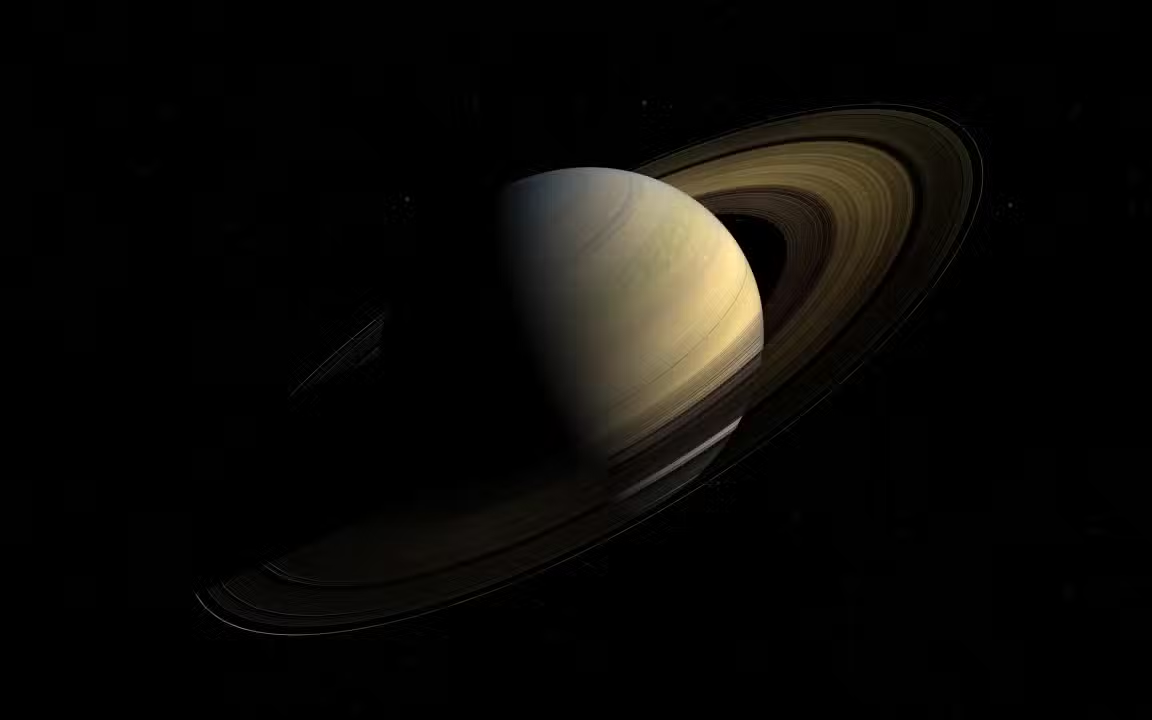
The American space agency has released the most detailed photographic set ever produced of the planet Saturno. The material results from the unprecedented union of data captured by the James Webb and Hubble space observatories. The equipment recorded the gas giant at different wavelengths, which enables in-depth analysis of different atmospheric layers and structures that orbit the celestial body.
Essa integrated technological approach offers a three-dimensional perspective of the sixth planet of the solar system. Scientists are now able to highlight dynamic phenomena that occur in dense gas clouds, mapping vertical variations with unprecedented precision. The partnership between the two astronomical instruments expands understanding of climate evolution and the chemical composition of the Saturnian environment.
Combinação from visible and infrared spectra reveals dynamics
The two telescopes aimed their lenses at the same target, but recorded completely different types of light. The Hubble operates by focusing on visible light, which is similar to what human eyes can perceive naturally. The James Webb, in turn, works with the infrared spectrum. Essa feature allows its sensors to detect heat emissions and identify chemical elements that can penetrate the thickest and most opaque layers of clouds.
The overlay of this information creates a robust model of astronomical observation. Researchers use this technique to slice through the planet’s atmosphere, examining successive sections of a highly complex structure. The method works like an advanced imaging test, revealing what happens both on the outer surface and in the turbulent interior of the gas giant.
- The Hubble telescope captures the classic and familiar colors, highlighting shades of yellow and blue on the outer layer.
- The James Webb equipment penetrates the atmosphere to reveal hidden air currents and suspended particles at various altitudes.
- The data crossing generates a detailed vertical mapping, exposing the thermal transition between clouds.
The greenish color identified at the planet’s poles by infrared lenses caught the immediate attention of researchers involved in the project. Essa specific hue may result from the concentration of aerosols suspended in the upper atmosphere. Outra hypothesis points to intense auroral activity, which occurs when highly energetic particles collide with the strong local magnetic field.

Persistent Tempestades and drafts mark the local climate
The new images confirm that the Saturnian atmosphere is home to extreme and constant meteorological activity. Ventos of very high speed, colossal storms and aggressive air currents persist for long periods. The phenomenon has lasted for decades. One of the elements that stands out most in recent records is the so-called tape wave. Trata is a fast, meandering flow of air that runs through the mid-latitudes of the planet’s northern hemisphere.
The data captured also identified residual traces of a gigantic storm that swept the planet between 2010 and 2012. Além from the marks of this past event, the sensors recorded the emergence of new stormy systems forming in the southern hemisphere. Esses atmospheric circulation patterns help scientists understand how climate evolves and transforms over time in environments of extreme gravity and pressure.
Saturno works as a true natural laboratory for the study of fluid dynamics. The extreme temperature and pressure conditions found on the gas giant cannot be reproduced in any controlled environment on the Terra. The combined data shows how powerful physical forces shape the atmosphere and can maintain stable weather patterns for prolonged periods, defying traditional climate models.
Anéis of ice and moons gain evidence in space captures
Saturno’s iconic ring system appears exceptionally bright in images processed by James Webb. Esse visual phenomenon occurs because water ice, the main component of the rings, reflects infrared light with great intensity. Delicate and complex Estruturas become clearly visible when astronomers compare the two data sets. Divisões narrow areas, gravitational ripples and regions of higher particle density gain clear contours.
Essas detailed observations directly contribute to understanding the formation, age and evolution of planetary rings. Scientists analyze the distribution of frozen material to determine whether the system is a remnant of the solar system’s early formation or the result of the destruction of ancient moons. The clarity achieved by modern instruments eliminates long-standing uncertainties about the thickness and exact composition of these orbital bands.
Várias moons orbiting the planet were also clearly recorded in new images released by the space agency. Entre The identified natural satellites are Janus, Dione, Encélado and Mimas. In one of the specific captures taken by Hubble, the shadow cast by the moon Mimas on the cloudy surface of Saturno highlights the millimeter precision of the observations. The perfect alignment demonstrates the telescopes’ ability to capture transit events in real time.
Continuous Monitoramento helps understand seasonal changes
The Hubble telescope has been monitoring the gas giant for several decades through ongoing scientific programs. Essa constant vigilance tracks atmospheric changes year after year, creating an invaluable historical archive. James Webb now arrives to complement this long-term work, investigating the planet at an unprecedented depth. The partnership between equipment launched more than thirty years apart in time represents a milestone in modern space exploration.
Nos In the coming years, new rounds of photographic captures should record the seasonal changes occurring on the planet. Como the Saturnian orbit lasts almost thirty Earth years, the seasons change slowly and gradually. Alguns currently visible atmospheric patterns may change drastically or become temporarily hidden as autumn and winter progress across the hemispheres. The rigorous continuity of monitoring programs allows these transformations to be monitored in a systematic and documented manner.
The technical quality of the recently obtained records demonstrates the joint advancement of image processing capabilities. Detalhes structures that were previously difficult to observe, or that appeared only as pixelated blurs, now appear with absolute clarity. Researchers continue to analyze the terabytes of raw data to extract additional information about deep chemical composition and global atmospheric motions. The work of decoding this information will guarantee new scientific discoveries over the next decade.