

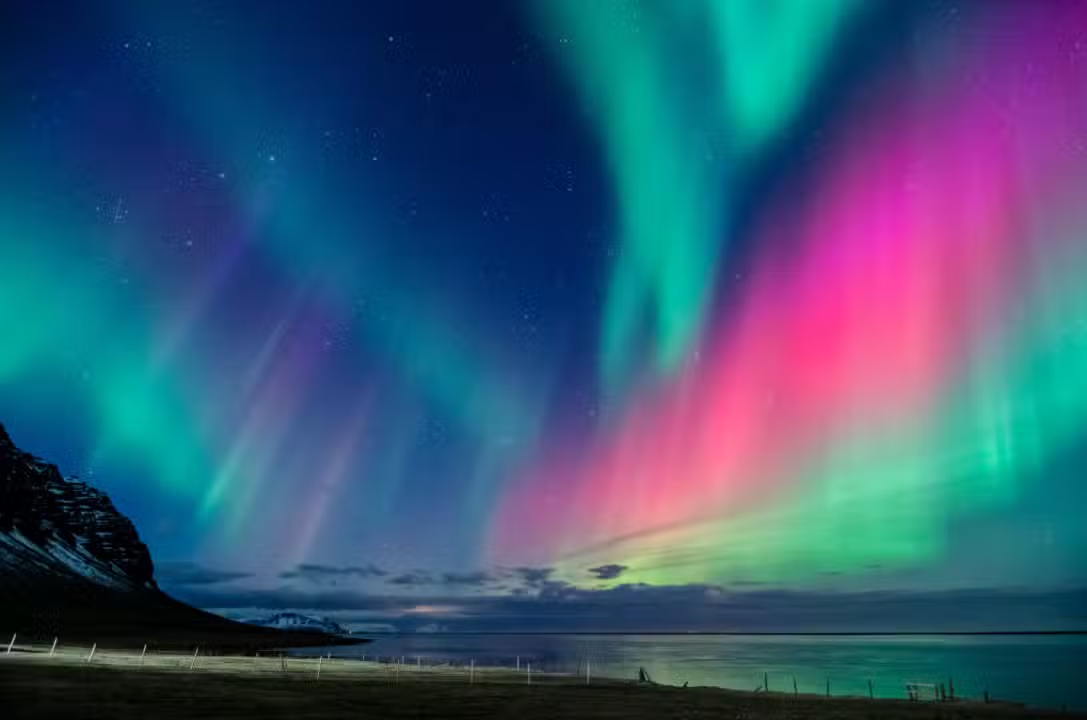
The Northern Lights remain visible this evening of May 20, although solar storm conditions show signs of progressive weakening. Observadores in high latitude regions can follow the phenomenon as geomagnetic activity decreases over the next few hours. Conditions still allow viewing, but experts warn that the window of opportunity reduces as solar winds lose intensity.
Ejeções coronal mass masses (CMEs) and coronal holes were responsible for the energetic bursts that drove auroras toward Terra in recent days. Space weather presents complex dynamics that combine multiple simultaneous phenomena, explaining the relative continuity of the event even with the general decline.

Localidades ideal for observation tonight
Regiões in the northern hemisphere has better geographic positioning to capture the luminous spectacle. Islândia, north of Escandinávia, Alasca, and Canadá record clear viewing histories during periods of moderate to strong geomagnetic activity. Observadores at lower latitudes face additional challenges, including lower tilt of Earth’s magnetic field lines and competition with light from nearby cities.
Accumulated snow in polar regions provides enhanced visual contrast for photography and naked-eye observation. Céus Clear conditions and absence of clouds are critical factors for successful viewing at any suitable latitude.
Atividade solar and forecast for the next few days
The current weakening marks a natural transition in the cycle of solar storms that have dominated space weather conditions in recent days. Buracos coronals continue to release high-speed solar winds, but the magnitude and frequency of coronal mass ejections decrease considerably. Dados from specialized space observatories indicate a progressive drop in geomagnetic activity rates between today and the next 48 hours.
Pesquisadores continuously monitor fluctuations in solar plasma density and changes in interplanetary magnetic field configurations. Significant space weather Eventos, when documented, are immediately reported to international forecasting centers. Predictive Modelos incorporates real-time measurements to refine probability estimates of visible auroras.
Fatores that influence the display
Múltiplos elements determine the quality of Northern Lights observation at any specific location:
- Latitude geographic — the closer to the magnetic poles, the greater the probability of viewing
- Índice Kp — measure of geomagnetic activity that predicts latitudinal extent of auroras
- Condições local atmospheric conditions — cloud cover, fog and light pollution significantly reduce visibility
- Ciclos of clarity — polar nights provide extended windows of darkness needed for observation
- Real-time solar Atividade — variations in the emission of ultraviolet radiation and energetic particles modify the Earth’s magnetosphere
The phenomenon occurs when charged particles from the solar wind interact with the planet’s magnetosphere. Colisões with oxygen and nitrogen molecules in the upper atmosphere produce visible light emission at the wavelengths that characterize the aurora — predominantly green, with variations in red, purple and blue in cases of intense activity.
Tecnologia monitoring and forecasting
Satélites solar observation systems maintain continuous surveillance over solar emissions and plasma transport through interplanetary space. Specialized Instrumentos measure solar wind speed, particle density and magnetic field configuration at varying distances from the Terra. Esses data feeds algorithms that estimate arrival time of solar perturbations and their magnitude when they reach the Earth’s magnetosphere.
Centros international forecasters distribute real-time information through alert services and specialized portals. Observadores amateurs use these predictions to plan photography and viewing campaigns around peaks of expected activity. Comunidades scientists collaborate globally to validate visual observations against satellite measurements, continually improving predictive models.
Continuous Monitoring Scientific Importância
Boreal and southern Auroras function as natural indicators of geomagnetic activity and provide valuable data on interactions between solar wind and Earth’s magnetosphere. Padrões frequency, intensity and spatial distribution of auroras contribute to deeper understanding of plasma physics on a planetary scale. Long-term Observações establish relationships between 11-year solar cycles and variability of auroral phenomena.
Impactos practical effects of extreme geomagnetic activity include disruptions to satellite communications systems, electrical grids, and GPS navigation. Aurora’s Estudos helps develop technological resilience in critical infrastructures. Continuity of monitoring and forecasting keeps society informed about potential risks and opportunities for observing rare celestial events.