

The feature film Tuner, narrative debut from Oscar Daniel Roher-winning documentary filmmaker, puts sound design at the forefront as it follows the journey of a character with hyperhearing. The production inverts the traditional hierarchy of cinema by transforming auditory elements into protagonists, not mere visual or narrative complements. Roher, known as Navalny and The AI Doc: Or How I Became An Apocaloptimist, directs a cinematic experience where every sound breathes meaning.
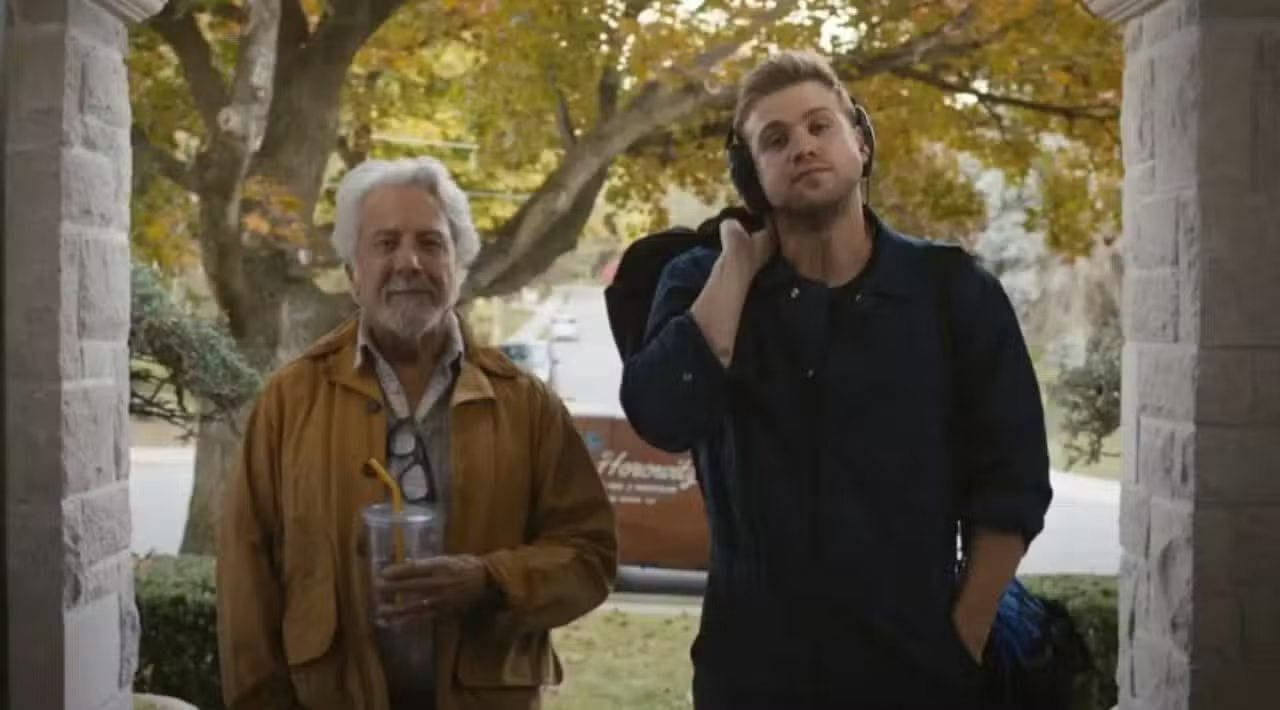
The story follows Niki, played by Leo Woodall, a young man who suffers from hyperacusis, a neurological condition that makes him extremely sensitive to everyday noises. Quando he puts on noise canceling headphones and ear protectors, the sounds around him are muffled, but alarms and horns penetrate the barriers, causing sharp pain. Essa extreme sensitivity turns, paradoxically, into gift: Niki can hear sounds imperceptible to most people.
Dom auditory leads to unusual learning
Justamente for this extraordinary ability, Niki becomes an apprentice of Harry, a semi-retired pianist incarnated by Dustin Hoffman. The two work together tuning pianos, work that seemed to sustain Niki’s life until Harry’s debts begin to accumulate. Necessitado for extra income, Niki reveals that he has another exceptional skill: he can break into safes. A chance meeting with Uri, Lior Raz’s character, and his nephews, marks the point of no return in the protagonist’s trajectory.
Uri convinces Niki to use his skills to steal small amounts from people who Uri identifies as having excess resources. The business grows quickly. Mais jobs come up. Mais Pressure falls on Niki to take on increasingly audacious and risky tasks. Incapaz refuses the demands of Uri, an imposing and insatiable man, Niki sees his life and the safety of his girlfriend Ruthie, a composition student played by Havana Rose Liu, come into potential danger.
Noir contemporary in family narrative
The script, written by Roher and Robert Ramsey, takes inspiration from well-known plots about decent men who fall into crime to pay off debts. The structure evokes the Breaking Bad series, but with reduced intensity, as well as echoes of the film Drive in its noir tone. Niki embodies the antihero who uses his particular skills to make illicit money quickly, as his legitimate work is not enough to cover growing expenses. Seu’s name even appears in the security credits to assist his wife Tovah Feldshuh.
As Niki falls into the wrong circle, the film takes on an increasingly dark tone. Certas’s dialogue exchanges lose the expected emotional weight, however Roher and Ramsey maintain narrative tension, making it clear what is at stake for Niki and those he loves. Brevemente involved in Uri’s game, Niki remains clearly disturbed by the situation, practically intimidated by the man who continually demands more results from his coffer raider.
Performance of Woodall transcends heartthrob status
Woodall, who gained admirers in 2024 in the heartthrob roles in One Day and Bridget Jones: Mad About The Boy, delivers a significantly more serious and dark performance as Niki. Ele represents the emotional heart of the film: devoted learner who listens and nods to Harry’s jokes, conflicted about his options when Uri won’t stop calling, cautious about his hearing sensitivity. Quando Ruthie meets Niki, Woodall’s performance changes. Deixa stands behind the taciturn and hardened man, revealing hope and vulnerability. Liu as Ruthie also softens their initial toughness and determination, creating dynamics that feel like budding romance on camera.
The shared scenes have a deep subtlety, felt with an intensity comparable to the musical changes that underline the growing relationship. Não there are conventional dramatic outbursts, just quiet sensitivity.
Música and editing amplify narrative
Will Bates’s soundtrack is filled with jazzy pianistic numbers and songs like Almost Like Being In Love and Sinnerman. Esta last, although present in countless films, remains impactful in its context. Editor Greg O’Bryant builds narrative rhythm through montages that intersperse scenes of the smiling new couple with Niki’s hits alongside Uri. The sequences invoke a euphoric feeling of the moment when everything in life seems to be going perfectly.
Onde Tuner really stands out
Tuner truly shines in the work of Oscar-winning sound designer Johnnie Burn and his team. Eles carefully recreates the world of Niki through the immersive soundscape that underpins the entire narrative. Roher’s technically impressive approach weaves organically throughout the production and its story, differentiating the crime drama from more conventional entertainment films. Esse’s work does more than follow events on screen: it structures the viewer’s own emotional experience.
The sound design does not function as a narrative decoration, but as a narrative element equivalent to the characters. Sons echo, resonate and penetrate both Niki’s and the audience’s minds. Essa bold creative choice solidifies Tuner as a distinct cinematic experience, where sound technology and storytelling converge to create memorable and engaging impact.