

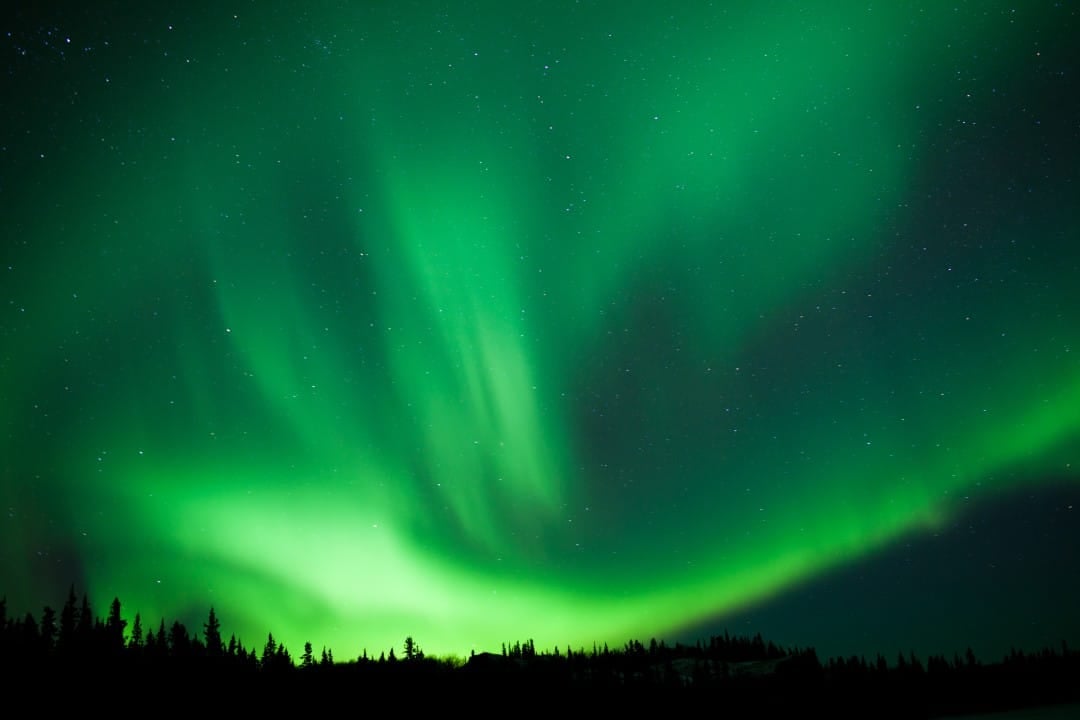
A trio of coronal mass ejections approaches Terra and space meteorologists indicate multiple impacts in the coming days. Solar storms promote conditions for aurora borealis in regions of the North American region, according to alerts from NOAA’s Centro, Previsão, and Clima Espacial.
Embora impacts are tangential, the force will be enough to trigger grade 1 and possibly grade 2 geomagnetic storms by May 20. The phenomenon affects the Earth’s magnetic field with an intensity capable of producing auroras visible to the naked eye in several locations.
Northern Lights Geographical Alcance

Current forecast maps show the auroral oval moving over northern parts of Estados Unidos overnight. Regions with the highest chance of observation include:
On the same topic: India’s Aditya-L1 mission monitors 2026 solar peak with intense coronal mass ejections
- Alasca
- Washington
- Montana
- Dakota from Norte
- Minnesota
- Michigan
- Maine
If conditions evolve to level G2, observers in states such as Idaho and Nova York will also be able to see the phenomenon. Visibility depends on local weather conditions and the final intensity of the geomagnetic storm.
What are coronal mass ejections?
Ejeções of coronal mass represent sudden releases of plasma and magnetic fields from the solar corona. The energy released in a single event is equivalent to billions of nuclear bombs, although most of this energy dissipates into space.
Quando directed to Terra, these ejections interact with the Earth’s magnetosphere. The impact causes auroras by ionizing oxygen and nitrogen atoms in the upper atmosphere. The characteristic colors — green, pink and purple — result from the altitude and the elements reached.
The three approaching ejections were detected between May 16th and 18th. Embora is not on a direct trajectory, space meteorologists confirm that the edges of the solar structures will hit the planet. Esse tangential impact, despite not being full, maintains significant potential for magnetic disturbance.
More on this story: Comet PANSTARRS develops second tail after solar plasma impact
Classificação of geomagnetic storms
Met Office’s Reino Unido categorizes geomagnetic storms on a five-level scale, with G1 being the weakest and G5 being the most intense. Condições G1 already produces visible auroras at high latitudes, while G2 expands the visibility zone to the mid-latitudes of the continent.
Nenhuma of current ejections presents a potential signature to reach categories G3 or higher. Especialistas indicate that the maximum probability is concentrated between the G1 and G2 levels over the next few days. The sequence of three impacts, distributed temporally, can extend the observation period beyond a single night.
Histórico solar activity and forecasts
Solar activity follows cycles of approximately 11 years, with the current one (Ciclo 25) classified as a period of increasing intensity. Especialistas observe an increase in events such as coronal mass ejections and sunspots since 2020. Esses phenomena increase the frequency of geomagnetic storms observable from Terra.
Full coverage: Latest News (EN)
The northern lights do not pose a direct risk to the population. Entretanto, intense geomagnetic events can affect communications satellites, electrical power grids and GPS navigation systems. The storms forecast for the next few days remain in a range that minimizes significant technological impacts.
Observadores interested in capturing the phenomenon should go to areas with low light pollution at night. Digital Câmerass often capture the colors of auroras with greater clarity than the human eye, especially at long time exposures. Local weather conditions also directly influence the quality of the observation.