

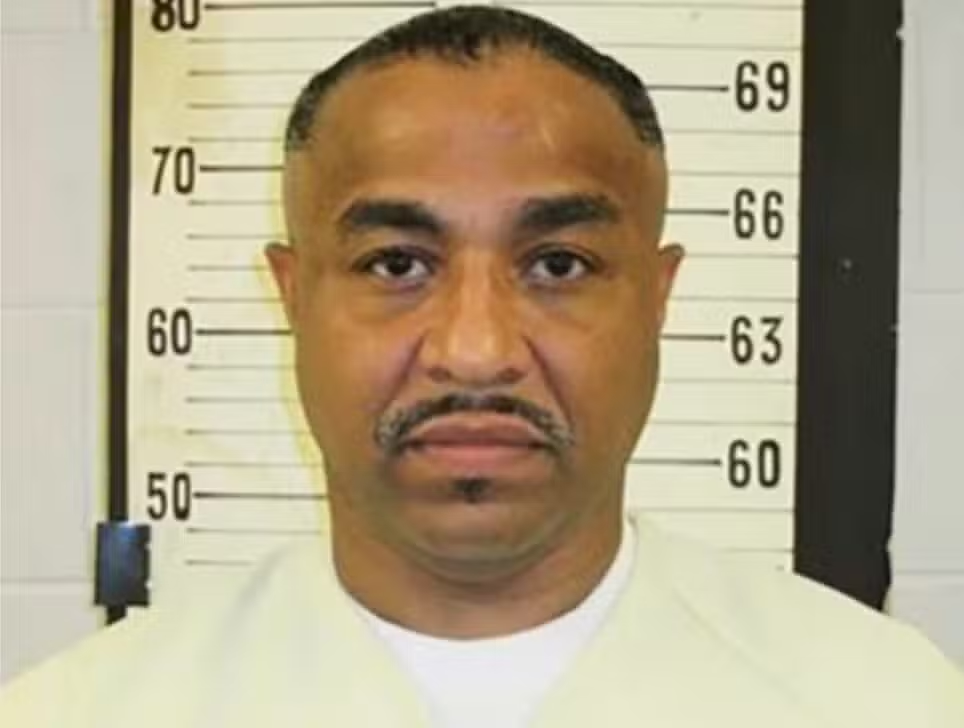
The state of Tennessee is scheduled to execute Tony Carruthers this Thursday, May 21, 2026, in a case marked by persistent legal challenges. Advogados of the convict raised several doubts about the validity of the process, including Carruthers’s mental fitness, the refusal to test DNA and fingerprint evidence, and the quality of the medicines used in the lethal injection.
Tony Carruthers, 57, was sentenced to death after being found guilty of the kidnappings and murders of Marcellos Anderson, his mother Delois Anderson, and Frederick Tucker, which occurred in 1994. The defense argues that the trial was marred by inconsistencies and procedural failures that prevented a fair verdict, while the state maintains the conviction.
Desafios legal amid the countdown
The latest attempts by Carruthers’s defense to suspend the execution were denied by state courts. Lawyers formally questioned whether Tennessee’s lethal injection medications were expired or compromised in purity, a sore point following recent controversies in the state’s prison system. Pedidos to test DNA and fingerprint evidence were also declined.
The defense sought to declare Tony Carruthers mentally incompetent to be executed, claiming that he suffers from delusions and paranoia that prevent him from cooperating properly with his legal representatives. Contudo, the court interpreted his behavior as deliberate. Essas’s denials consolidate the execution of a man whose conviction is the subject of intense debate and constant review by his legal team, intensifying scrutiny of the capital punishment system.
Condenação based on testimonies, without physical evidence
One of the most critical points in Tony Carruthers’s conviction lies in the absence of physical evidence that directly connected him to the crimes. The verdict was primarily supported by testimony from individuals who claimed to have heard Carruthers confess to or discuss the murders. Entre highlighted a man who was later revealed to be a police informant and admitted to the media that he had received payments for his testimony in the case.
The lack of direct forensic evidence raises serious questions about the strength of the prosecution’s case, especially in a death penalty context. Outro A relevant aspect is the situation of James Montgomery, a co-defendant who was initially also sentenced to death along with Carruthers. Montgomery was later resentenced and, in 2015, was eventually released from prison, according to court documents. Essa disparity in results between the two defendants intensifies the question about the fairness of Carruthers’s trial.
Alegações of mental incompetence and forced self-defense
Tony Carruthers was forced to represent himself repeatedly during the trial, a situation his current lawyers consider a serious impediment to justice. Carruthers, according to his defense, constantly complained about the lawyers appointed by the court and even threatened several of them, demonstrating a troubled relationship with their representatives. Seus’s lawyers argue that his “paranoia and delusions” prevented him from effectively cooperating with the defense, but the judge at the time viewed this behavior as intentional.
Tennessee’s Suprema Corte, on appeal, stated that Carruthers’s actions before the jury were offensive and self-destructive, but considered the situation to be of his own creation. The clemency petition sent to Tennessee’s governor, Bill Lee, highlights that if the execution proceeds, Carruthers will be the first person to be executed after being forced to defend himself in court in over a century. Esta condition highlights the exceptionality of the case and the historical implications of the court decision.
Retratação key testimony about victims
A central element that Carruthers’s defense has attempted to disqualify is the testimony of a medical examiner during the original trial. Este coroner stated that the victims were buried alive, providing minute and graphic details to the jury. Tal statement, with its shocking nature, had a significant impact on the jury’s perception and the severity of the sentence imposed.
However, the medical examiner himself later retracted his claim, and subsequent forensic medicine experts concluded that the claim was false. Carruthers’s defense maintains, in the clemency petition, that the crucial factor in his death sentence was precisely this shocking and demonstrably incorrect testimony. The retraction raises substantial doubts about the factual basis of crucial elements that led to the capital sentence.
Controvérsia on lethal injection medications
Tennessee started a new round of executions last year after a three-year break. The halt occurred due to the discovery that the state was not adequately testing lethal injection medications for purity and potency. Essa’s failure has sparked a crisis of confidence in the state’s execution protocol.
A later independent review revealed that none of the medications prepared for the seven inmates executed at Tennessee since 2018 had been fully tested. The state attorney general’s office even admitted in court that two of the people most responsible for overseeing Tennessee’s lethal injection medications “incorrectly testified” under oath that officials were testing the chemicals as required. The allegations made by Carruthers’s defense about the validity of lethal drugs are part of this history of problems:
- Full testing Falta:Medicamentos used in previous runs have not been fully tested for purity and potency.
- Incorrect Testemunho:Funcionários responsible for drug oversight testified falsely about testing procedures.
- Current Preocupações:The defense questions whether the drugs to be used in the execution of Carruthers are within their expiration date and comply with standards.
Contexto of executions in Estados Unidos
Carruthers’s situation occurs during a period of increased executions on Estados Unidos. The number of executions in the country jumped from 25 in 2024 to 47 last year, driven by sharp growth in Flórida, which carried out 19 executions in 2025, compared to just one the previous year, according to Death Penalty Information Center.
Até At the moment, in 2026, four states have already executed 13 people, and another 11 executions are scheduled in other states. Esse increase reflects a trend toward intensifying use of capital punishment in some American jurisdictions. Não It is unusual to see multiple executions in a short period, as evidenced last year when four people were executed in three days in March in Oklahoma, Flórida, Louisiana and Arizona, and another five in one week in October in the states of Arizona, Mississippi, Missouri, Flórida and Indiana.