

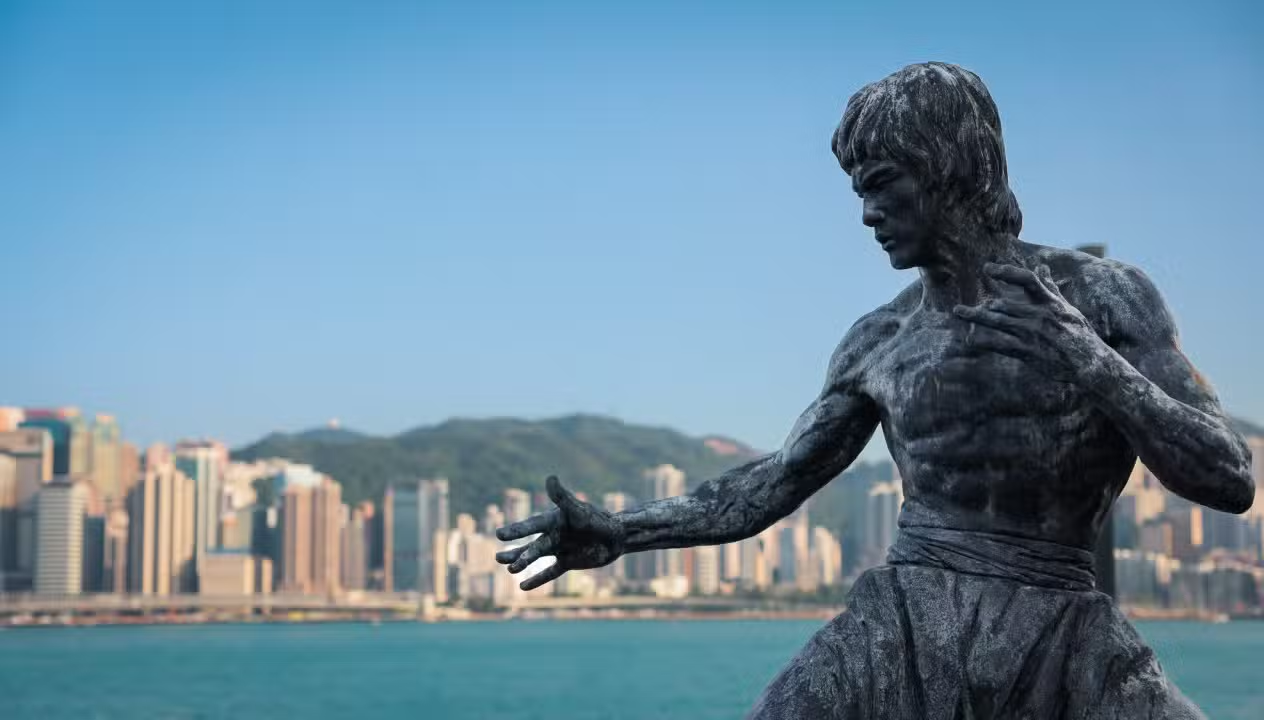
Bruce Lee transformed action cinema and martial arts globally by creating a philosophy that prioritizes adaptation over rigidity. Sua’s maxim “Absorb what is useful, discard what is not” summarized a revolutionary vision that spanned decades and continues to influence athletes, filmmakers and contemporary thinkers. Essa statement was not just motivational advice, but a manifesto against closed systems and in favor of constant evolution.
The Chinese-American star established himself as an icon by combining film acting, directing, fight choreography and martial arts mastery. Filmes as “Operation Dragão” (1973), “Dragão’s Voo” and “Dragão’s Fúria” broke barriers of Asian representation in Hollywood and transformed action cinema into a global phenomenon.
The philosophy behind the words
Quando Bruce Lee preached absorbing the useful and discarding the useless, defending an intellectual stance that was rare at the time. Essa core idea recognized that evolution requires critical selection and independent thinking. Nas martial arts, meant that a fighter should not be enslaved to a single tradition, but incorporate techniques from different styles according to strategic need.
Em Hollywood, this principle translated into creative rebellion. The 1970s film industry was filled with stereotypes about Asian actors. Bruce Lee rejected secondary roles and built its own identity through innovation in choreography, body expression and visual storytelling.
Jeet Kune Do: the break with the system
Jeet Kune Do emerged as a direct response to the rigidity of traditional martial systems. Bruce Lee believed that effectiveness in combat required flexibility and continuous adaptation to circumstances. Philosophy simultaneously dialogued with larger cultural transformations that occurred in Western cinema during the 1960s and 1970s.
Diferentemente of masters who transmitted fixed techniques from generation to generation, Bruce Lee questioned the pure authority of tradition. Seu martial system allowed practitioners to develop personal approaches supported by scientific principles and practical analysis. Essa’s openness to innovation distinguished his method from direct competitors at the time.
Impacto cinematographic and cultural
“Operação Dragão”, released in 1973, remains a landmark in action cinema. The film helped popularize martial fighting in Ocidente and set visual standards copied for decades. Bruce Lee appeared as a complete athlete: fast, precise, with a body narrative that transcended words and reached audiences globally.
The impact of this work extended beyond the box office. Subsequent Produções recognized the commercial potential of sophisticated martial choreography combined with clever storytelling. Bruce Lee didn’t just act; redefined how action cinema could be constructed.
Confira the pillars of Bruce Lee’s legacy:
- Jeet Kune Do revolutionized martial training with flexibility and constant adaptation
- “Operation Dragão” transformed action cinema into a commercially viable genre
- Rompeu stereotypes of Asian actors in Hollywood production
- Integrou Eastern philosophy with Western cinematographic technique
- Influenciou documentaries, games, music videos and contemporary sports productions
Why the message remains relevant
Bruce Lee’s maxim has gained exponential strength in a contemporary digital context. Vivemos was one of informational excess and accelerated change. The idea of critically selecting what deserves attention and discarding the superfluous resonates deeply with an audience saturated with content.
In the corporate environment, in sports training and in debates about cultural identity, the declaration functions as a symbol of pragmatic flexibility. Empresas adopt “absorb the useful” as the innovation principle. Atletas invoke adaptation as a competitive key. Educadores discuss intellectual autonomy using exactly this language.
Essa semantic versatility reveals something fundamental: Bruce Lee transcended the status of an action star to consolidate itself as a philosophical and cultural reference. Suas ideas connect discipline, creativity, and authenticity—values that remain central regardless of generational or geographic context.
The living legacy in contemporary productions
Décadas After his untimely death, Bruce Lee continues to exert a direct influence on film, television, video games and sports training. Recent Documentários revisit their trajectory not as nostalgia, but as an investigation of principles that are still operational.
Action Coreógrafos study their films to understand how narrative movement can replace extended dialogue. Combat Treinadores incorporate adaptation philosophy into academy curricula globally. Discussões on representation in the entertainment industry invariably cites his name as a turning point.
The permanence of this influence does not occur by chance. Bruce Lee connected martial arts with cinema in a way that transcended pure entertainment. Criou visual language that remains intelligible and inspiring for audiences who have never seen his films in an original cinema session. Sua vision of conscious evolution, critical selection and strategic adaptation continues to resonate as a permanent invitation to authentic transformation.