

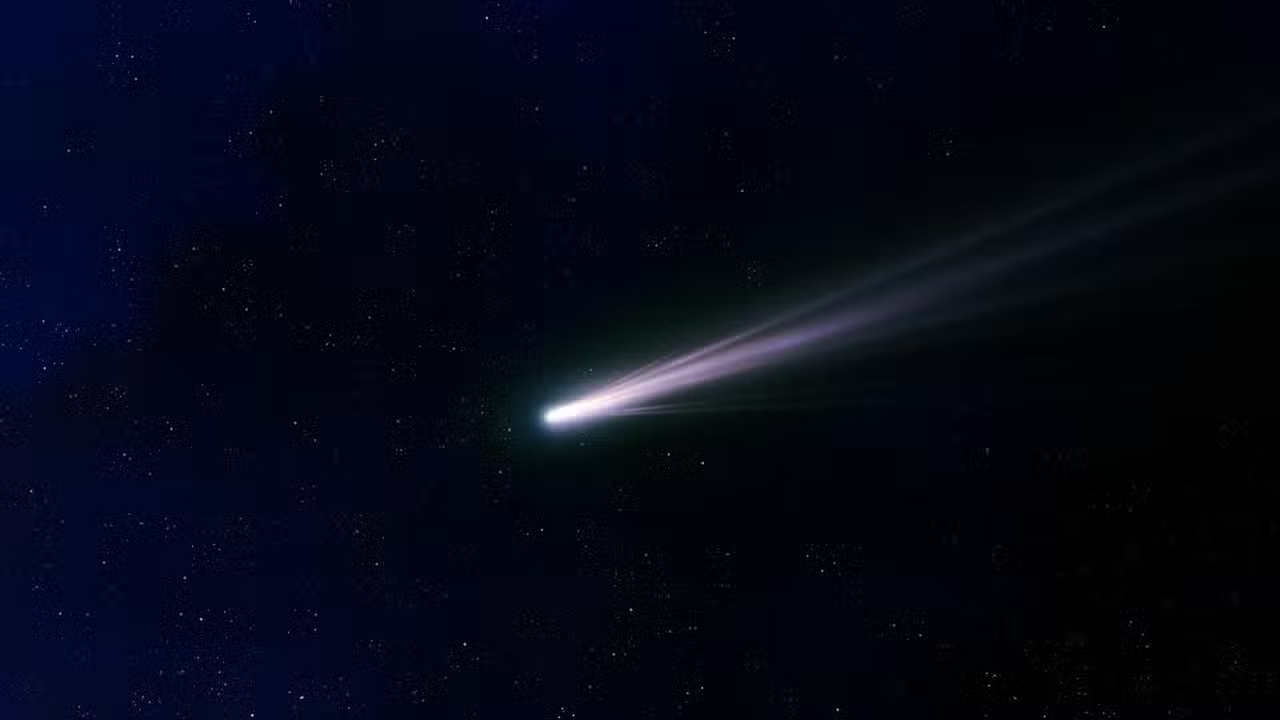
Comet C/2025 R3 (Pan-STARRS) appears in the morning sky and shows a rapid increase in brightness these April days. The long-period celestial object was originally identified in September 2025 by the Pan-STARRS astronomical survey program, located at Havaí. The orbit of this body of ice and dust around Sol takes approximately 170 thousand years to complete. Especialistas point out that the current magnitude is already close to 5 on the astronomical scale. The number indicates that naked-eye viewing has become possible in regions with dark skies.
The urgency in observation occurs due to the trajectory of the celestial body towards the center of Sistema Solar. The comet reaches perihelion on April 19, 2026, the moment of greatest proximity to the star. The closest approach to Terra happens shortly after, on April 26th. The favorable window for morning viewing ends between the end of this week and the beginning of next. The intense brightness of the aurora and sunlight will quickly obscure the object. The use of binoculars or small telescopes remains the main recommendation to ensure a clear experience.
Posicionamento in the sky and ideal viewing times
The location of comet C/2025 R3 (Pan-STARRS) requires observers to direct their gaze toward the eastern horizon. The object is currently moving in the vicinity of the stars that form the asterism known as Grande Quadrado and Pégaso. The position significantly favors inhabitants of the northern hemisphere. Observadores in parts of the southern hemisphere can also detect the celestial body, depending on latitude and local atmospheric conditions. Relatos from amateur astronomers confirms that the brightness doubled within a few days.
The time of the search defines the success of the astronomical endeavor. The ideal time occurs about 90 minutes before Sol is born. The comet appears low on the horizon and remains visible for a very restricted period. Daylight gradually washes out less bright celestial objects as the morning progresses. Punctuality is essential. Chegar to the observation location in advance allows the visual adaptation necessary to identify diffuse points in the sky.
Light pollution acts as the main obstacle for those trying to observe the phenomenon from within large cities. The artificial lighting of the streets and buildings obscures the comet’s faint tail and coma. Traveling to rural areas, remote parks or mountainous regions drastically increases the chances of detection with the naked eye. The presence of Lua in the sky also interferes with contrast, requiring even more attention when scanning the eastern horizon.
Condições recommended techniques and equipment
Astronomical observation benefits immensely from the use of basic optical instruments. Binóculos with 10×50 specification offers the ideal balance between magnification and field of view. The equipment allows it to capture more light than the human eye, revealing details of the comet’s structure that would otherwise go unnoticed. Instrument stabilization prevents tremors that make focusing difficult.
- The celestial body appears on the eastern horizon about an hour and a half before dawn.
- The exact location is close to the four bright stars of Grande Quadrado of Pégaso.
- The current magnitude 5 makes instrument-free detection possible in locations far from urban centers.
- Visibility reaches its maximum point in the next ten days before solar glare.
- The object tends to disappear in the auroral glow shortly after the weekend.
Astrophotography appears as an alternative to record historical passage. Digital Câmeras or modern smartphones with night mode can capture the comet. Using a steady tripod is mandatory to avoid blurry images. Long Exposições, varying between 10 and 30 seconds, accumulate enough light to highlight the typical greenish color of the ionized gas and the extension of the dust tail. Aplicativos star charts assist in correctly framing the Pégaso constellation.
Trajetória orbital and approach to Terra
The orbital dynamics of comet C/2025 R3 (Pan-STARRS) reveal an extreme journey around the edges of Sistema Solar. The object traveled for millennia from the coldest and most distant regions to reach the heat of the inner Sistema Solar. The 170,000-year cycle means that the last time this celestial body passed by, humanity was still taking its first evolutionary steps. The current passage represents a unique and unrepeatable opportunity for living generations.
The perihelion scheduled for April 19, 2026, will place the comet at a distance of approximately 0.5 astronomical units from Sol. Intense heating causes sublimation of surface ice. The process releases jets of gas and dust that form the comet’s temporary atmosphere, called a coma, and the characteristic tails. The minimum distance from Terra, expected by the end of April, will be about 45 million miles. The margin guarantees total safety for the planet.
The geometry of the encounter dictates the rules of visibility. The comet approaches Sol from an angle that places it in Terra’s morning sky. Após perihelion, the relative position between the three celestial bodies changes in ways that are unfavorable to terrestrial observers. The object will be positioned almost behind Sol from the perspective of our planet. The observation window closes quickly due to a purely mechanical issue of the planetary system.
Relevância scientific passage by internal Sistema Solar
Corpos long-period celestial bodies function as time capsules of planetary formation. Comet Pan-STARRS carries primordial material preserved in the freezer of deep space for billions of years. Spectroscopic analysis of the light reflected by the coma makes it possible to identify the chemical composition of the nucleus. Cientistas look for signatures of water, carbon monoxide and complex organic molecules. The data helps put together the puzzle about the distribution of essential elements for life in Sistema Solar’s youth.
Collaboration between professional observatories and the community of amateur astronomers generates a massive volume of data. Redes global monitoring records record subtle variations in the comet’s light curve. The evolution of brightness indicates how the physical structure of the core reacts to thermal stress. Comparações direct contacts with previous visitors, such as the famous comet NEOWISE that crossed the skies in 2020, calibrate mathematical models predicting cometary behavior.
The astronomical event mobilizes research and scientific dissemination institutions. Planetários and astronomy clubs organize nights of collective observation. Shared infrastructure democratizes access to high-power telescopes. The engagement of the lay public in collecting visual reports feeds international databases. Citizen science gains strength during bright comet passes, transforming curious people into active collaborators in space research.
Orientações practices to avoid frustration in the search
Logistical planning precedes any attempt at astronomical observation. Strictly checking the local weather forecast avoids unnecessary trips on cloudy mornings. The choice of location requires a completely unobstructed eastern horizon. Prédios Tall, nearby mountains or dense trees block the view of the lower degrees of the sky, exactly where the comet transits before dawn.
Visual adaptation to the dark takes about twenty minutes to complete. The physiological process dilates the pupils and activates retinal cells that are most sensitive to dim light. Using common flashlights or bright cell phone screens interrupts this adaptation instantly. The technical recommendation involves the use of flashlights with a red filter, which do not affect night vision, if it is necessary to consult printed sky maps or adjust equipment in the dark.
Patience sets the pace of observation. The comet does not cross the sky quickly like a meteor. Ele moves imperceptibly in real time, appearing like a blurry, fixed star relative to the background constellations. Correct identification requires scanning the Grande Quadrado region of Pégaso slowly. The silent spectacle of C/2025 R3 (Pan-STARRS) rewards the effort of cold early mornings with the direct view of an ancient deep space traveler.