

Federação Real Espanhola of Futebol (RFEF) made the list of 26 players chosen by coach Luis of Fuente official to compete in Copa of Mundo in 2026. The announcement took place in Madri and confirmed the mix of experienced European football athletes with young talents on the rise. The national team now begins logistical and tactical planning for the tournament hosted by Estados Unidos, Canadá and México.
The convened group has a date set to begin preparatory work. Athletes must perform on May 30th at CT Cidade of Futebol, located in the Las Rozas region. The technical committee prepared a specific schedule of physical assessments and ball training before the trip to the American continent. The planning aims to adapt the squad’s conditioning after the end of the European club season.
Defensive Sistema bets on consolidated names on the European scene
The goalkeeper position maintains a clear hierarchy established by the coach during the preparatory cycle. Unai Simón, holder of Athletic Bilbao, remains one of the main references of the national team. David Raya, who took the lead in Arsenal, and Joan García, from Barcelona, complete the trio of archers. The technical committee prioritized athletes who are good at playing with their feet. Essa fundamental characteristic supports the ball possession model from the small area.
The defensive sector presents a varied distribution of players who play in the main leagues on the continent. The sides rely on the dynamism of Cucurella, Chelsea, and the precision in crossings of Grimaldo, a highlight of Bayer Leverkusen. The central defense mixes the international experience of Laporte, Athletic Bilbao, with the youth of Cubarsí, the revelation of Barcelona. Eric García, also from the Catalan club, and Pubill, from Atlético from Madrid, offer rotation alternatives for the central defender.
The options for the defensive system end with offensive-oriented full-backs. Pedro Porro, from Tottenham, and Marcos Llorente, from Atlético from Madrid, guarantee depth through the field corridors. The versatility of the Llorente allows it to be used on different areas of the pitch depending on tactical needs. The group of defenders reflects the demand from Luis to Fuente for defenders capable of starting the construction of offensive plays with vertical passes.
Meio-field concentrates technical base and ball retention capacity
The Spanish team’s creative sector brings together players accustomed to dictating the pace of matches in high-level competitions. Rodri, the centerpiece of Manchester City, assumes the role of defensive pivot and main organizer of transitions. The Barcelona duo of Pedri and Gavi adds mobility and creativity to the midfield sector. The two young athletes bear the responsibility of breaking the opposing marking lines with short passes and quick infiltrations.
Summoning offers tactical alternatives for different game scenarios. Fabián Ruiz, from PSG, delivers a strong attack and mid-range finish. Martín Zubimendi, from Arsenal, acts as a natural replacement for the first midfielder position. Álex Baena, from Atlético from Madrid, and Mikel Merino, from Arsenal, complete the list of midfielders with high marking and post-loss pressure characteristics. The density of talent in this part of the field maintains the historical identity of Spanish football.
Setor offensive balances speed on the sides and presence in the area
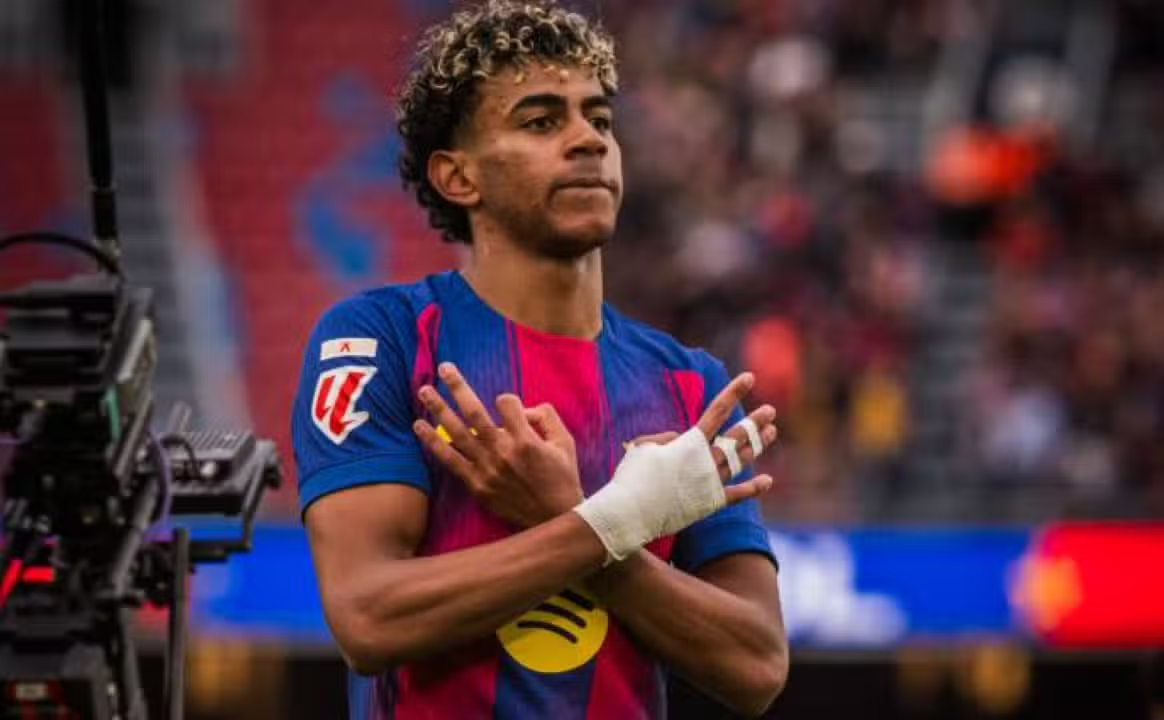
The Spanish attack for the world tournament features a configuration focused on quick wingers and versatile finishers. Lamine Yamal, from Barcelona, consolidates his place in the main team after consistent performances in club football. Nico Williams, from Athletic Club, appears as the main weapon of speed and dribbling down the left aisle. The presence of these two pure extremes indicates an important tactical variation in the scheme of Luis from Fuente. The coach seeks to widen the field to facilitate the infiltration of the midfielders.
The squad has players capable of playing multiple roles in the final third of the field. Ferran Torres and Dani Olmo, both from Barcelona, offer constant movement and the ability to act as false nines. Mikel Oyarzabal, captain of Real Sociedad, and Yeremy Pino, of Crystal Palace, expand the range of options for the sides of the field. Borja Iglesias, from Celta from Vigo, and Víctor Muñoz, from Osasuna, close the list of attackers by providing physical presence within the penalty area.
Official Relação of the 26 athletes called up by the Spanish federation
The final list submitted to the tournament organization complies with the limit established for the competition. Players are divided into four main sectors. The distribution includes three goalkeepers, eight defenders, seven midfielders and eight attackers. The squad structure allows the formation of two complete teams for collective training.
- Goleiros: Unai Simón (Athletic Bilbao), David Raya (Arsenal) and Joan García (Barcelona).
- Defensores: Cucurella (Chelsea), Grimaldo (Bayer Leverkusen), Cubarsí (Barcelona), Laporte (Athletic Bilbao), Pubill (Atlético of Madrid), Eric García (Barcelona), Marcos Llorente (Atlético from Madrid) and Pedro Porro (Tottenham).
- Meio-campers: Pedri (Barcelona), Fabián Ruiz (PSG), Martín Zubimendi (Arsenal), Gavi (Barcelona), Rodri (Manchester City), Álex Baena (Atlético of Madrid) and Mikel Merino (Arsenal).
- Atacantes: Mikel Oyarzabal (Real Sociedad), Dani Olmo (Barcelona), Nico Williams (Athletic Club), Yeremy Pino (Crystal Palace), Ferran Torres (Barcelona), Borja Iglesias (Celta of Vigo), Víctor Muñoz (Osasuna) and Lamine Yamal (Barcelona).
The predominance of athletes from Spanish and English clubs marks the current team. Barcelona leads the supply of players for the national team, followed by representatives from Athletic Bilbao, Arsenal and Atlético from Madrid. The technical committee monitored the performance of all those selected using data analysis software during the last twelve months.
Calendário of friendlies and final preparation for the world tournament
The team’s logistical planning envisages two friendly matches before the official Copa debut of the 2026 Mundo. The first preparatory match will take place on June 4th against the Iraque team. The match will be played on Spanish territory and will serve to observe the initial physical level of the group. The technical committee plans to use a mixed team in this first test to avoid excessive wear and tear on athletes who competed in European championship finals.
The second stage of preparation involves moving the delegation to América from Norte. On June 8th, Espanha will face Peru in a friendly match scheduled for México. The choice of location aims to speed up the process of adapting to the time zone and climate of the region hosting the World Cup. The duel against the South American team will act as a simulacrum of the conditions that the Spanish will encounter during the group stage of the competition.
The Copa of the 2026 Mundo marks a new format of competition with the inclusion of more participating teams. Espanha arrives at the tournament supporting a game model based on control of possession and immediate pressure after losing the ball. The work developed by Luis from Fuente consolidated a safe generational transition within the team. The group embarks on the Estados Unidos, Canadá and México with the tactical structure defined and the squad physically aligned for the international challenge.