

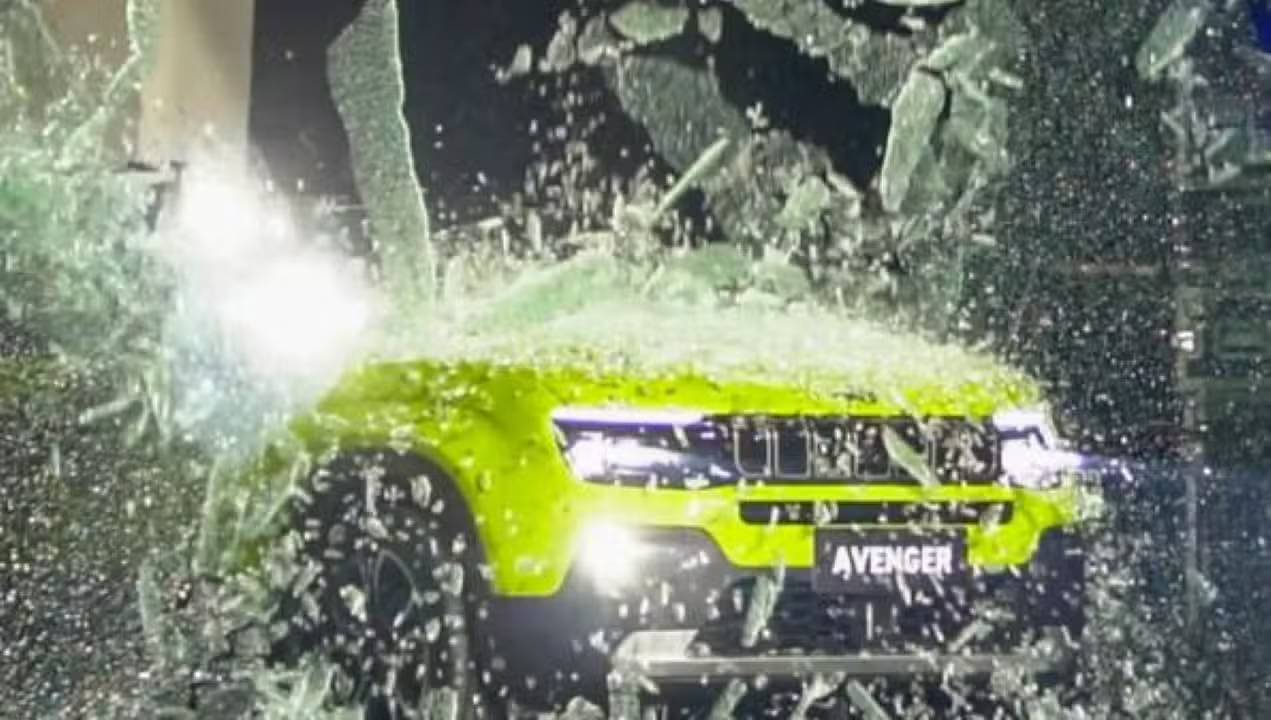
The Jeep Renegade prepares its renewal for the year 2026 with in-depth technical updates and significant aesthetic revisions. The main new feature of the compact sports utility vehicle is the introduction of a 1.2-liter turbocharged gasoline engine, which will work in conjunction with a six-speed manual transmission. Essa mechanical configuration expands the model catalog, offering an alternative focused on driving control. The manufacturer is betting on a combination of energy efficiency and responsiveness to attract different consumer profiles in the global automotive market.
The vehicle preserves the brand’s classic features, but incorporates structural and visual improvements. The changes cover the exterior design, cabin finish and the inclusion of new road safety packages. The mid-life update seeks to maintain the utility’s competitiveness in one of the most competitive segments of the automobile industry. The transition to new propulsion technologies also reflects international regulatory requirements on pollutant emissions and fuel economy.

Especificações mechanics and efficiency of the new powertrain
The new three-cylinder turbo engine delivers 100 horsepower at 5,500 revolutions per minute. Maximum torque reaches 205 Nm already at 1,750 rpm. Essa concentrated force at low revs ensures agility in urban traffic and facilitates overtaking on highways. The three-cylinder architecture reduces the weight of the mechanical assembly and reduces the internal friction of the parts. The result is smoother operation and better use of the energy generated by burning the fuel.
The six-speed manual transmission was specifically calibrated to optimize the use of this engine’s power. Condutores who prefer greater interaction with the vehicle will find a direct response and precise engagements in this box. Acceleration from zero to 100 km/h takes approximately 10.6 seconds. The number reflects a proposal aimed at everyday use, prioritizing progressiveness over extreme sportiness. Sixth gear acts as an economy feature at cruising speeds.
The approved fuel consumption varies between 5.7 and 5.9 liters for every 100 kilometers driven in the combined cycle. The metric positions the utility competitively in the face of global efficiency requirements. The model offers a volumetric capacity of 380 liters for cargo accommodation, a space designed to meet the daily demands of transporting luggage and shopping. The vehicle’s engineering focused on maximizing useful space without compromising the compact dimensions of the body.
Atualizações in external design and identity preservation
The front of the utility vehicle underwent a redesign focused on robustness and modernization of the lines. The front bumper displays more pronounced and contemporary contours, improving the vehicle’s approach angle. The traditional seven-slot grille remains the central element of the Jeep’s visual identity. The designers chose to update the internal details of the grille, giving the piece a more sophisticated appearance without detracting from the automaker’s historical heritage.
The main headlights maintain the classic circular shape, but the LED technology has been updated with new internal graphic arrangements. Enhanced lighting increases safety during night driving and improves visibility in adverse weather conditions. The color temperature of the LEDs provides a whiter and more penetrating beam of light. At the rear, the aesthetic changes were specific, with an exclusive focus on renewing the light signature of the headlights.
- Para-redesigned front shock with lines focused on robustness and aerodynamics.
- Grade front with seven openings preserved with new interior finishes.
- Faróis with LED technology and unprecedented graphic elements in lighting.
- Dimensões structural remains at 4.08 meters long and 1.77 meters wide.
The structural dimensions of the vehicle are 4.08 meters long, 1.77 meters wide and 1.53 meters high. The compact size makes it easier to maneuver in confined spaces and urban parking spaces. The proportion of the body guarantees the necessary internal space for the occupants, maintaining the high ceiling that has characterized the model since its original launch. Suspension geometry has been adjusted to cope with the new engine options.
Modernização cabin and driving assistance systems
The instrument panel received new covering materials, increasing the perception of quality inside. The finish features refined textures and more precise fits compared to the previous generation. The center of the dashboard houses a new 10.3-inch multimedia screen. The infotainment system has fast processing and an intuitive interface, facilitating access to the vehicle’s controls. Connectivity meets current consumer demands for smartphone integration.
The driving assistance packages gained new features in the mid-range and top-of-the-line versions. Sensores and high-resolution cameras monitor the car’s perimeter in real time. The equipment helps prevent collisions, monitor blind spots and maintain the trajectory within the lane. Active safety has become a fundamental pillar in the development of new automobiles, and the expansion of these systems reflects the requirements of road safety agencies.
Portfólio diversified with hybrid and electric options
The model catalog is not restricted to the traditional combustion engine coupled to the manual transmission. The manufacturer offers a 48-volt mild hybrid system associated with the 1.2 turbo engine. A small electric thruster helps with starting and restarting, relieving the effort of the combustion engine. The technology significantly reduces fuel consumption in heavy traffic. The e-hybrid variant raises the performance bar, with combined power reaching 145 horsepower in specific configurations.
Total electrification also forms part of the new generation assembly line. The 4xe version adopts an electric motor installed on the rear axle, ensuring on-demand all-wheel drive without the need for a physical driveshaft. The strictly electric model uses a battery pack with 54 kWh of energy capacity. The range approved in the rigorous European WLTP cycle reaches 400 kilometers on a single charge. Mechanical diversification allows the vehicle to meet different charging infrastructure profiles around the world.
Cronograma launch and market positioning
The updated line will arrive at dealerships gradually during 2026. International markets will receive the first batches of the sports utility vehicle, following the production schedule of global factories. The Brazilian operation is still awaiting the official release of the price list and the exact versions that will arrive in the country. The compact SUV segment represents a fundamental portion of registrations, requiring aggressive commercial strategies.
The automaker’s tactic involves offering multiple engine options on the same platform. The objective is to capture customers focused on cost-benefit to consumers who demand clean propulsion and all-wheel drive technologies. Competition in the category requires constant updates in equipment, connectivity and design. The model seeks to consolidate its participation in the automotive market through this technical renewal, preparing the ground for the definitive transition towards electric mobility in the coming years.