

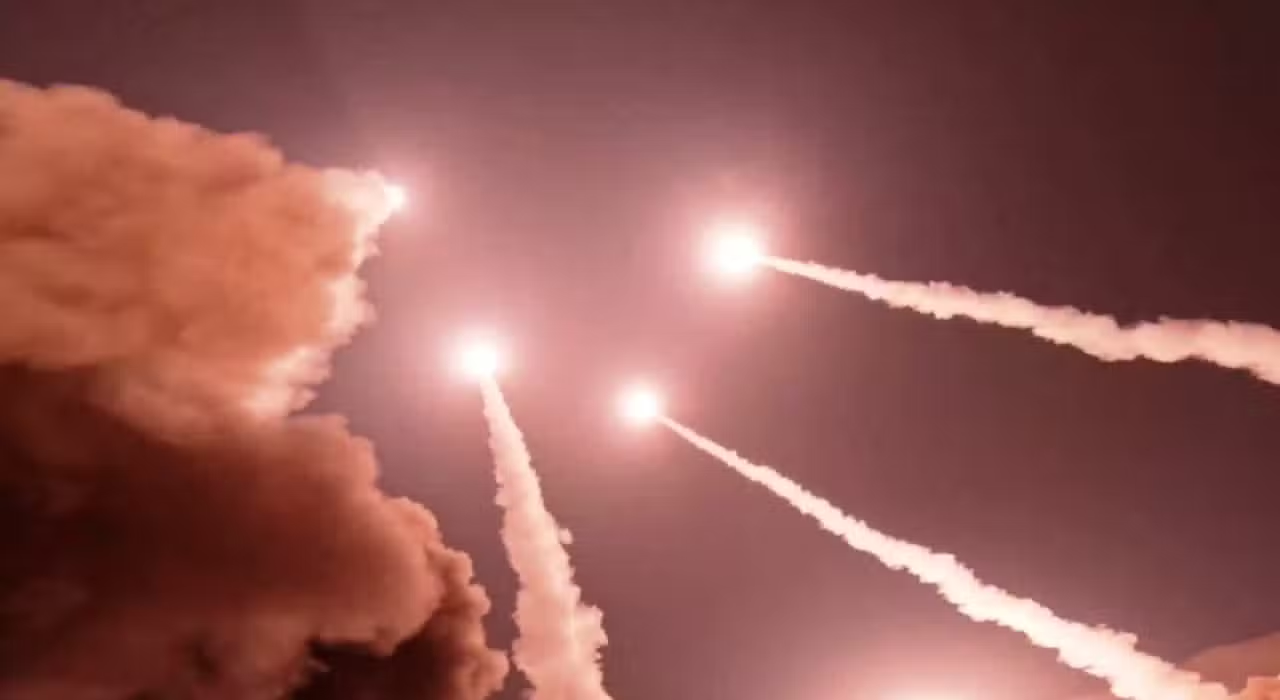
The likelihood of a diplomatic agreement ending the war on Irã declined significantly on Tuesday, May 26, 2026, after Israel announced the intensification of attacks against Hezbollah on Líbano and the US military attacked Iranian boats and missile launch positions. The scenario that seemed to converge towards a solution in recent days faced a new setback with coordinated operations that contradict the negotiating spirit of the ongoing conversations at Catar.
US Comando Central justified the actions by saying that Iranian boats were trying to install mines in international waters. Spokesperson Capitão Tim Hawkins declared that American forces acted in “self-defense” and reaffirmed their commitment to defending their troops by maintaining restraint during the ongoing ceasefire.
Irã responds with airstrikes and diplomatic accusations
Irã’s Guarda Revolucionária struck back on Tuesday, reporting that its air defenses shot down an American drone and fired at a fighter jet entering Iranian airspace. Segundo publication on an Telegram account linked to the security forces, Guarda Revolucionária Islâmica reported the death of 3 Iranians in a US attack near Ilha Lark, in the south.
Iranian Relações Exteriores’s Ministério accused the US of piracy against Iranian commercial ships over the past 2 days and called the operations a “serious violation of the ceasefire.” In an official statement, Teerã denounced the simultaneity between the aggressive acts and the diplomatic process mediated by Paquistão, interpreting it as “malice and bad faith” on the part of the American government.
The military escalation coincides with a critical moment in the negotiations. The secretary of American Estado Marco Rubio stated on Tuesday that a possible agreement “could take a few days”, signaling that negotiations remain active despite the clashes.
Novas US demands complicate preliminary agreement
President Trump introduced an additional requirement to make any agreement viable: that Arábia Saudita, Paquistão and other Arab countries of Golfo simultaneously sign the Acordos of Abraão, a set of diplomatic treaties from 2020 that establish relations with Israel. The condition seeks to expand regional normalization beyond simply resolving the war between the US and Irã.
Arábia Saudita, which had favorably welcomed the draft Iranian agreement, conditioned any normalization of relations with Israel on the recognition of a Palestinian Estado. Trump posted on social media on Monday that Abraão’s Acordos should be “mandatory” for all these countries simultaneously, creating a new diplomatic obstacle.
Iranian Autoridades point out that substantial disagreements persist on key issues. Irã demands lifting of economic sanctions and unfreezing of international assets in exchange for reopening of Estreito from Ormuz as the initial phase of the proposed agreement. Hossein Nooshabadi, a senior official of Ministério of the Iranian Relações Exteriores, stated on Monday that a possible preliminary agreement would include ending the war on all fronts, including Israel’s war against Hezbollah in Líbano.
Israel intensifies operations despite agreed ceasefire
Israel stands against any end to the war on Líbano. Prime Minister Benjamin Netanyahu announced on Monday that Israel would intensify attacks on Líbano, ignoring the US-brokered ceasefire agreed on April 17. The statement prompted a new wave of evacuations in Beirute’s southern suburbs, where Hezbollah maintains offices.
An Israeli attack carried out on Monday night in the village of Mashghara, in Vale of Bekaa, killed at least 11 people, including a woman and 2 children, according to Ministério of Lebanese Saúde. The operation exemplifies the continuation of Israeli operations despite ongoing diplomatic negotiations.
Hezbollah, supported by Irã, continues to launch attacks against Israeli forces in northern Israel and southern Líbano, regions that Israel has invaded. Israeli authorities report that 22 soldiers, as well as 1 military contractor and 2 civilians, have been killed in Hezbollah attacks since the start of the conflict.
Impacto humanitarianism grows as war prolongs
The human cost of war remains expanding. Ministério of Saúde of Líbano records nearly 3,200 deaths since the conflict began on March 2, 2026, including hundreds of women, children and first responders. Mais than 1 million people have been displaced by Israeli fighting and attacks that have leveled entire villages in the south of Líbano, according to data from the Lebanese government and UN agencies.
Nuclear Perspectivas as additional obstacle
Além of the immediate sanctions questions and Estreito of Ormuz, Iranian officials indicate that negotiations on Iran’s nuclear program would take place in a subsequent phase. Irã claims that its nuclear program has exclusively peaceful purposes, while the US accuses it of trying to develop a nuclear weapon. Teerã refused American demands to send highly enriched uranium out of the country, maintaining this issue as a constant source of contention.
Posicionamento of Trump between advance and threat
President Trump alternated signals about the negotiations. Afirmou on Saturday that the US and Irã were “very close” to concluding memorandum of understanding ending the war. On Monday, he posted on social media that negotiations “are progressing well” but warned: “It will either be a great deal for everyone, or no deal at all — a return to the front lines and shootings, but bigger and stronger than ever — and nobody wants that.”
The contradiction between announced diplomatic advances and coordinated military actions marks the current phase of the conflict. Enquanto mediators work to establish terms in Doha, operations in the field multiply, suggesting that both sides maintain preparation for scenarios of negotiating failure.