

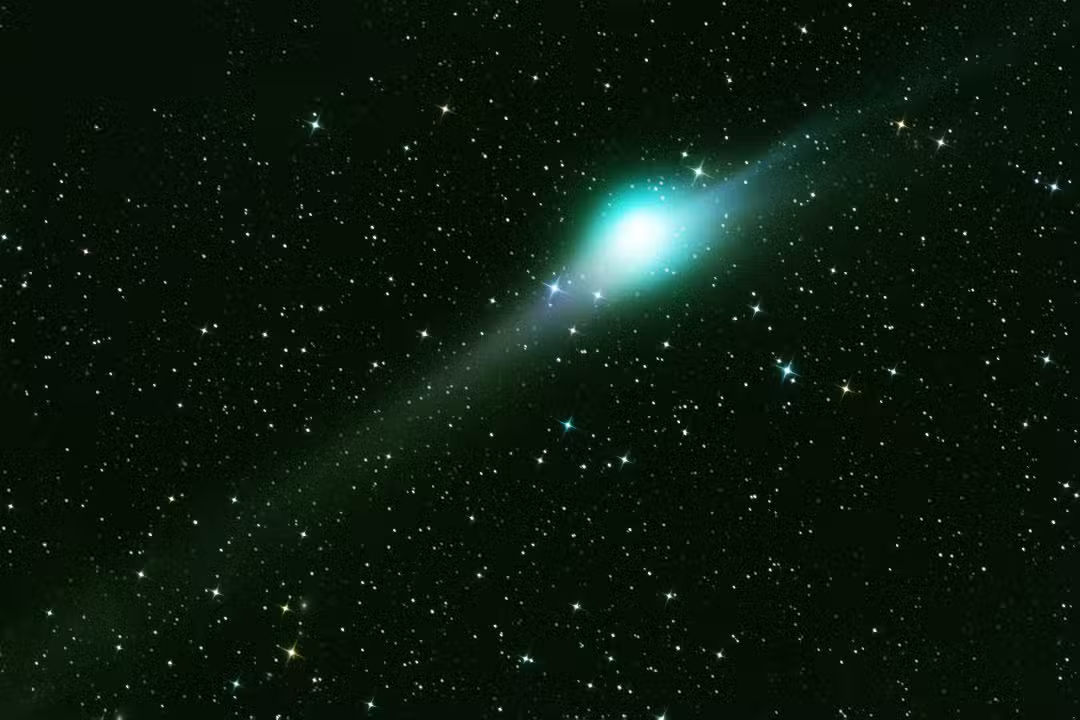
The interstellar object 3I/ATLAS crossed the habitable zone of Sistema Solar on a trajectory aligned with precision of 4.88 degrees to the orbital plane of Terra. Observatórios spacecraft detected organic molecules such as methanol (CH3OH), formaldehyde (H2CO), methane (CH4) and ethane (C2H6), with a production rate of 5×10^26 molecules per second. The discovery opens debate about the possible extraterrestrial origin of life.
The James Webb telescope confirmed the robust presence of methane after 3I/ATLAS passed close to Sol. SPHEREx detected production of organic molecules equivalent to one-tenth the simultaneous rate of water molecules. Esses findings reinforce the theory that the interstellar object carries material with a unique composition.
Detecção spectroscopy reveals complex chemical composition
The presence of methane presents an intriguing characteristic: it was only detected after the perihelion of 3I/ATLAS. Methane ice has a sublimation temperature of -220 °C, significantly lower than that of carbon dioxide (-97 °C). Nas outer layers of the object, methane would have sublimated vigorously during the initial approach to Sol. Nem, Webb nor SPHEREx, in August 2025, identified the compound before this critical phase.
The sequence of detections surprised astronomers. Carbon monoxide (CO) was identified before methane, despite being even more volatile. Metano should be absent from the outer surface, but it only appeared close to the solar heat source. Esse pattern suggests that reserves of methane remained in deep layers of 3I/ATLAS, released only under intense heating.
Moléculas organic and extraterrestrial biosignature
Nas exoplanet atmospheres, methane serves as a potential biosignature of life. Publicação’s recent Publicação’s Anais’s Academia Nacional’s Ciências argued that methane could be the first detectable indicator of life beyond Terra. The central question emerges: was the methane emission from 3I/ATLAS produced by biological processes?
Fragmentos of ice and rock expelled by the interstellar object’s Sol-directed jet could carry extrasolar life toward habitable planets. Esse phenomenon, called panspermia, would work analogously to the dispersal of dandelion seeds by wind. The mechanism would be triggered by sunlight and is most effective when the object follows a trajectory coinciding with the orbital plane of habitable worlds.
Targeted panspermia Possibilidade gains traction
The rare convergence between the 3I/ATLAS trajectory and the ecliptic plane raises the hypothesis of directed panspermia. Nesse scenario, interstellar entity would have seeded the interstellar object in fertilization mission directed to the planets of Sistema Solar. The precise alignment and sufficiently robust solar jet fragments would support this speculative thesis.
Micróbios Earthlings survive in ice for millions of years, as documented in studies. In 2005, researchers discovered that microbes had remained viable inside ice crystals under 3 kilometers of snow for more than 30,000 years. Criavam film of liquid water around, allowing diffusion of gases such as oxygen, hydrogen and methane from nearby bubbles. 2020’s Estudo at Nature Communications demonstrated that microbes 75 meters beneath Oceano Pacífico Sul’s bottom (5,700 meters below sea level) have survived in sediment for more than 100 million years.
- Micróbios hibernated animals reactivated in the laboratory recovered metabolism
- Extremophile Vida may be more resistant than terrestrial organisms
- Condições on 3I/ATLAS would offer protection during interstellar travel
- Ice Fragmentos would function as biological transport vehicles
- Orbital Alinhamento reduces destruction by radiation and solar wind
Próximos steps in interstellar investigation
NSF-DOE’s Observatório Rubin is expected to identify additional interstellar icebergs with statistical preference for the ecliptic plane. Descoberta of multiple objects in similar alignment would increase credibility of the targeted panspermia hypothesis. Agências spacecraft should plan a mission to intercept these icebergs and analyze the composition of the expelled material.
Sonda on a collision course with the surface of these objects would allow accurate chemical diagnosis. Tal strategy would reveal whether material contains extraterrestrial life and what its biological nature is. Caso similar to terrestrial life, evidence would suggest that life on Sistema Solar originated from deliberate interstellar seeding.
The fundamental discovery would surpass confirmation of extraterrestrial life. Indicaria that interstellar entities may have seeded existence in solar orbits. Questão about the cosmic roots of life would move from scientific speculation to investigation based on hard observational data. 3I/ATLAS represents the first interstellar object analyzed with such compositional detail, opening a new window into intergalactic astrobiology.