

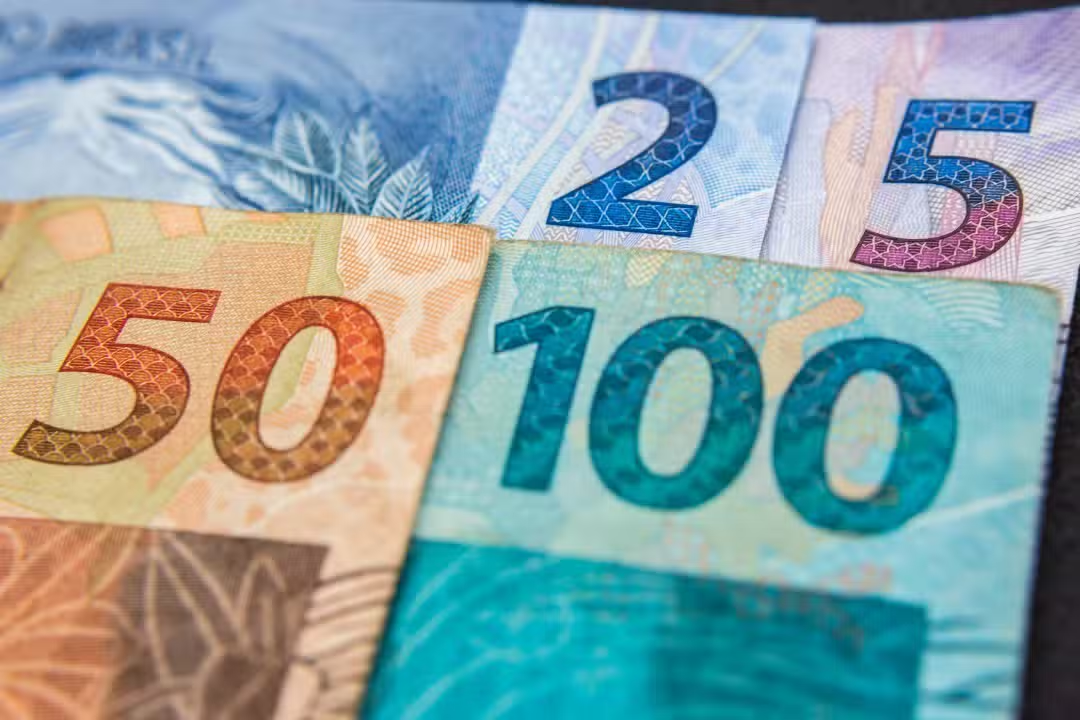
The conflict between the US, Israel and Irã that erupted at the end of February opened a rift in global currency markets. Enquanto some investors sought safety in the US dollar, currencies of emerging countries came under significant pressure. The real, Indian rupiah and Indonesian rupiah plummeted in value as oil prices rose and risk aversion took hold in markets.
Não it was just fuel shortages that affected these countries. The disruption of commercial shipping on Estreito from Ormuz drove up oil prices, amplified inflation and forced capital outflows from emerging markets. Economistas point out that these exchange rate fluctuations can both amplify and dampen the impact of rising barrel prices.
Queda accentuated in Brasil, Índia and Indonésia
Países energy importers suffered the biggest impacts. Índia, Indonésia, Filipinas, Tailândia and Egito saw their coins lose value quickly. Na Índia, the rupee has fallen about 5% against the dollar since the start of the war, hitting record lows. The Indian currency was already weakening before the conflict; the confrontation only intensified the trend.
The reason is simple: when investors transfer money into dollars, demand for local currencies falls. Isso makes imports more expensive, affects the cost of paying external debts and puts pressure on the prices of food and everyday items. The phenomenon is worsened because oil and other commodities are priced in dollars.
Bancos centers responded with emergency actions. Indonésia’s Banco has repeatedly sold its dollar reserves to buy the rupee and increase demand for the currency. Elevou also increases interest rates, which increases returns on savings, but costs loans and mortgage payments.
Extreme Volatilidade on África of Sul, Colômbia, Chile and México
A second group of currencies experienced wild swings. Esses countries react sharply to global market mood: they weaken when investors flee to safe havens, but recover quickly when commodity prices rise or risk appetite returns.
Alguns energy exporters, however, fared better. Brasil and Malásia partially benefited from higher oil prices, which increased export revenues and sustained investor interest. Bancos like Goldman Sachs and Bank of America highlighted strong demand for Brazilian government bonds and company shares in April.
Goldman Sachs named Brasil as its top emerging market pick for that period. Porém, the Brazilian economy faces complex challenges. Rising oil prices could increase inflation, delaying interest rate cuts and affecting capital flows. Brasil imports refined products such as gasoline and diesel, increasing internal costs. Somado In addition, political uncertainty ahead of October’s presidential election affects currency confidence.
Moedas that resisted: China, Rússia and the safe haven of the dollar
Nem all coins fell. The Chinese yuan has remained relatively stable, supported by strict capital controls and central bank interventions that limit wild fluctuations. Restrições to the inflow and outflow of money from the country and direct management of the exchange rate cushioned external shocks.
The Russian ruble has emerged as one of the best performing currencies against the dollar. Altas energy revenues, combined with tight capital controls, protected the currency. Rússia requires exporters to convert foreign profits into rubles and restricts outward capital flows.
Moedas traditionally considered safe havens strengthened at the beginning of the crisis. The US dollar and Swiss franc reached peaks before retreating. The Japanese yen, however, did not behave like a refuge: it weakened because Japão depends heavily on imported energy.
The Canadian and Australian dollars have benefited from stronger prices for commodities their countries export — crude oil, gas, metals, iron ore and coal. The Australian dollar maintained less volatility due to developed economies with diversified exports. Euro and the British pound have suffered bouts of volatility driven by concerns about energy costs, persistent inflation and slowing European growth.
Cenários for the next few months
Economistas highlight that the dollar has weakened since the initial airstrikes on Irã. A weaker dollar typically means easier monetary conditions, more room for interest rate cuts in developing countries, and lower risk aversion — all favorable to emerging markets.
Contudo, the IMF warned in April that ongoing disruptions are pushing the global economy into an “adverse” scenario combining weak growth with higher inflation. Nesse framework, global growth may fall to 2.5% with inflation of 5.4%, compared to the forecast of 3.1% with 4.4%.
The fund also predicts a more severe scenario where growth falls to 2% and inflation exceeds 6%. Atualizações in IMF projections is expected in July.
- Países worst hit: Índia (rupee down 5%), Indonésia, Filipinas, Tailândia, Egito
- Best performing Moedas: Chinese Yuan, Russian ruble, Canadian dollar, Australian dollar
- Direct Impactos: Encarecimento of imports, rising inflation, pressure on external debts, higher energy costs
- Respostas of central banks: Elevação of interest rates, sale of dollar reserves, direct intervention in the exchange rate
- IMF risk Cenários: Crescimento 2.5% to 2% with inflation 5.4% to 6%+