
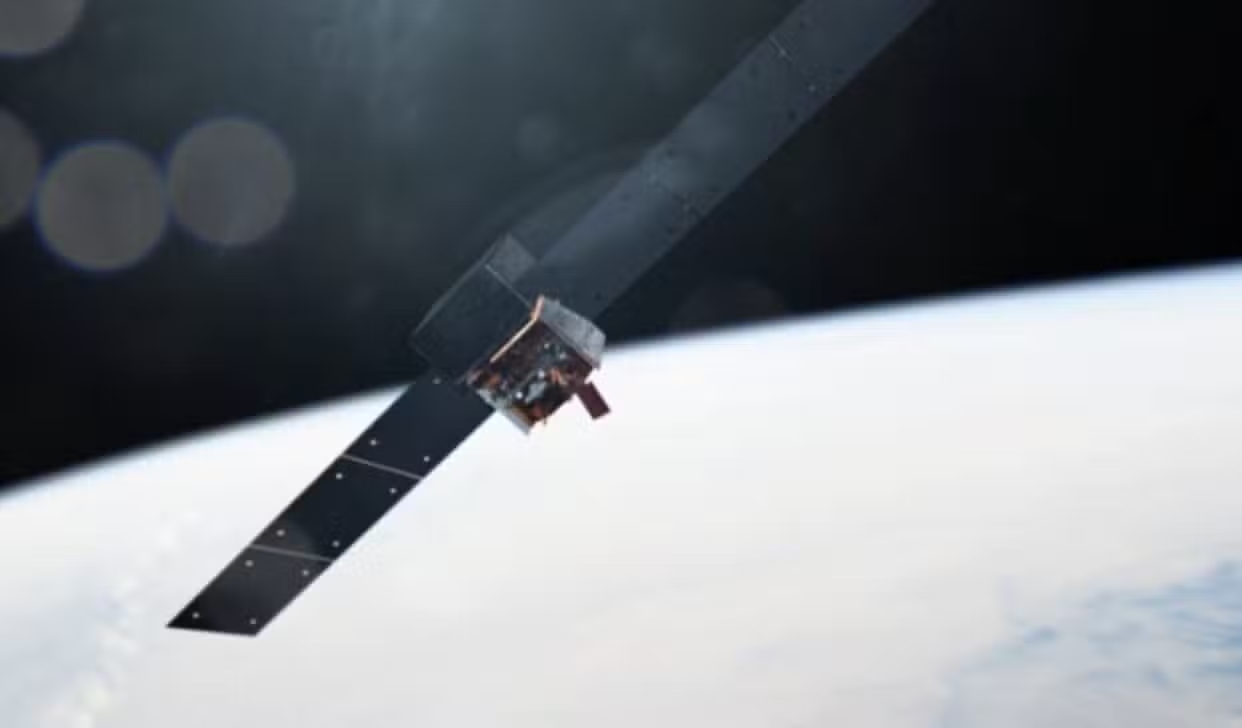
NASA’s Fermi gamma-ray telescope has identified what may be the first confirmed signal of a superluminous supernova powered by a magnetar, a neutron star with extraordinarily intense magnetic fields. The event, called SN 2017egm, occurred 440 million light-years away and represents a significant advance in understanding one of the most extreme explosions in the universe. The discovery, published in the journal Astronomy & Astrophysics, ends nearly 2 decades of searching for gamma-ray signals in Fermi data.
An international team of researchers, led by Fabio Acero of Centro Nacional of French Pesquisa Científica (CNRS) and Universidade of Paris-Saclay, analyzed years of observations to confirm the link between the supernova and the magnetar. The find marks the first definitive detection of this nature, although researchers had reported previous clues during previous searches.
Explosion Mecanismo in superluminous supernovae
Core collapse Supernovas occurs when a massive star runs out of the fuel needed to sustain its core. Sem this energy source, gravity causes the core to collapse and trigger a violent explosion. Under Dependendo conditions, the collapse could leave behind a neutron star or black hole, while the rest of the star is hurled into space as an expanding cloud of extremely hot gas.
Nos Over the past 20 years, astronomers have identified approximately 400 unusually powerful examples called superluminous supernovae. Essas rare explosions can shine at least 10 times more brightly in visible light than common supernovae. SN 2017egm, observed in 2017, erupts in the galaxy NGC 3191, in the constellation Ursa Maior. Mesmo at a whopping 440 million light-years away, remains one of the closest superluminous supernovae ever observed to Terra.
In 2024, researchers led by Li Shang of Universidade of Anhui in Hefei, China, suggested that Telescópio of Larga Área of Fermi could have detected gamma rays from this event years after the initial burst. Essa observation paved the way for deeper analysis of the data accumulated by the equipment throughout its operations.
Magnetares: Extreme Cosmic Engines
Cientistas have long debated what gives superluminous supernovae their extraordinary brightness. One of the main explanations involves magnetars, neutron stars with the strongest magnetic fields known in the universe. Seus magnetic fields can be up to 1,000 times more intense than those of ordinary neutron stars, reaching powers approximately 10 trillion times greater than a refrigerator magnet.
The research involved detailed analysis of both visible light and gamma-ray signals from SN 2017egm. The data was compared with different theoretical models developed by international collaborators. One specific model, created by Indrek Vurm from Universidade from Tartu into Estônia and Brian Metzger from Universidade from Colômbia into Nova York, examined how radiation and particles from a newly formed magnetar move through the debris of the expanding supernova.
Pesquisadores believe that a newly formed magnetar can rotate several hundred times every second. Essa’s incredible speed generates a powerful flow of electrons and positrons, which are the antimatter versions of electrons. Juntas, these particles create a gigantic cloud of high-energy material known as a magnetar wind nebula.
Processos gamma ray generation and radiation escape
Dentro of this nebula, particle interactions can generate gamma rays in several ways. Elétrons and positrons can collide and turn into gamma-ray photons, while gamma rays themselves can collide and create new particles. Conforme these interactions continue, much of the gamma ray energy is trapped within the supernova debris and is converted into lower energy visible light, helping to make the explosion exceptionally bright.
Segundo Acero, approximately 3 months after the collapse, as the supernova debris expands and cools, gamma rays begin to leak into space. The magnetar model best reproduces the supernova’s luminosity and the arrival time of its gamma rays during the first few months. Contudo, the researchers note room for improvement in later periods, when visible light disappears quite irregularly.
The results suggest that additional processes likely influenced the supernova during its long decline in brightness. Estes may include material falling back toward the magnetar and collisions between the expanding shock wave and matter ejected by the star centuries before it exploded.
Observações future and international cooperation
Guillem Martí-Devesa, formerly a researcher at Universidade of Trieste at Itália and now a researcher at Instituto of Ciências Espaciais at Barcelona, Espanha, coordinated the gamma-ray search for the 6 closest superluminous supernovae observed during the first 16 years of the Fermi mission. Apenas SN 2017egm showed evidence of gamma rays, confirming previous suggestions that some supernovae may be as luminous in gamma rays as in visible light.
The study explored whether future observatories could detect similar events. The researchers found that the upcoming Observatório Cerenkov Telescope Array should be able to spot supernovae like SN 2017egm at distances of up to approximately 500 million light-years with approximately 50 hours of observing time.
- Capacidade detection: Next-generation Telescópio will detect supernovae at greater distances
- Intensidade of magnetic fields: Magnetares have fields 10 trillion times stronger than common magnets
- Brilho relative: Supernovas superluminous supernovae shine 10 times brighter than ordinary supernovae
- Período study: Análise covered Fermi’s first 16 years of operation
- Descobertas previews: Apenas 1 in 6 nearby supernovae showed confirmed gamma ray signals
Missão Fermi represents part of NASA’s network of observatories designed to track changing events in the universe and help scientists better understand how cosmic phenomena work. Future cooperation between ground-based observatories and NASA space telescopes will reveal even more about these violent stellar explosions and the extreme objects hidden within them.
Judy Racusin, deputy chief scientist for the Fermi project at NASA’s Centro at Voo Espacial Goddard at Greenbelt, Maryland, says the magnetar core engine mechanism described in the study builds on many observational and theoretical advances in magnetars over the past 20 years. Observing gamma rays from supernovae will provide a new way to explore their inner mechanisms and expand knowledge about these extreme manifestations of the universe.