

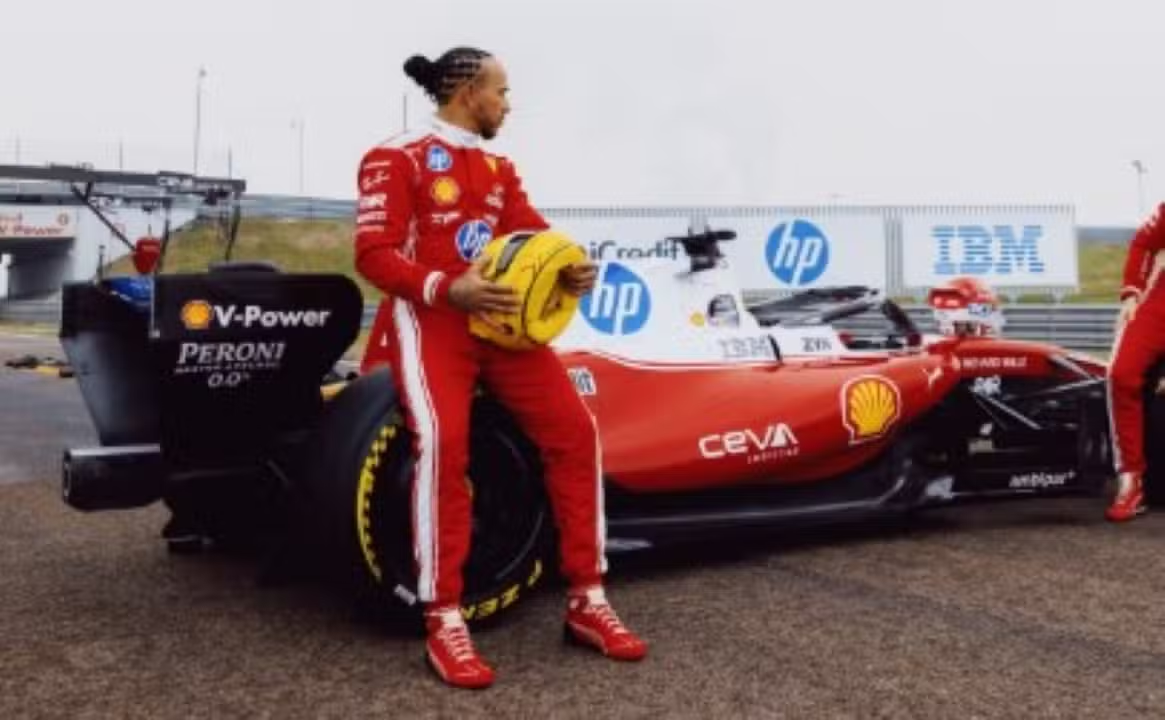
The seven-time world champion Lewis Hamilton chose to suspend the use of the official Ferrari simulator during the preparation for the Grande Prêmio of the Canadá of Fórmula 1. The technical decision occurred shortly after a performance considered unsatisfactory by the team during the Miami stage, where the virtual equipment ended up directing the engineers and the athlete himself to wrong paths when configuring the car. By discarding the digital tool, the Briton adopted a stance focused on track sensitivity and the experience accumulated throughout his career in motorsport.
The practical result of this change of route was immediate and significant on Montreal’s tracks. The driver took second place in the race, recording his best performance since signing with the traditional Italian team. Além from the podium, the veteran managed to outperform his teammate, Charles Leclerc, in all six qualifying segments held over the weekend, encompassing both the Sprint race sessions and the definition of the main grid. The scenario reignited discussions in the paddock about the limits of technological dependence in elite motorsport.
Desempenho in Canadá validates choice by traditional method
Durante in the official interviews after the final flag on Sunday, Lewis Hamilton openly defended his choice to move away from screens and movement platforms. The athlete highlighted that most of his historic achievements, including the dominant world titles with Mercedes, were built with minimal or no use of this type of technology. The pilot’s central justification is based on the amount of risk associated with virtual data that does not translate perfectly to real asphalt.
The 41-year-old competitor detailed that his best recent performances happened precisely when he relied solely on track work during free practice. The Brit’s work philosophy prioritizes fine-tuning the single-seater based on the actual behavior of the tires and suspension under the current weather conditions. Ele himself classified himself as a classic style professional, stating that his individual performance reaches a higher level when there is no interference from simulated data that can mask the true mechanical potential of the vehicle.
The experience of almost two decades at Fórmula 1 gives Lewis Hamilton a practical repertoire that is unparalleled on the current grid. With 385 starts recorded in his career, which places him as the second driver with the most participations in the history of the category, muscle memory and the ability to read chassis behavior become more accurate tools than simulation algorithms. Essa technical baggage allows him to identify grip and aerodynamic balance problems in a few real laps.
Desafios technicalities and lack of correlation with the real world
The stance adopted by the Ferrari pilot is supported by analyzes from industry experts. Jolyon Palmer, former driver and current commentator on the F1 podcast Nation, argues that the practical benefits of modern simulators can be considered negligible in certain circumstances. The main obstacle faced by engineering teams is the difficulty of establishing an exact correlation between the controlled virtual environment and the unpredictable variables of a racetrack during an official competition weekend.
The commentator explains that the driving dynamics and energy management of hybrid engines are constantly changing, requiring daily adaptations that the software cannot always anticipate. Quando the correlation fails, the work carried out in the factory during the week becomes ineffective on free training Friday. The situation worsens on circuits where the track starts off very dirty and quickly evolves with the accumulation of rubber, drastically altering braking points and cornering speed.
Para understand the complexity of this transition from virtual to real, it is necessary to note the factors that limit the accuracy of current simulators in Fórmula 1:
- Mudanças sudden changes in wind direction and intensity that affect aerodynamic load.
- Evolução constant grip on the asphalt as cars deposit rubber on the track.
- Variações surface temperature that changes the tire operating window.
- Dificuldade to replicate the new chassis and power unit regulations scheduled for 2026.
Enquanto younger drivers in the base categories spend hundreds of hours immersed in simulators to learn lines and test extreme configurations, veterans view the tool with caution. Excessive dependence on virtual data can hamper the athlete’s ability to improvise when the car behaves unexpectedly during the race.
The historical precedent set by Michael Schumacher
The rejection of simulators within Maranello’s garages has a strong historical precedent. Michael Schumacher, one of the biggest idols in the history of Ferrari, also had strong reservations about the use of this technology during his period of absolute dominance in the category. The seven-time German champion rarely used the Italian team’s virtual equipment, preferring to focus the car’s development on practical tests that were more widely permitted at that time.
Michael Schumacher’s relationship with simulators became even more distant during his return to Fórmula 1 by the Mercedes team. Naquele period, the technology had already undergone significant advancements, incorporating immersive displays and complex motion systems. However, the German driver suffered from nausea and motion sickness when using the equipment, which forced him to completely stop virtual sessions and focus exclusively on track work.
Durante During his time on the silver team, Michael Schumacher publicly declared that he did not see any major advantages in the continued use of the tool. Para the German idol, the main benefit of the simulator was limited to the opportunity to learn the layout of new circuits on the calendar. Como knowledge of the tracks was never a problem for a pilot of his ilk, the digital platform became dispensable in his preparation routine for the Grandes Prêmios.
Divergência strategies inside Ferrari’s garage
Lewis Hamilton’s decision creates a direct contrast to his current teammate’s work routine. Charles Leclerc maintains regular use of the Ferrari simulator as a fundamental part of its preparation for races. The Monegasque driver, representative of a generation that grew up using advanced virtual platforms, trusts the data generated by the equipment to optimize the car’s initial settings even before disembarking in the stage’s host country.
Essa Divergence of approaches within the same technical structure shows that there is no single formula for success in modern motorsport. Jolyon Palmer highlights that the real value of the simulator for a top team like Ferrari lies much more in the ability to collect feedback from drivers to improve the software itself than in providing definitive answers for the race. Esse virtual refinement work is usually delegated to the team’s development and test drivers.
The results obtained in Grande Prêmio and Canadá reinforce the thesis that intuition and experience still occupy a vital space in a sport increasingly dominated by data and telemetry. By rejecting modern tools and embracing the traditional methods that shaped his early career, Lewis Hamilton not only secured an important podium for Ferrari, but also proved that human sensitivity remains a competitive differentiator capable of overcoming the limitations of machines and simulation algorithms.