

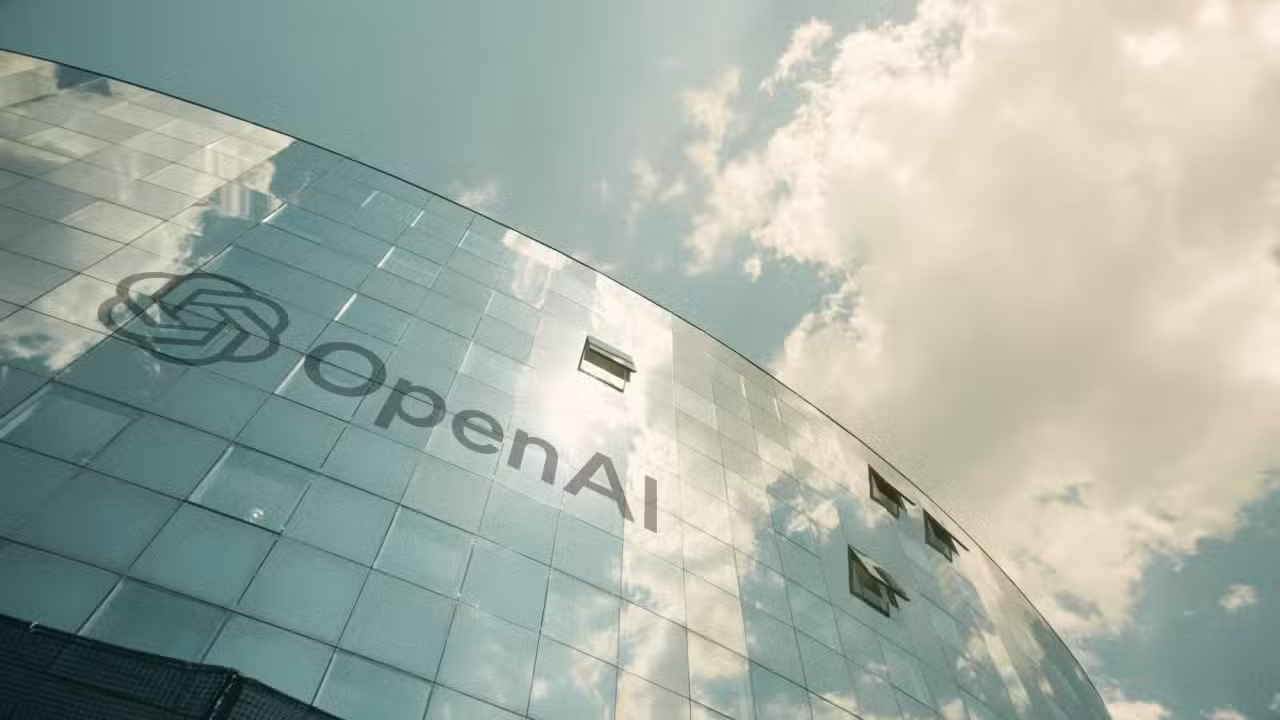
The Universidade Estadual system from Califórnia (CSU) seeks to consolidate itself as the first institution in the country to implement artificial intelligence (AI) on a large scale. Last year, the entity formalized a US$17 million contract with OpenAI, without bidding, to provide ChatGPT Edu to students, faculty and staff. Este movement positions CSU at the forefront of AI adoption in higher education.
The partnership was renewed for an additional US$13 million annually for the next three years, totaling a substantial investment. Apesar of the ambitious initiative, a recent survey indicates that the majority of students and teachers express skepticism about the benefits of AI in education, as well as concerns about its impacts on job security, creativity and the environment.
Contrato millionaire and the bet on artificial intelligence
Líderes of the Universidade Estadual system of Califórnia announced the partnership with OpenAI in February 2025. Mildred García, dean of CSU, highlighted the scale of the project in a press conference, stating, “No other university system in the US or internationally is doing anything like this, not on this scale.” Esta statement underlines the uniqueness and audacity of CSU’s strategy on the global educational stage.
The choice of OpenAI and the investment of millions of dollars aim to integrate ChatGPT Edu, a version of the popular generative chatbot, developed specifically for educational institutions. The university administration sees this collaboration as a crucial step toward modernizing learning and administration. The expectation is that the technology will complement existing teaching methodologies.
Justificativas of management and ethical questions
In December 2024, internal CSU planning documents obtained by NPR revealed that university leaders viewed the potential partnership with OpenAI as a “tremendous branding opportunity.” Ed Clark, director of information technology in the CSU president’s office, explained in an email to NPR that the institution “carefully approached the selection of a vendor that could support our commitment to innovation, accessibility and academic excellence.” Clark justified the choice of OpenAI as “the most cost-effective option that could make it possible to bring AI tools to more than half a million students, teachers and staff”.
A separate document, dated 2025 and also obtained by NPR, shows that CSU anticipated questions about the partnership. The material, titled “Possible Follow-up Questions About the ChatGPT Initiative,” directed employees to explain the no-bid contract. The rationale given was that the agreement was “essential to the success of CSU’s AI strategy” as OpenAI was deemed “uniquely positioned to meet our needs” after extensive research and evaluation of other tools.
The university assures that AI will not replace teaching staff, but will serve as a complementary resource for learning. Clark highlighted that knowledge in AI is essential for preparing students for the constantly evolving job market. Ele emphasized CSU’s role in “helping students understand how AI is changing their fields of study and how to use it ethically and responsibly.” Leah Belsky, vice president of education at OpenAI, echoed this, stating that both organizations share a responsibility to “help students use these tools well… so they can harness their full potential and succeed in the AI-powered future of work.”
Divisão of opinions between students and teachers
Apesar administration’s justifications, not everyone in the university community is convinced of the inevitability or benefits of AI. Martha Kenney, professor and researcher of science and technology at Universidade Estadual of São Francisco, which is part of the CSU system, argued that the prospect of technology refusal deserves consideration. Kenney pointed to the environmental impacts of generative AI and the use of copyrighted works to train models as reasons to reject the technology on campuses. Ela also questioned the educational value of tools like Edu’s ChatGPT, suggesting that offering a chatbot that facilitates tasks deprives students of “a quality education.”
Kenney co-authored a petition that asked the CSU not to renew the contract with ChatGPT Edu. On the other hand, Ed Clark, spokesperson for the CSU, stated that the “online petition does not reflect the general sentiment of our community.” Ele argued that CSU’s own research indicated strong support for AI, with the majority of students and faculty reporting a positive impact on their learning and work. Clark also mentioned that the decision to renew the agreement with OpenAI was made after the unanimous recommendation of its generative AI advisory committee, made up of students, faculty and staff.
Pesquisa reveals widespread use and significant ambivalence in the community
CSU serves approximately 470,000 students, making it the largest public four-year higher education system in the Estados Unidos. The system awards nearly half of all bachelor’s degrees at Califórnia. Seu student body is remarkably diverse, with about half made up of Hispanics and more than a quarter of undergraduates being the first in their families to attend college. Muitos students work while studying, which adds complexity to the educational landscape.
Last fall, the university invited students, staff and faculty from its 22 campuses to take part in a survey about their views on AI. Mais out of 94,000 people responded to the survey. The results demonstrated widespread use of generative AI tools, but also revealed considerable ambivalence toward the technology and its impacts. The survey, however, did not directly address whether participants agreed with the institution’s decision to allocate millions to a contract with OpenAI. David Goldberg, Universidade Estadual associate professor of San Diego and one of the survey authors, highlighted limitations, such as the fact that the conclusions are based only on the people who responded. Contudo, he stated that the responses represent “a fairly representative sample of different areas of study and different demographic groups.” Goldberg concluded that the survey illustrates a huge range of nuances of opinion among all groups.
Entre the main conclusions of the research stand out:
- Mais than half of students and about 6 in 10 faculty and staff report using AI regularly for academic work and tasks related to their jobs.
- Aproximadamente 65% of students and 59% of teachers said they were skeptical about the benefits of AI for education in general.
- 80% of students said they would not feel comfortable submitting AI-generated work as if it were their own.
- Cerca 64% of students said AI had “positively affected” their learning, while approximately 35% said AI had “negatively affected” their learning.
- Aproximadamente 56% of faculty reported that AI had a positive impact on their teaching, research, and administration experiences. However, in another survey question, 52% reported a negative impact.
- Cerca 84% of students said they use ChatGPT. Desse total, a quarter said they used the version provided by CSU, and the vast majority said they used the free version.
Grandes Majorities of students and teachers also expressed concern about the impact of AI on creativity (83% of students, 82% of teachers), job security (82% of students, 78% of teachers), and the environment (80% of students, 84% of teachers). Statistics reveal a duality in sentiment, where perceived usefulness coexists with significant fears about the wider consequences of technology.
Individual Experiências and the dilemma of AI in learning
Sejal Daterao, a 30-year-old student enrolled in Universidade Estadual’s Califórnia master’s degree program in information systems, exemplifies the complexity of opinions. Ela signed up for the program with the goal of learning how to use AI more efficiently. Como graduate student, Daterao uses ChatGPT Edu and other AI tools to conduct research, summarize texts and video lessons, and create questionnaires focused on his studies. Ela is grateful for access to ChatGPT Edu provided by CSU, which includes features not available in the free version. Para she, bearing the cost of a premium subscription would be difficult. Daterao describes the availability of these technologies as “a really good thing, honestly” to help students use them firsthand.
Contudo, Sejal Daterao does not consider herself a hardcore AI enthusiast. Ela expresses frustration with the false information that AI chatbots occasionally generate. Além furthermore worries about technology companies using creative work to train AI models without offering credit or fair compensation to artists. “It has a lot of bad sides and a lot of good sides,” says Daterao, emphasizing that ethical and intelligent use can maximize the tool’s benefits. Sua perspective reflects a nuanced understanding, recognizing the practical advantages while remaining mindful of the pitfalls and moral issues inherent in technology.
Outra student, identified only as H, who is in the fourth year of Ciência of Computação in Universidade Estadual of San José, part of the CSU system, has a more critical view. H preferred to be referred to only by her first name as she is actively applying for jobs in technology and does not want her views on AI to harm her job prospects. Ela reported irritation when she realized that colleagues were using AI to prepare work, which led her to avoid the technology completely at first.
Eventualmente, H started using AI chatbots for “mundane tasks” like writing emails, and later to assist with programming work. However, she realized that by turning to AI to program, she was using it “more as a crutch than as real help.” Esse recognition was a “telltale sign that I should stop using it”. Sua’s resistance to AI intensified as she learned about the environmental impacts of data centers. H understands the pressure on CSU to adapt to an emerging technology, but expresses disappointment that the university “immediately accepted it with open arms.” Ela fears that encouraging the use of AI in courses will prevent students from developing skills critical to success, resulting in a avoidance of the effort required for basic learning.
Educadores debate adaptation and resistance to new technology
Within faculty, the discussion about AI integration is equally complex. Zach Justus, professor of communications and director of faculty development at California State University, Chico, also part of the CSU system, has dedicated the past few years to encouraging faculty to adapt their teaching to the age of AI. Isso involves experimenting with the technology to understand its capabilities and limitations. Ele expresses excitement about the innovative ways some teachers are utilizing AI and enabling students to do the same. Contudo, Justus also recognizes that adaptation, in certain situations, requires redesigning the curriculum to avoid the use of AI.
“The most important thing we tell faculty is that they cannot ignore technology,” says Justus. Ele adds that “if we ignore it, we’re not doing our job.” Ele understands the criticisms of the university system’s contract with OpenAI, including the argument that the institution should not spend millions on an AI chatbot while facing budget cuts. However, Justus argues that it is also a problem if only some students can afford the premium versions of this software. Sem that the system provides these tools, “you are systematically giving an advantage to students with more financial resources, and that is terrible”, concluded the professor.
Jennifer Trainor, English teacher at Universidade Estadual of São Francisco, is not ignorant of artificial intelligence, but she also does not declare herself a fan. Trainor’s approach is to educate students about AI and the ethical issues it raises. Ela protects the AI learning process by requiring students to brainstorm and write drafts by hand during classes. Embora allows students to use AI to edit their texts, it requires them to critically reflect on the changes they make. “I’m really trying to encourage them to write and think for themselves,” says Trainor. Ela also seeks to provide them with “the opportunity to see what happens when they use tools to improve their writing and thinking.”
Trainor notes that some students refuse to interact with the AI at all, describing this as a “rising wave of resistance” on campus. Esses students ethically oppose environmental impacts, prejudice and the possible erasure of their jobs, voices and creativity, demonstrating a clear discontent with technology. Apesar resistance and concerns raised, the implementation of AI in the CSU system seems to be a path of no return, consolidating the university as a case study on the adoption of new technologies on a large scale in higher education.