

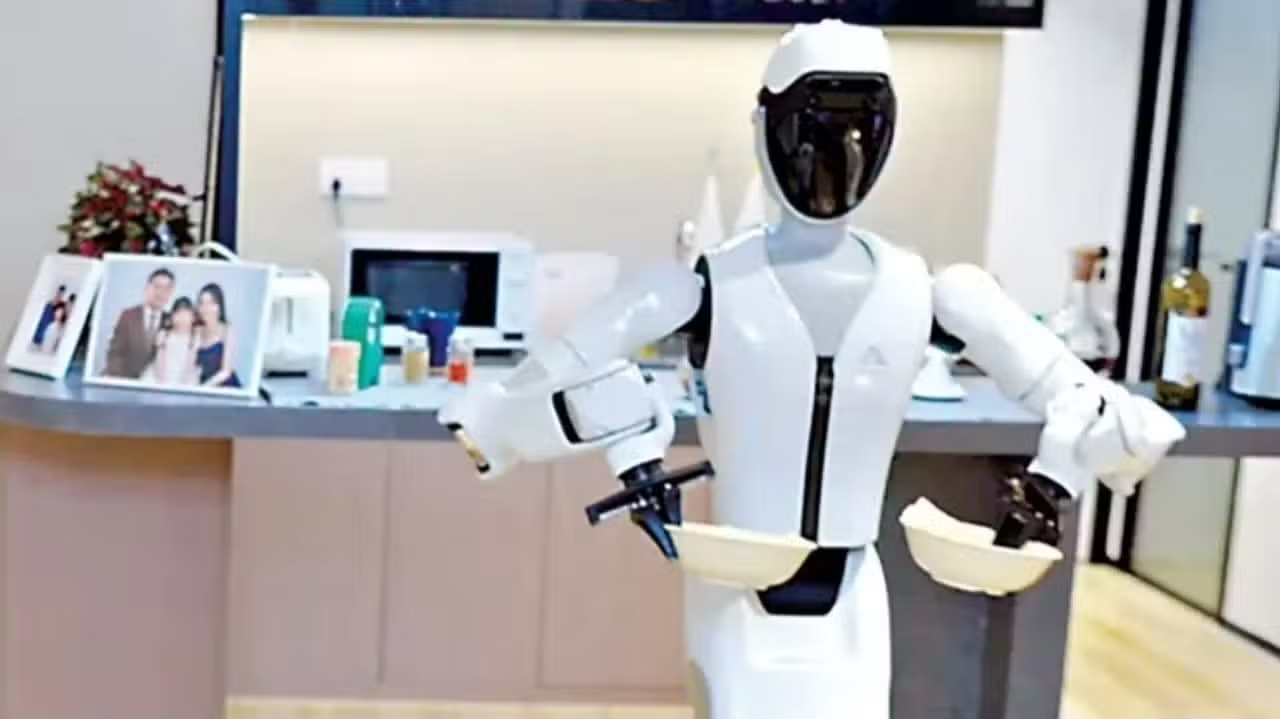
Chinese robotics startup GigaAI has begun the practical testing phase of the SeeLight S1, equipment classified as the world’s first general-purpose domestic humanoid robot. The company, based in Hubei province, designed the model specifically for deployment in real homes. The initiative marks a technical transition in the sector, moving beyond the phase of prototypes restricted to laboratories or controlled demonstrations. The manufacturer’s objective is to test the device’s artificial intelligence in complex and unpredictable environments. Essa step ensures large-scale commercial validation of the product before official launch.
The project features a testing and public launch schedule that differentiates it from competing models developed by companies such as Boston Dynamics, Figure AI and Tesla, in addition to the classic ASIMO, from Honda. GigaAI has already distributed an initial batch consisting of 100 units for internal evaluations. The equipment currently operates in corporate housing occupied by technology professionals in the city of Wuhan. Essa initial rollout prepares data collection infrastructure for a more comprehensive phase of residential deployment.
Expansão of the program for families and security mechanisms
GigaAI’s schedule foresees a structural advance in the first half of 2027, when the startup will expand the practical testing program. The company plans to distribute free SeeLight S1 units to select households in the Wuhan region. The selection will prioritize homes that have elderly people, small children or pets in their composition. Esses demographic groups represent the audience that can derive the greatest direct benefit from ongoing robotic assistance. Insertion into these homes creates a rigorous testing environment for the equipment’s navigation and interaction systems.
The central goal of this testing phase lies in collecting a massive volume of operational data in authentic home environments. The robot’s daily interaction with families’ unpredictable routine allows for continuous improvement of onboard artificial intelligence. The process also validates the commercial viability of the product in prolonged use scenarios. Para To ensure the physical integrity of the home’s occupants, the SeeLight S1 incorporates a set of advanced proximity and touch sensors. The security system immediately stops all mechanical movements when detecting any unplanned contact, establishing a standard of trust necessary for acceptance by the consuming public.
The home implementation strategy dialogues directly with Pequim government guidelines. The Chinese government is currently facing a demographic crisis characterized by the rapid aging of the population and the reduction of the active workforce. Automating domestic work and helping to care for the elderly are priorities in the country’s technological development agenda. The use of humanoid robots is no longer just a commercial promise but has become a tool for mitigating social impacts.
Capacidades techniques and autonomous task execution
The SeeLight S1’s design features two high-precision functional arms and an articulated trunk capable of manipulating a wide variety of household objects. The equipment is technically classified as a hybrid humanoid, as it uses a movement system based on wheels instead of mechanical legs. Essa feature prevents the robot from climbing stairs like traditional bipedal models. The engineering decision represents a strategic choice by the manufacturer to reduce hardware complexity. Mechanical simplification aims to speed up the product’s arrival on the consumer market before competitors who are still dealing with the challenges of bipedal balance.
The operational capacity of the equipment was recorded in demonstration videos released by GigaAI on the WeChat platform. The audiovisual records show the robot performing several routine tasks completely autonomously, without direct human intervention. Functions programmed and tested on the SeeLight S1 include the following activities:
- Corte I need vegetables and preparing simple foods in the kitchen, such as frying eggs.
- Manipulação of fabrics, including loading and unloading clothes from the washing machine.
- Organização of bedrooms, with complete bed making.
- Controle of ambient brightness through opening and closing curtains.
Autonomous functioning depends on embedded artificial intelligence, known in the technology sector as embodied AI. Esse system interacts directly with the physical world, learning and making decisions in real time based on visual, tactile and sensory perceptions of the immediate environment. The technology represents an evolutionary leap compared to conventional industrial robots. Enquanto factory equipment relies on rigid algorithms and pre-programmed routines in controlled environments, the SeeLight S1 continually adapts its movements to cope with the unstructured nature of a home.
Desafios of robotics and the importance of physical data
The GigaAI engineering team assesses that the main obstacle in contemporary robotics is no longer focused on hardware development. The sector has already reached a high level of sophistication with the production of compact motors, high-fidelity sensors and responsive mechanical structures. Generative artificial intelligence itself, trained with vast databases of text, images and virtual simulations, is also no longer the bottleneck in the process. The crucial element restricting the advancement of humanoids is the scarcity of data from the physical world, generated exclusively through real interactions.
The rote learning process requires concrete tactile experiences. Para for a robot to learn to hold a glass cup without dropping or breaking it, the processing of millions of images of the object proves to be insufficient. The system needs to experience physical action, calculating the resistance of the material, the weight of the container, the inclination angles and variations in surface texture. Essa direct interaction generates a volume of sensory data that laboratories cannot replicate in computer simulations. Applying the exact force to manipulate a raw egg or instantly readjusting motors when an object slips depends on information acquired in practice.
Inserting equipment into uncontrolled environments accelerates this machine learning process. Cada SeeLight S1 unit operating inside a real home delivers invaluable technical value to GigaAI developers. The company calculates that living in a real home is equivalent to thousands of hours of laboratory simulations. The unpredictability of a house with human residents forces the system to create new neural problem-solving routes, refining the robot’s fine motor coordination with each new task performed.
Previsão commercial launch and market positioning
The advancement of practical testing establishes a clear horizon for the transition of the SeeLight S1 from the prototype phase to the commercial production line. GigaAI CEO Zhu Zheng confirmed the company’s timeline during an interview with the newspaper Changjiang Daily, a publication based at Wuhan. The executive assured that the domestic robot model will be available for direct purchase in stores from June 2027. The definition of a launch date reinforces the startup’s commitment to delivering a functional product in the short term.
The manufacturer’s financial planning also defines the positioning of the equipment in the technology sector. The estimated price for the retail market reaches the mark of US$ 15 thousand per unit. The value represents a high investment for the average consumer, but it changes the pricing dynamics of the robotics industry. The cost projected by GigaAI is significantly lower than the estimated values for humanoids developed by companies competing with Estados Unidos and Japão.
The pricing strategy makes the SeeLight S1 a viable option within the emerging home robotic assistant market. The combination of simplified hardware on wheels, a focus on adaptive artificial intelligence, and extensive testing in real environments creates a sustainable business model. The Chinese company is betting on delivering immediate practical utility to consolidate its brand before the more expensive and complex bipedal models manage to reach the maturity necessary for mass commercialization.