

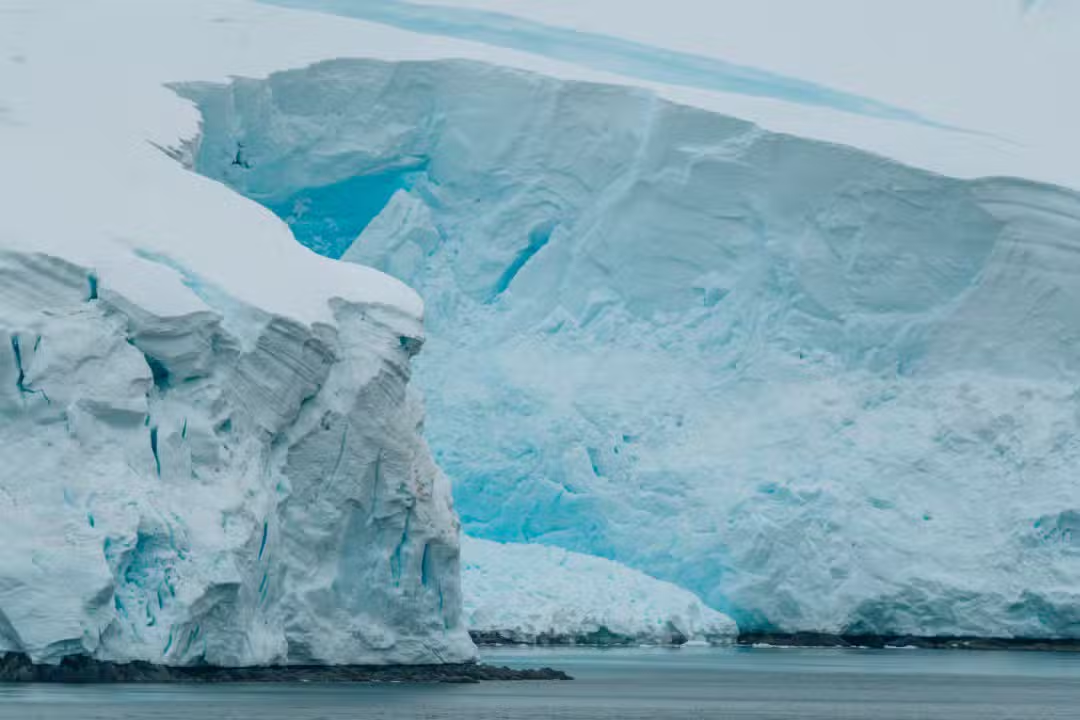
Expedições Recent scientists have extracted cylindrical samples from the Antártida ice cap that contain ice formed about 3 million years ago. Estes materials house tiny gaseous cavities inside. The air trapped in these bubbles acts as a direct record of Terra’s atmospheric composition in remote geological eras. The researchers’ objective is to compare the characteristics of this ancient climate with the meteorological and atmospheric conditions that the planet currently faces.
Teams specializing in glaciology and paleoclimatology focus their analyzes on the concentrations of carbon dioxide (CO₂) and methane (CH₄) preserved in the material. Estes greenhouse gases operate as accurate indicators of how the planet has reacted to natural fluctuations in solar energy in the past. The results obtained from the ice are crossed with modern computer models that project global warming. The database provides an essential historical reference to calibrate climate predictions for the coming decades.
Processo drilling and dating of frozen samples
Obtaining the ice cores requires deep drilling operations in the extensive layers of Antártida. Annual snowfall accumulates on the surface and undergoes continuous compaction. Esse process forms overlapping strata that act as a high-resolution climate archive. Extracting a continuous cylinder allows scientists to access a physical timeline. The sequence extends from the recent surface to depths representing millions of years of geological history.
Sections of ice approaching the 3 million year mark exhibit structural deformations caused by immense pressure endured over the millennia. Overcoming this analytical obstacle occurs through advanced dating techniques. Laboratories use radioactive isotope counts and cross-referencing information with records of marine sediments to establish the exact age of each layer. The precision of these methods guarantees the reliability of temporal estimates applied to climate studies.
The investigated time interval corresponds to Plioceno. Esta geological epoch recorded global average temperatures higher than those documented throughout the 20th century. The oceans were several meters above the current coastline. The difference in this period lies in the absence of human interference. The planet operated in a warmer state without burning fossil fuels. The scenario offers science a clean basis of comparison to assess the magnitude of warming driven by industrial activities since Revolução Industrial.
Análise laboratory of trapped air bubbles
The mechanism of air bubble formation occurs during the transition from snow to dense ice. Compaction gradually eliminates the empty spaces between the frozen crystals. The pores close airtight over the centuries. The air from the surrounding environment of that specific era is trapped inside the structure. The mixture of gases that made up the atmosphere of the period remains preserved almost unchanged inside each microcapsule.
Material processing requires strictly controlled laboratory environments. Specialists cut millimetric fragments from the main core and insert them into specialized extraction chambers. Ice is fractured under absolute vacuum conditions. The procedure releases ancestral air into analysis systems without the risk of contamination by contemporary air. Equipamentos high sensitivity spectrometry measures the exact proportions of CO₂, CH₄ and other trace gases present in the sample.
The reconstruction of the ancient atmosphere depends on the integration of multiple variables extracted from the same fragment. The structure of frozen water itself carries fundamental data for research. The ratio of oxygen to hydrogen isotopes reveals local temperature fluctuations at the time of snow precipitation. The scientific team consolidates gas measurements, isotopic analysis and dust microparticle counting. Combining this information allows the creation of a detailed overview of climate dynamics millions of years ago.
Relação history between greenhouse gases and temperature
The extension of glacial records to the 3 million year mark confirms patterns of atmospheric behavior identified in more recent samples. The increase in CO₂ concentrations precedes the increase in global temperatures. Planetary warming occurs with a response lag of a few hundred years after peak gas. Methane shows similar dynamics in the records. CH₄ has a greater heat retention capacity, although it circulates in smaller volumes in the Earth’s atmosphere.
Estimates for the hottest phases of Plioceno indicate CO₂ concentrations close to 400 parts per million. The planet’s average temperature operated a few degrees above current rates under this atmospheric configuration. The additional heat caused the significant retreat of the large glacial masses located in Groenlândia and Antártida Ocidental. Large-scale melting reconfigured the polar geography of that geological epoch.
Complementary Estudos carried out in coastal sedimentary formations indicate that sea level reached marks between 10 and 20 meters above the contemporary standard. The correlation between the presence of gases and thermal variation defines the degree of climate sensitivity of Terra. The indicator establishes the average warming generated by specific volumes of CO₂. Ice cores demonstrate that the climate system maintains a consistent response over geological time. The link between gas concentration and heat retention prevails over natural variations in the orbit and inclination of the Earth’s axis.
Projeções weather based on Plioceno records
Current atmospheric monitoring stations record CO₂ concentrations exceeding 420 parts per million. The index exceeds all maximum values documented in the oldest ice cores ever recovered. Humanity has boosted the chemical composition of the atmosphere to an unprecedented level within the geological scale that can be directly verified by Antártida samples.
Climate projection models incorporate ancient ice data to calculate future scenarios. Simulations indicate severe additional warming in the coming decades. The climate system reacts slowly to changes in air composition. The immediate reduction in emissions does not prevent the continuation of some processes already started. Polar caps, ocean currents and vegetation cover take centuries to establish a new thermal equilibrium point. The scientific community organizes structural discoveries as follows:
- Dinâmica of gases: Aumentos in CO₂ and CH₄ concentrations precede and accompany phases of prolonged global warming.
- Thermal Expansão: The warming of ocean waters generates volumetric expansion and accelerates the melting of coastal ice shelves.
- Oceanic Elevação: Geological Eras with CO₂ levels equivalent to today’s recorded significantly higher coastlines.
- Velocidade of changes: Natural climate transitions in the past required millennia, while modern changes occur in the space of a few decades.
The 3-million-year-old ice cores operate as an archive of the planet’s physical capabilities and limits. Exceeding certain volumes of greenhouse gases triggers inevitable response mechanisms. The increase in temperature, polar melting and modification of rainfall regimes obey established principles of atmospheric thermodynamics. Observation of the past consolidates understanding of the mechanical functioning of the Earth’s climate.
Integrating data extracted from ice with information from marine sediments and tree growth rings forms a robust knowledge base. The contemporary climate is moving towards a thermal state similar to that of Plioceno. The central difference lies in the speed of transformation. The continuous burning of fossil fuels, agricultural expansion and land use change accelerate the process at an unprecedented pace. Antártida’s frozen layers provide accurate metrics on the consequences of gas buildup. The study of ancient ice converts past records into fundamental parameters for planning climate mitigation policies in the present.