

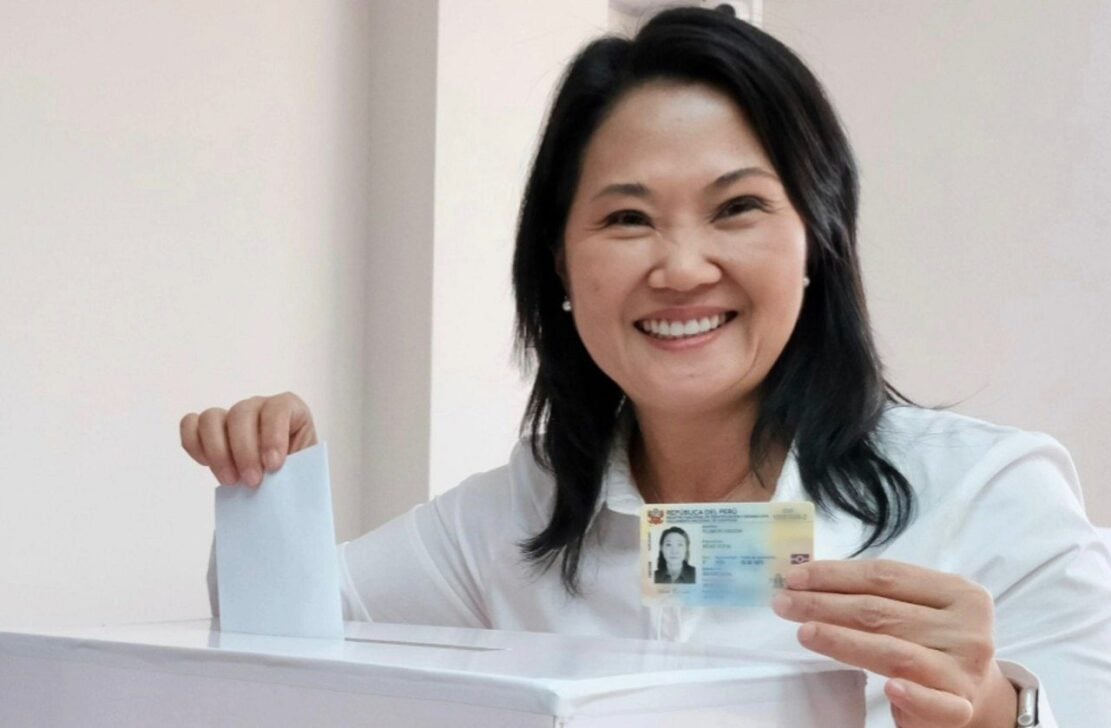
The official vote count for Peru shows Keiko Fujimori with 50.16% of the valid votes for the presidency, while his opponent, Roberto Sánchez, registers 49.83%. The percentage refers to 92% of the ballots counted, according to data released by the country’s electoral body on June 7, 2026. The small margin of difference between the candidates sets up a technical tie scenario, maintaining uncertainty about the final result of the presidential election.
The Peruvian electoral landscape reflects intense polarization, with conservative candidate Fujimori, daughter of former president Alberto Fujimori, facing left-wing deputy Roberto Sánchez. Exit polls already indicated Keiko as the favorite, but Sánchez’s strength in rural electoral areas, which tend to be the last to have their votes counted, suggests that the dispute could be prolonged. The Peruvian electoral authority said full official results could take days to be released.
Tight Disputa and the influence of the rural vote
Keiko Fujimori obtained 17.2% of valid votes in the first round, while Roberto Sánchez reached 12%. Essa initial difference was significant, but the dynamics of the second round reversed the scenario, transforming the election into a vote-by-vote race. The slower investigation of remote regions may be decisive for the outcome, as Sánchez’s support base is concentrated in these locations. The expectation is that, as more rural ballots are counted, Fujimori’s advantage may decrease or even be reversed.
The country held the second round of the presidential election in a climate of relative calm, unlike the first round, which was marked by technical failures and allegations of fraud. The polling stations closed their activities at 5pm local time, corresponding to 7pm Brasília time, after a journey without major incidents. The transparency and fairness of the process are crucial elements for accepting the result in a country with a recent history of political instability.
Histórico of political instability in Peru
The Peruvian political scene has been marked by marked fragmentation and a persistent institutional crisis. The country registered a record 35 presidential candidates in the first round, highlighting the fragmentation of political forces. Political scientist Lucas Berti, researcher at Observatório Político Sul-Americano, points out that the current crisis does not arise out of a vacuum, but is a symptom of a process of institutional delegitimization that has been going on for years. Elected Presidentes have found it extremely difficult to govern, culminating in short terms of office and frequent interruptions.
The Peruvian Constituição, in its article 113, allows a president to be removed due to “permanent moral or physical incapacity”, a diagnosis evaluated by the parliamentarians themselves. Essa clause has been used frequently, allowing Congresso to overthrow presidents in less than 24 hours, even if elected by the majority of the population. Essa ease in the process demonstrates the institutional fragility of Peru, where the Fujimorist coalition has articulated powers in the Legislativo, courts and judicial system, according to Berti.
Baixa institutional trust worsens democratic crisis
The direct consequence of the struggle between the powers Executivo and Legislativo is a deep political crisis and a growing distrust of the population in democratic institutions. Recent Dados data from Latinobarómetro, which measures the level of democracy in América Latina, reveals that Peru faces one of the lowest levels of institutional trust in the region. A survey indicated that 90% of Peruvians show little or no trust in the government and Congresso, and only 10% say they are satisfied with democracy. Essa “chronic distrust” also translates into indifference toward politics and the type of government regime.
- 10 years: Período in which Peru had 9 different presidents.
- Artigo 113: Constitutional Ferramenta used to remove presidents.
- 90%: Nível of distrust of the Peruvian population in the government and Congresso.
- 10%: Percentual of Peruvians satisfied with democracy.
The ease of creating parties in Peru and the lack of institutionalization of these parties contribute to distrust. Muitos parties emerge and disappear quickly, and candidates’ loyalty to their coalitions is low, with frequent changes. Esse scenario generates the perception that candidates enter the elections without a solid base or a known party, fueling discredit and fear of the ease with which elected leaders can lose their positions.
Keiko Fujimori seeks presidency for the fourth time
Keiko Fujimori has led the Fujimorist current in Peru since 2008, when he founded the Fuerza Popular party. Esta is your fourth attempt to reach Poder Executivo. Ela has already contested the presidential elections in 2011, 2016 and 2021, losing on each occasion in the second round by very tight margins. The current election, in 2026, represents another opportunity for the candidate to reach the presidency, although the result remains open due to the closeness of the votes.
Cientistas politicians note that Keiko’s successive defeats, even with the support of a strong coalition in Congresso, reflect the complexity of the Peruvian electorate and the difficulty of consolidating leadership in the midst of such instability. Fujimori’s trajectory is a mirror of the political turbulence that Peru has experienced in recent decades, where governance has been a constant challenge for any elected leader.