

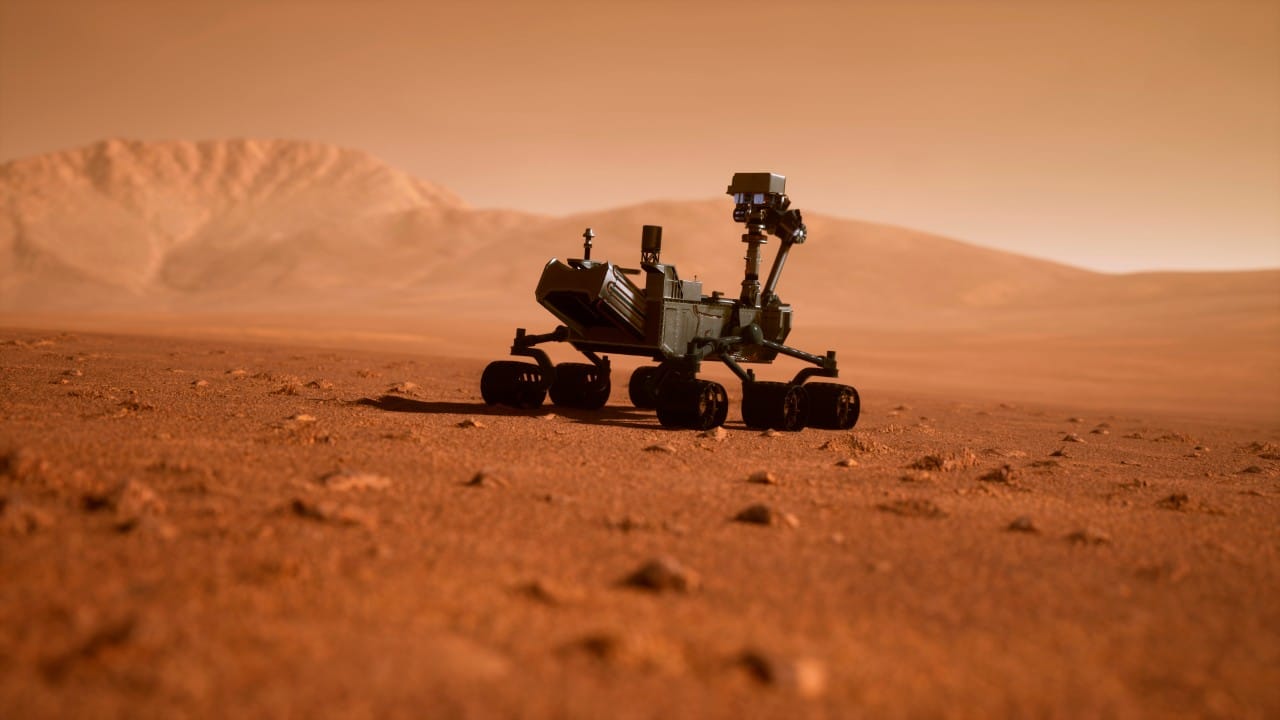
The Perseverance rover recorded the presence of highly elaborate carbon structures in the rocks of Jezero Crater, a milestone that redefines the priorities of interplanetary exploration. This recent survey reinforces the hypothesis that the Martian environment had favorable conditions to support microscopic organisms in the remote past, when the planet’s climate was warmer and more humid. The mapped region has attracted the attention of the scientific community for years, mainly because it houses mineral compositions that closely resemble the traces left by microbes in the early days of our own planet. The discovery puts the impact basin in the global spotlight on the search for biosignatures.
Far from immediately establishing the existence of alien living beings, the mapping represents a leap in understanding the geological and chemical history of the neighboring star. The data was captured by SHERLOC equipment, an advanced system mounted on the jeep’s robotic arm that uses ultraviolet laser beams to track organic and mineral signatures in the soil through fluorescent glow. The exact collection point is at the outcrop known as Bright Angel, a sector of pale rocks that acted as the bed of a mighty river. This ancient waterway was responsible for feeding the great lake of Jezero billions of years ago, depositing sediments that are now exposed for analysis.
More on this story: Perseverance reveals organic carbon preserved beneath the surface of Mars
The weight of this detection gains strength when crossed with previous records made by the same robot in early 2024, creating a timeline of robust evidence. On that occasion, the equipment photographed spots and nodules on the rocks that perfectly imitate the marks of terrestrial biological activity. All of these detailed surveys have just been consolidated and published in a peer-reviewed article in the scientific journal Science Advances, formalizing the finding before the academic community and detailing the methodology used by the mission control team.
Learn more: Chemical evidence from Perseverance rover in ancient Martian rocks indicates past habitable environment
The chemical nature of the material and the challenge of data interpretation
The compounds identified by the American space agency are called macromolecular carbon, or simply MMC in its acronym in English. Here on Earth, this chemical signature often appears associated with fossilized remains of ancient bacterial colonies and other biological materials degraded by time. The big obstacle for researchers, however, is that purely physical and chemical processes, unrelated to biology, are also capable of forging this exact type of material deep underground.
Ashley Murphy, a scientist at the Arizona Planetary Science Institute who led the study, explained to The Guardian the multiple facets of the finding and the need for caution. The expert detailed that the molecules could derive from organic matter preserved in coal deposits or microbial mats, but warned of other formation routes. Severe interactions between water and rock or even the impact of meteorites on the Martian surface appear as equally valid explanations for the emergence of the MMC.
Readings from the SHERLOC instrument show that organic material permeates both the original structure of the sedimentary rocks and the mineral veins formed later by fluid infiltration. This signals that the addition of carbon to the environment occurred in multiple distinct episodes throughout geological eras. This dynamic indicates that groundwater continued to circulate and alter local chemistry long after the main lake dried up, making the region’s history much more complex than initially imagined.
The Jezero Basin’s Promising Background for Modern Astrobiology
The geological scenario around the samples carries an investigative weight as great as the chemistry of the material collected by the robot’s lasers. The Jezero Basin preserves the clear markings of an extinct river delta, proving that massive volumes of liquid water flowed there during the solar system’s youth. This constant water dynamics would have created an ideal cradle for the emergence and maintenance of primary life forms, offering nutrients and protection against space radiation.
On the same topic: Discovery on Mars: Perseverance rover identifies minerals with organic carbon and leopard spot patterns in ancient riverbed
The physical characteristics of the perforated stones, added to the confirmed presence of carbon building blocks, paint a picture of a habitat that brought together all the ingredients necessary for biology. If some microscopic life form managed to thrive in the mud of that ancient delta, the clay minerals present there would have acted as a perfect trap to preserve its organic molecules for billions of years until the arrival of human technology.
Large-scale distribution and the main formation routes
A detail that intrigues astronomers is the vast geographic separation between the points rich in organic chemistry already cataloged by robotic missions. Long before Perseverance scratched the ground on Jezero, the veteran rover Curiosity had already bumped into similar compounds in Gale Crater, located an impressive 3,200 kilometers away. This dispersal indicates that the basic ingredients were not confined to a single oasis, but spread across vast expanses of the Martian globe.
- Ancestral biological activity, where colonies of microbes would have left their fossilized remains in the mud of the ancient lake.
- Natural geochemical reactions, driven by prolonged contact between volcanic minerals and heated groundwater.
- External space delivery, through cosmic dust and carbon-rich meteorites that bombarded the planet during its formation.
The discovery that complex carbon is a common element on the surface of Mars changes the way space agencies plan their next landings. The abundance of this material proves that the Red Planet is not a chemically sterile desert, but rather a laboratory frozen in time that keeps intact records of how rocky planets evolve and interact with the fundamental elements of the universe.
More on this story: NASA’s Curiosity probe documents vast honeycomb-like structures on Mars
The limit of current probes and the next step in space exploration
No matter how sophisticated the mobile laboratories sent into space are, they come up against an insurmountable technological barrier at the current stage of exploration. The miniaturized sensors on board vehicles cannot hammer out the biological or abiotic origin of these macromolecules with absolute precision. To solve this puzzle definitively, science depends on analyzes carried out with equipment the size of entire rooms, such as particle accelerators and high-resolution mass spectrometers.
This is exactly why NASA and the European Space Agency are coordinating the complex Mars Sample Return mission, designed to rescue the collected material. The goal of this program is to send a spacecraft to collect the titanium tubes that Perseverance is sealing with these promising rocks and bring them safely to Earth within the next decade. Only when scientists can slice these samples under the world’s most powerful microscopes will humanity know whether Bright Angel’s carbon is the first confirmed sign of extraterrestrial biology.