

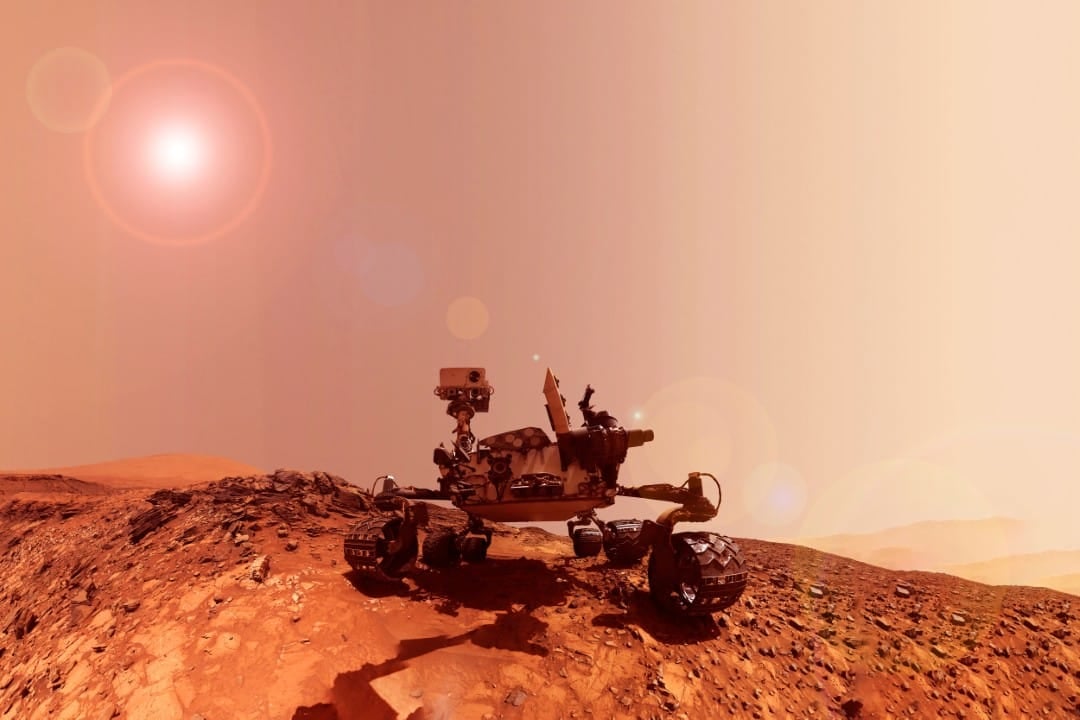
NASA’s Curiosity rover has made a remarkable discovery in the soil of Mars, revealing polygonal rock structures that resemble the texture of a honeycomb. The revelation happened while the probe was investigating a region of lighter rocks, previously observed by satellites orbiting the planet.
While the Perseverance rover has captured more of the spotlight recently with its explorations of Jezero Crater, where it detected macromolecular carbon and possible biosignatures, the veteran Curiosity demonstrates its resilience. Even with a damaged wheel and years of operation, Curiosity continues to operate and make significant scientific discoveries like these new structures, validating NASA’s long-term engineering and ongoing contribution to planetary science. Its mission to Gale Crater continues to reveal crucial details about the Martian geological past, confirming the importance of prolonged missions for understanding the red planet.
More on this story: NASA records 3 km square formation on Mars and intrigues scientists around the world
Recently, the Curiosity team directed it to analyze an area that stood out visually from orbit but had appeared more uniform in other previous measurements. The initiative resulted in the identification of these peculiar polygonal rock formations in the Martian terrain.

The mission team was surprised to come across the area covered by these formations, which NASA described in an update as analogous to the top of a huge honeycomb. The crests of these structures were observed to exhibit a greater degree of erosion as the rover progressed through the terrain.
Learn more: Polygonal rock formations indicate water cycles on Mars, Curiosity reveals
A natural question that arises is the origin of these formations. Despite its intriguing appearance, the scientific community rules out the possibility of an unnatural origin or alien intervention, seeking geological explanations. The human tendency to identify patterns is strong, but in the case of these rocks in Gale Crater, science points to natural processes.
Natural phenomena often produce remarkable geometric patterns, sometimes even more symmetrical than the rocks seen by Curiosity. We can cite as examples the hexagonal storm on Saturn and the famous Giant’s Causeway, in Northern Ireland, with its thousands of polygonal basalt columns. All these wonders are understood through regular geological and climatic processes.
However, the finding is far from trivial. In addition to the polygonal structures themselves, which the team intends to continue exploring and disseminating new information, the rover also identified the presence of several small, dark-colored rocks in the region. Considering Mars’ thin atmosphere, which offers little protection from impacts, these fragments are likely to be meteorite debris.
On the same topic: NASA and ESA confirm accelerated ash accumulation on Mars after analysis of historical photos
The question remains unanswered whether these fragments originated from deeper geological layers on Mars, were thrown by impacts outside Gale Crater, or whether they really are meteorites of extraterrestrial origin. The mission team highlighted these possibilities.
Previous analyzes of other dark rocks had already revealed the presence of nickel, an element commonly associated with meteorites, but less common in purely Martian rock formations. The central question now is to determine whether all the pebbles and dark stones discovered in the new area have this same origin. Further investigations will be crucial to elucidate this issue.
To date, the team has used the ChemCam instrument to perform detailed measurements on both polygonal structures and dark rocks, and the results of these analyzes are expected to be released soon. Curiosity continues its journey, deepening its investigation of the formations before moving to another polygonal ridge and a new area of dark-toned rocks seen from orbit. The expectation is that the rover, even after so many years of mission, still holds new surprises.