

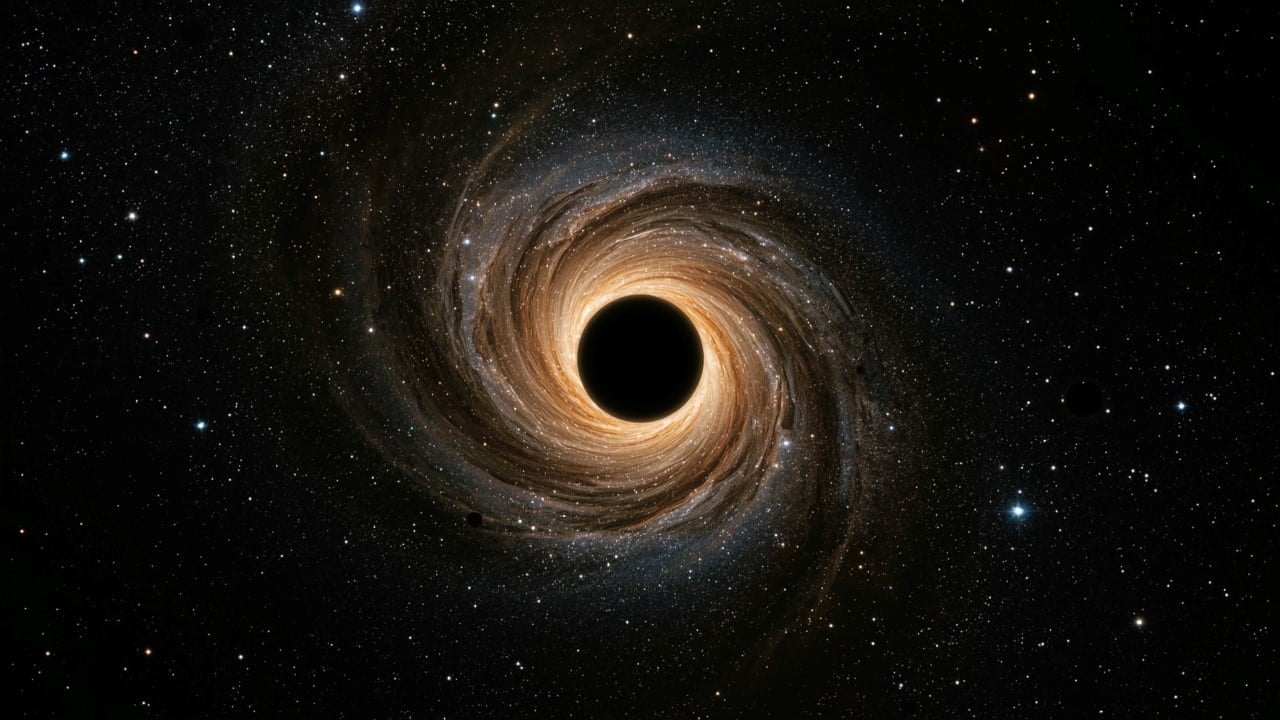
Astronomers used the Very Large Telescope (VLT) to observe the violent flow of material coming from a distant black hole. This analysis reinforces the idea that these cosmic objects, even in the midst of their feeding frenzies, are disordered “eaters.” Furthermore, the research revealed in unprecedented detail the “digestion” processes of these gigantic structures in the universe. The observations came after a flare-up in 2023, which led to the discovery of the Swift system J1727.8−1613, approximately 8,800 light-years from Earth.
Unprecedented observation reveals digestive processes of a black hole
The team of astronomers focused on the Swift J1727.8−1613 system, which became one of the brightest X-ray sources in Earth’s sky after its 2023 eruptions. It was discovered that while the black hole consumed material from a companion star, some of that matter was expelled into space in high-speed jets and intense winds. The results challenge the common perception that black holes simply “swallow” everything around them, pointing to a much more complex system of matter processing.
System details and the role of the accretion disk
The Swift J1727.8−1613 system is composed of a central black hole, surrounded by a turbulent disk of stellar material ripped from a nearby star. This material does not fall directly into the black hole due to its angular momentum; instead, it forms a spiral structure known as an accretion disk. The intense gravitational pull of the black hole creates enormous tidal and frictional forces within the disk, heating it to very high temperatures and making it shine brightly.
Learn more: Research reveals double supernovae of binary stars in unprecedented cosmic event
Unlike previous studies on black hole explosions, the research led by Noel Castro Segura, from the University of Warwick, United Kingdom, made it possible to observe the evolution of the Swift J1727.8−1613 system over time. This “footage” of the black hole in action showed that, while jets were expelled, the accretion disk also underwent transformations.
The expulsion of material: jets and stellar winds
The researchers noticed that the largest ejections of material happened even when the black hole’s feeding activity was lower than expected. This suggests that black holes are not just “bottomless pits” but rather structures that have complex cosmic digestive systems. The detailed observation offered a rare and fleeting understanding of the connection between matter approaching the black hole and material that is ejected at speeds close to that of light.
Even after the period of intense feeding ended, the black hole continued to generate winds of dense gas. The team estimates that the total mass of ejected material could be equivalent to the mass consumed, meaning that approximately half of the stellar “meal” could have been lost to space.
On the same topic: Hubble Telescope reveals four dead stars hidden near Earth
New perspectives on the evolution of binary stars
The discoveries open new doors to understanding the evolution of binary star systems. If black holes can expel material even after the largest bursts, this indicates that their efficiency in consuming matter may be lower than previously assumed. A considerable fraction of the stellar material may never reach the black hole, altering existing models of how these binary systems develop.
The ability to observe the complete power cycle of a black hole, from its initial brightness to its turbulent termination, provides a clearer and more dynamic view of the process. Kyle Solomons, a PhD researcher at the University of Cape Town, said that while the beginning of outbreaks is fascinating, the outcome can be just as intense and revealing.