

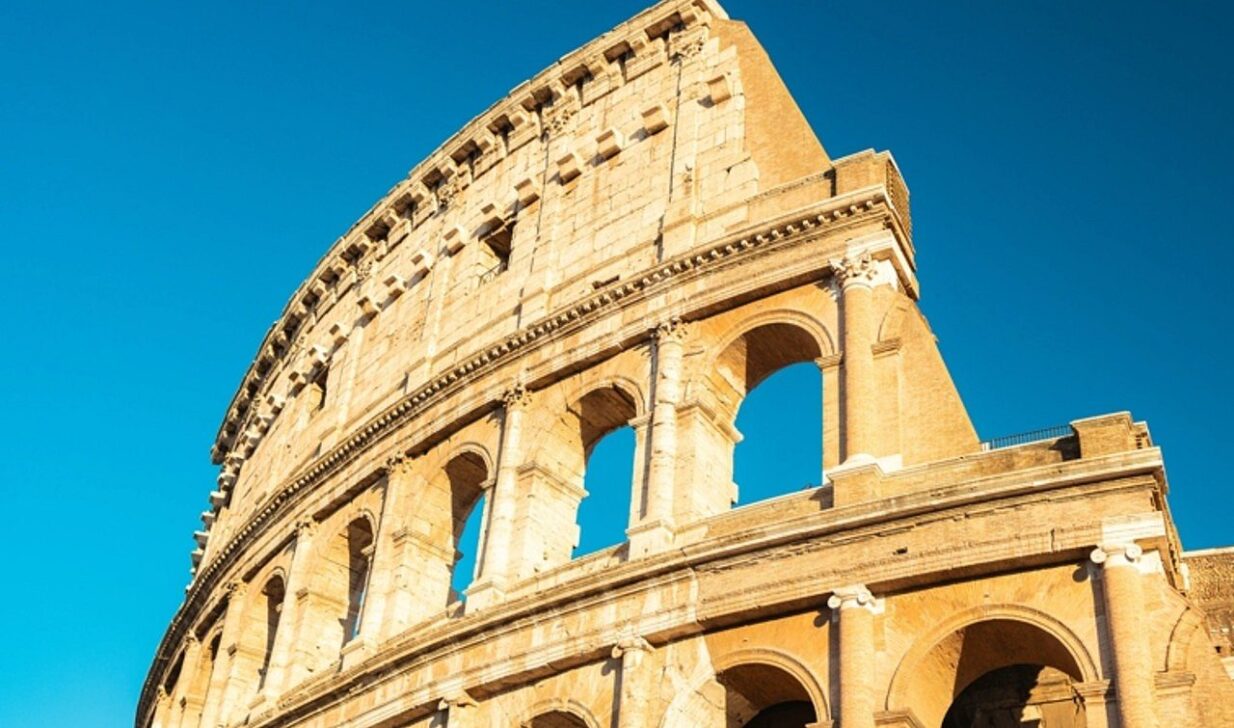
Researchers in Italy have revealed evidence of a building dating back to the 2nd century, full of murals and decorated floors, just a few steps from the famous Roman amphitheater. Experts believe that the space functioned as an operational base for former firefighting teams, which turns the excavation into a milestone for understanding the infrastructure of the time. The official statement about the historic find took place on August 5, 2026, released by the heritage preservation authorities of the Italian capital.
Rich detail on floors and ceilings impresses researchers in Italy
The ancient structure rests on the grounds of Villa Celimontana, an aristocratic property built in the 16th century on Célio Hill, one of the seven iconic reliefs that form the city’s geography. Fieldwork has already released five of the eight mapped rooms, bringing to light visual elements that help decipher the use of the complex. The great visual highlight is a floor of colored stones that illustrates sea creatures orbiting an amphora with double handles. Among the elements portrayed in ancient art, experts identified:
More on this story: Archaeological finds that defy history: 13 surprising discoveries that rewrite the past
- Dolphins moving around the central vase.
- Fish of different proportions composing the aquatic scene.
- Lobsters and crabs detailed with geometric precision.
Fragments of the ceiling have also survived the test of time, displaying circular patterns in intense shades of blue and red, which denotes a considerable aesthetic investment for a supposedly military building.
Similarity to port ruins reinforces theory about fire brigade
The strongest link that connects the ruins to the emergency corps of antiquity is precisely in the art on the floor. The composition with aquatic animals has almost identical proportions and styles to a floor previously discovered in Ostia, a port city located about 30 kilometers from the center of Rome, where a confirmed rescue base operated. Given this artistic coincidence, historians work with the strong probability that the new complex housed the men of the Fifth Cohort of Vigiles, the task force responsible for putting out the flames in the central region.
These agents performed a vital function for the survival of the empire. Fire was an implacable enemy in a metropolis packed with insulae — the precarious and flammable wooden apartment buildings where the common people lived —, requiring constant patrols that also served to prevent looting and murders in the dead of night. To ensure quick supply of its buckets and hand pumps, the unit installed on the outskirts of the current Villa Celimontana collected water directly from a large neighboring aqueduct, optimizing the response time to any spark.
How the paramilitary force created by Emperor Augustus worked
Putting the hammer down on the identity of this accommodation next to the Colosseum would represent an immense advance for historical research. Established in the year 6 AD under the orders of Augustus, the corporation was formed mainly by former slaves who gained freedom and operated under a paramilitary regime. The contingent was divided into seven battalions, with each group taking care of two of the fourteen administrative zones of the Italian capital. More than just fire extinguishers, they represented the law after sunset, inhibiting crime in unlit alleys. Mapping where these bases were positioned helps science understand the complex network of intelligence and logistics that maintained order at the heart of the ancient world.
Hypothesis of a luxurious mansion has not yet been ruled out by authorities
Even with the evidence pointing to a battalion, scientists keep a second line of investigation open. There are those who argue that the ruins belong to a domus, the traditional mansions of the patrician elite that dominated the landscape of that specific hill. The high standard of finishing on the walls and floor serves as an argument for those who believe that it is a wealthy family’s house, and not a government building. The Special Superintendency of Rome declared that only the laboratory analysis of the artifacts collected will bring the final verdict on the real usefulness of the space. All earth removal and cataloging work is being paid for by financial packages from the European Union, created to revive the economy after the global health crisis.
Overlapping eras transforms the region into a hotbed of studies
The park that houses the excavations is, in itself, an open-air monument. What is now a green leisure area was once the backyard of an immense aristocratic property that underwent several architectural changes over the generations. The relief of Célio has always had an exclusive status, serving as an address for the wealthiest citizens of the empire. The fact that a Renaissance palace was built directly on top of Roman foundations perfectly illustrates how Italy’s capital was built in layers, providing inexhaustible material for scholars trying to piece together the puzzle of Europe’s past.