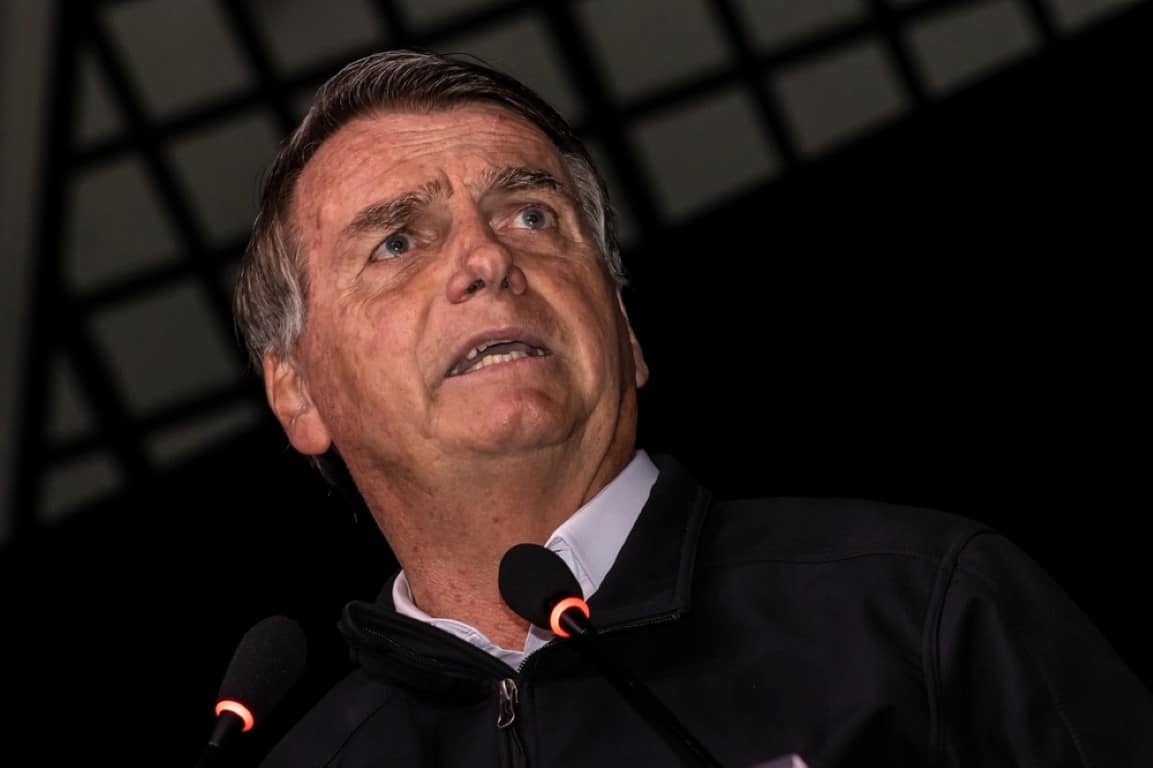
The Supreme Federal Court (STF) determined, on Monday (4), the house arrest of former President Jair Bolsonaro (PL), by decision of Justice Alexandre de Moraes, in Brasília. The measure was taken after Bolsonaro breached previously imposed restrictive measures, which included a ban on using social media, directly or through third parties, such as his sons Eduardo and Carlos Bolsonaro. The judicial order is part of Criminal Action 2668, which investigates an alleged coup attempt following the 2022 elections. Moraes justified the decision by citing Bolsonaro’s “repeated criminal conduct,” using his family’s social media to disseminate content, constituting disrespect for court orders. The house arrest intensifies existing restrictions, such as wearing an electronic ankle monitor and nighttime confinement, reflecting escalating tensions between the STF and the former president.
The decision followed a series of events that placed Bolsonaro under judicial scrutiny. Last week, Moraes had already warned the former president about posts on Eduardo Bolsonaro’s social media, which shared excerpts of a speech in the Chamber of Deputies. Bolsonaro’s defense denied any intent to breach the measures, but the justice deemed the actions coordinated, pointing to a pattern linked to so-called “digital militias.”
- Key previously imposed restrictive measures:
- Use of an electronic ankle monitor for tracking.
- Nighttime home confinement, from 7 PM to 6 AM, and full confinement on weekends.
- Ban on contact with ambassadors, foreign authorities, and other investigated individuals.
- Prohibition on using social media, directly or indirectly.
The case has sparked intense debates about freedom of expression, judicial limits, and political polarization in Brazil. The house arrest marks a new chapter in Bolsonaro’s trajectory, as he faces multiple investigations in the STF.
Reactions to the STF’s Decision
The imposition of Jair Bolsonaro’s house arrest triggered immediate reactions in the political sphere and society. Opposition parliamentarians, especially from the Liberal Party (PL), labeled the measure as an attempt to “silence” the former president, while government allies defended it as necessary to uphold judicial order. Senator Magno Malta (PL-ES) claimed the order by Moraes reflects an “abuse of authority,” but provided no concrete evidence to support the allegation. Meanwhile, Deputy André Fernandes (PL-CE) called for supporters to hold rallies in defense of Bolsonaro, though no date was confirmed.

Conversely, figures aligned with the government, such as Deputy Erika Hilton (PSOL-SP), praised the decision, arguing it reinforces the fight against disinformation. Legal experts consulted by media outlets diverged on the measure’s legality. Thiago Bottino, a Criminal Law professor at FGV Rio, noted that banning social media use is not explicitly provided for in the Criminal Procedure Code but may be justified by the severity of the allegations. Alessandro Chiarottino, a Constitutional Law Ph.D. from USP, criticized the decision, arguing that restrictive measures must be based on clear evidence of risk to the investigation.
Civil society also reacted. In Brasília, small groups of Bolsonaro supporters gathered in front of the STF with signs demanding “freedom” for the former president. The demonstrations were peaceful and monitored by the Federal District Military Police.
History of Restrictive Measures
Since July 2025, Jair Bolsonaro has faced severe judicial restrictions. On July 18, Moraes ordered the use of an electronic ankle monitor and nighttime home confinement after the Federal Police (PF) identified risks of flight and obstruction of investigations. The Attorney General’s Office (PGR) reinforced the need for these measures, citing Bolsonaro and his son Eduardo’s interactions with U.S. authorities to pressure the STF. These actions included requests for sanctions against Brazilian public officials, interpreted as attempts to interfere with national sovereignty.
At the time, Bolsonaro’s defense argued the measures were disproportionate and based on third-party actions. Lawyers Celso Vilardi and Paulo Amador da Cunha Bueno denied the former president’s intent to defy court orders, but Moraes deemed the evidence sufficient to maintain the restrictions. The decision was upheld by the STF’s First Chamber, with favorable votes from Justices Flávio Dino, Cármen Lúcia, and Cristiano Zanin, with only Luiz Fux dissenting, citing no imminent flight risk.
- Key milestones in the investigation against Bolsonaro:
- January 2023: Start of investigations into the January 8th events.
- July 2025: Imposition of restrictive measures, including an ankle monitor.
- August 2025: House arrest decreed for breaching measures.
The Criminal Action 2668 investigates crimes such as coercion during the process, obstruction of justice, and attacks on national sovereignty, with combined penalties that could reach 20 years in prison.
Political and Legal Implications
Bolsonaro’s house arrest heightens political polarization in Brazil, especially ahead of the 2026 municipal elections. The former president, declared ineligible by the Superior Electoral Court (TSE) until 2030, remains a central political figure, leading hypothetical voting intention polls. Moraes’ decision may bolster the victimization narrative adopted by Bolsonaro and his supporters, who claim political persecution.
Legally, the measure reignites debate about the STF’s scope. Experts note that house arrest, while less severe than preventive detention, significantly restricts individual freedom. Lawyer Rodrigo Chemim argues that, if intent to obstruct justice is proven, the measure is valid, but stresses the need for robust evidence. Jurist Katia Magalhães, consulted by news outlets, considers the restrictions “excessive” due to a lack of concrete evidence of violent acts by Bolsonaro.
The decision also impacts international relations. Bolsonaro and Eduardo’s interactions with U.S. authorities, including mentions of sanctions against Brazil, sparked diplomatic tensions. The Brazilian government, through the Ministry of Foreign Affairs, refuted claims of trade imbalances with the U.S., highlighting a $43 billion surplus for the Americans over the past decade.
Monitoring and Next Steps
Bolsonaro’s house arrest will be monitored via an electronic ankle monitor, tracking his movements 24/7 by satellite. The former president is barred from leaving the Federal District without judicial authorization and must remain at home from 7 PM to 6 AM on weekdays, and fully on weekends and holidays. Any violation could lead to immediate conversion to preventive detention, as warned by Moraes.
Bolsonaro’s defense has signaled it will file appeals against the decision. The lawyers requested clarification on the scope of the restrictions, particularly regarding the possibility of giving interviews, provided they are not shared on social media. Moraes reiterated that interviews are allowed, but any coordinated dissemination on digital platforms will be considered a breach.
- House arrest rules:
- Home confinement from 7 PM to 6 AM, Monday to Friday.
- Full confinement on weekends and holidays.
- Ban on contact with other investigated individuals, including family members.
- Continuous monitoring via electronic ankle monitor.
- Prohibition on disseminating content on social media, directly or indirectly.
Debate on Freedom of Expression
The social media ban, expanded by Moraes’ decision, drew criticism from sectors viewing it as a restriction on freedom of expression. Jurists like Thiago Bottino note that, while the Criminal Procedure Code does not explicitly provide for social media restrictions, Moraes’ interpretation is based on protecting the investigation. Conversely, digital rights advocates argue the measure sets a dangerous precedent, especially by involving third-party posts.
Organizations like the Brazilian Press Association (ABI) issued statements calling for clarity in judicial decisions to avoid interpretations that could limit journalistic work. The ABI emphasized that disseminating public figures’ statements, like Bolsonaro’s, is essential to journalism, and broad prohibitions may undermine coverage of matters of public interest.
Political Landscape in Turmoil
The STF’s decision comes amid heightened political tension. The proximity of municipal elections and the clash between the Lula government and the Bolsonaro-led opposition amplify the impact of the house arrest. PL leaders plan to intensify the narrative of Bolsonaro as a target of persecution, potentially mobilizing his supporter base. Meanwhile, the government seeks to leverage the decision to reinforce its stance against disinformation and threats to democracy.
Bolsonaro’s continued influence, even under restrictions, underscores his political relevance. In a recent Reuters interview before the house arrest, he expressed certainty of his conviction in the coup inquiry but denied plans to flee the country. The statement bolsters the narrative of a process aimed at removing him from the political arena.
International Context and Sanctions
The interactions between Bolsonaro, Eduardo, and U.S. authorities, flagged by the PF, involved contacts with the Trump administration. U.S. Senator Marco Rubio announced the revocation of Moraes’ visa, citing “political persecution.” The move was seen as retaliation for the STF’s actions against Bolsonaro, but the U.S. State Department avoided detailing further sanctions. The Brazilian government responded by highlighting the trade surplus favoring the U.S., dismissing the need for retaliatory measures.
The house arrest may escalate this scenario, with potential reactions from Bolsonaro’s international allies. The Ministry of Foreign Affairs is monitoring developments but has not yet issued an official statement on Moraes’ decision.
