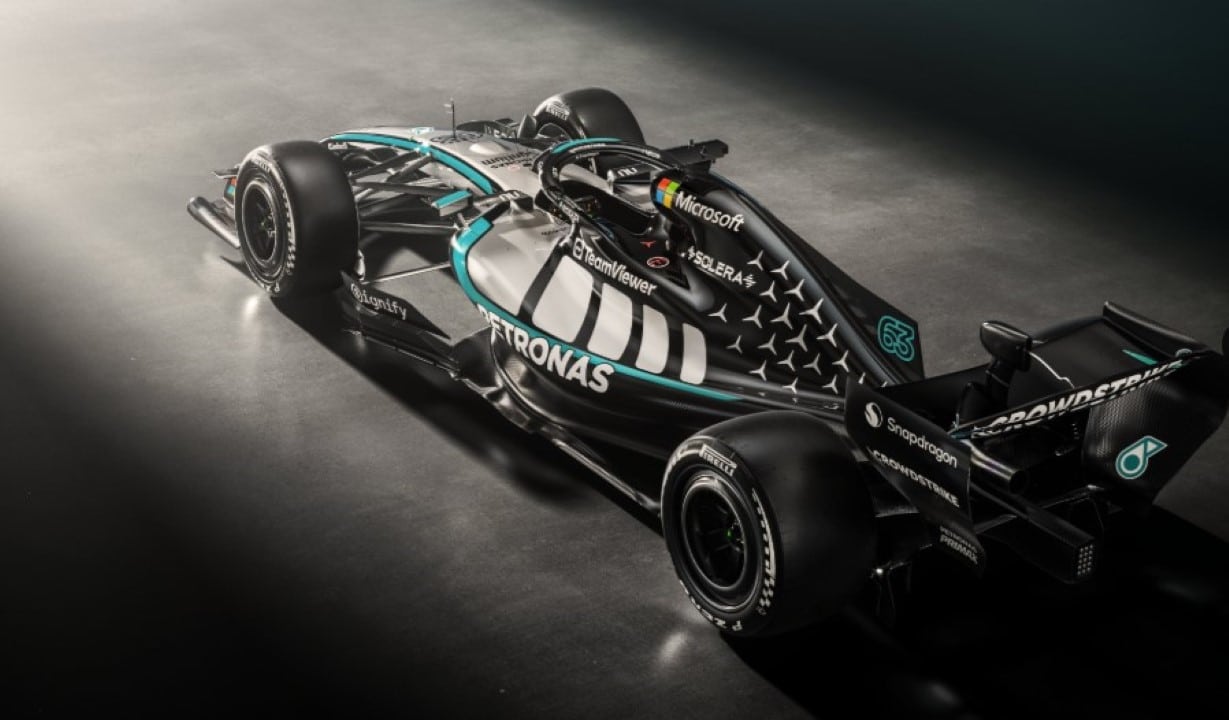
The Mercedes team surprised the world of motorsport during the shakedown of its new single-seater, the W17, held on the Silverstone circuit under unstable weather conditions. The model, developed to comply with the new technical regulations of Fórmula 1 that comes into force in 2026, presented an aerodynamic detail that was not included in the initial renderings released by the German automaker. Especialistas identified a strategic side opening in the diffuser wall, a technical solution that aims to significantly increase aerodynamic pressure at the rear of the vehicle.
This innovation comes at a time of transition, where the category abandons the pure ground effect concept to adopt an improved flat bottom. Mercedes engineering seems to have found a unique interpretation of the 2026 rules, which are considerably more restrictive regarding body geometry. The team’s main focus is to ensure that the airflow remains stable and glued to the interior surfaces, allowing the car to maintain performance even through sudden variations in height and lateral lean during high-speed cornering.
Major changes noted in the W17 design include:
- Longitudinal opening in the outer wall of the rear diffuser;
- Sidepods with deep cutouts that direct air to the rear;
- Optimized integration between the floor and brake ducts;
- Redesigned geometry to mitigate turbulence generated by tires.
Understand the mechanical functioning of the new aerodynamic slot
The concept applied by Mercedes on the W17 operates in a similar way to the flaps found on aircraft wings or on multiple elements of racing rear spoilers. By creating a gap, engineers allow high-pressure air coming from the top of the floor to penetrate the low-pressure zone inside the diffuser. Esse mechanism helps energize the airflow boundary layer, preventing it from detaching from the internal surface of the component at more aggressive tilt angles.
Without this injection of energy, the airflow tends to separate from the diffuser wall, which causes an immediate loss of downforce and makes the rider’s driving unpredictable. By keeping the air “stuck” to the part, the Mercedes is able to use a more pronounced curvature in the outlet channel, generating extra suction without the risk of aerodynamic stall. The system also acts as a shield against the phenomenon known as “tyre squirt”, which occurs when the rotation of the tires throws turbulent air into the diffuser.
Legality of technical solution challenges FIA interpretation
Federação Internacional of Automobilismo designed the 2026 rules to avoid loopholes that would allow disproportionate advantages between teams participating in the world championship. Entretanto, the regulation mentions exclusion zones and specific volumes where the body must be solid or may have small openings for ventilation. Mercedes appears to have exploited the proximity between the diffuser and the rear brake deflectors to justify removing material from the sidewall of the part.
Although the term “double diffuser” has been discarded by experts, the W17 solution is seen as a technical evolution that defies the spirit of the simplification standard. Rivals are analyzing thermal and high-resolution images captured on Silverstone to understand whether the concept undermines the required structural rigidity. Até At the moment, the FIA has not issued any technical opinion banning the component, which places the Mercedes in a position of initial theoretical advantage.
Airflow stability improves rider handling
One of the biggest benefits reported indirectly by sources linked to the team is the predictability of the car’s behavior on wavy tracks or with side winds. Quando the air flow inside the diffuser is robust, the vehicle’s center of pressure does not move erratically during braking maneuvers and cornering. Isso allows Lewis Hamilton and George Russell riders to attack the curbs with greater confidence, knowing that the rear aerodynamic load will not suddenly disappear.
The computational fluid dynamics used by Mercedes indicated that the lateral crack compensates for the losses generated by the floor reduction imposed by the new rules. The aggressive design of the sidepods, which feature a lower cutout along their entire length, serves as a funnel to feed this opening in the diffuser with clean air. Essa systemic integration between the side of the car and the rear end demonstrates a level of complexity that few teams have managed to display in the first track tests of the new generation.
Impact of innovation on tire efficiency and rain
During the wet shakedown, the effectiveness of the new system was evident through the water spray patterns observed behind the W17. Air injected through the side slit creates a pressure barrier that pushes turbulence generated by the rear tires away from the center of the diffuser. Isso preserva a integridade do vácuo sob o carro, garantindo que o desempenho não seja tão prejudicado em condições de asfalto úmido ou com alta degradação de borracha.
This aerodynamic protection also reflects on the useful life of softer compound tires, as the car slides less when exiting curves. With a more planted rear end, thermal stress on the rear tires is reduced, allowing for longer stints during long-distance races. Mercedes is betting that this efficiency will be the difference needed to regain the top of the constructors’ table against Red Bull and Ferrari.
Technical perspective on the future of aerodynamic components
The history of Fórmula 1 is marked by innovations that begin in regulatory loopholes and end up being adopted by the entire grid or summarily banned. The blown diffuser and f-duct system are classic examples of how human ingenuity overcomes the barriers imposed by the sport’s legislators. The case of the W17 once again raises the debate about how far teams can go in manipulating the air flow to obtain pure performance gains.
If the FIA definitively validates the solution before the start of the official season, it is expected that the other teams will begin an accelerated reverse engineering process. However, integrating such a slot requires a complete redesign of the side airflow, which could take months to successfully implement in other chassis. Mercedes remains silent about the telemetry data collected, but optimism in the pits of Silverstone was visible among the mechanics and technical directors.
Engineering details behind the sliced diffuser concept
The application of slots on aerodynamic surfaces is not an absolute novelty in fluid mechanics, being widely used in cargo planes for landings on short runways. In the context of a racing car at 300 km/h, the millimeter precision of the opening determines whether the system will function as a flow accelerator or as an unwanted aerodynamic brake. Mercedes used state-of-the-art supercomputers to simulate thousands of variations before manufacturing the final reinforced carbon fiber part.
The material used on the edge of the crack needs to resist extreme pressures and heat generated by its proximity to the engine’s internal components. Qualquer Minimal deformation during the race could ruin the car’s balance, resulting in lost lap time. The choice to test this component on the first day of open track demonstrates Mercedes’s confidence in the correlation between its wind tunnels and real performance in abrasive asphalt conditions.
