Photographic equipment captures the passage of the interstellar comet 3I/ATLAS with a green glow in Egypt
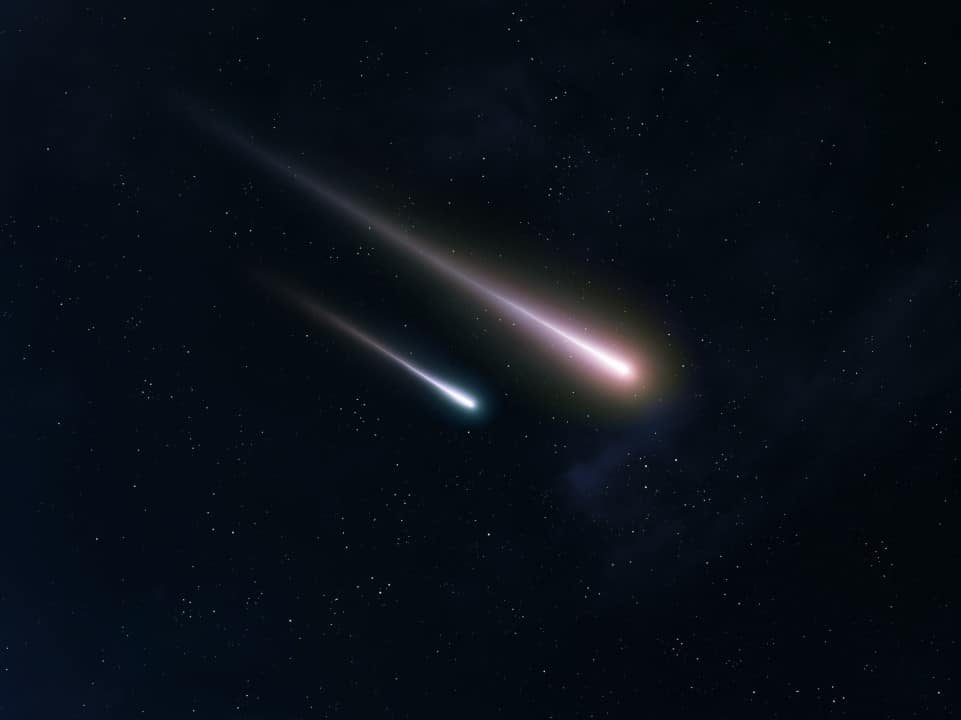
Astrophotographer Osama Fathi recorded the passage of the interstellar comet 3I/ATLAS through the night sky of Deserto Negro, in Egyptian territory. The capture occurred in the early hours of November 29, 2025, at 3 am local time. The record shows the celestial body emitting a greenish glow as it crosses a region without light pollution. The silhouettes of trees and volcanic formations make up the observation scene.
The object represents the third confirmed visitor from outside our planetary system. The space rock re-emerged into Earth’s field of view after passing behind Sol in the fall of 2025. Astrônomos track its movement during winter nights. The event offers a rare opportunity to study materials formed in other regions of the galaxy.
🚨: Photographer captures interstellar comet 3I/ATLAS glowing brilliantly over Egypt's Black Desert!🌌 pic.twitter.com/0UGUp2kpit
— All day Astronomy (@forallcurious) December 10, 2025
Hyperbolic Trajetória and origin beyond solar orbit
The ATLAS system, on Chile, performed the first detection on July 1, 2025. Calculations confirmed an extreme hyperbolic trajectory. Essa characteristic indicates that the object is not tied to the gravity of Sol. Ele travels at a speed of 58 kilometers per second. Corpos originating from Nuvem and Oort have elliptical orbits, unlike this external visitor.
The orbital dynamics of 3I/ATLAS differ from cataloged periodic comets. The object reached perihelion on October 30, 2025. Naquela date, the rock passed about 1.4 Unidade Astronômica from Sol. The high speed ensures that the comet will not be captured by the sun’s gravitational pull.
The identification consolidates a new phase in astronomy. The history began with the object 1I/’Oumuamua in 2017. Dois years later, the equipment detected the comet 2I/Borisov. 3I/ATLAS provides the third set of data on the mechanics of objects ejected from other systems. Pesquisadores estimate that the solid core could be billions of years old.
Composição chemistry and the phenomenon of gas emission
The greenish color captured in the desert results from chemical processes in the comet’s coma. Ultraviolet radiation from Sol hits the frozen core during approach. Esse heating causes immediate sublimation of volatile materials. Ice changes from a solid to a gaseous state. The release of radical cyanide gas generates the intense green glow recorded in the photograph.
The phenomenon of green light emission appears frequently in comets in our system. The presence of this signature in 3I/ATLAS confirms that the building blocks of other star systems share similarities with ours. The cloud of gas and dust expands for thousands of kilometers in a vacuum. The solar wind pushes particles away from the star.
High-resolution Telescópios tracks structural evolution since discovery. The images show classic cometary activity, with the formation of a dust tail and active coma. Spectroscopic analysis makes it possible to catalog the chemical elements trapped in primordial ice. The material preserves the conditions of the environment where the body was formed.
Equipamentos and photo capture techniques
Registering a diffuse object requires adapted equipment. Osama Fathi used an Nikon Z6 camera modified for astrophotography. The change in the sensor allows for greater light capture at specific wavelengths. The photographer attached the camera to a RedCat telescope lens. The optical assembly was zoomed three times.
The configuration resulted in an effective focal length of 750 millimeters. The astrophotographer had to compensate for the rotation of Terra to avoid blur. The work involved digitally stacking multiple photographs. Fathi took 60 exposures of 60 seconds, setting the sensitivity to ISO 1500. It then captured another 60 images with a time of 30 seconds.
The software combined the 120 photographs to reveal the details of the comet’s structure. The stacking technique reduces digital noise and highlights the coma against the space. The choice of Deserto Negro was fundamental to success. The remote region offers a night sky free from the interference of artificial lights.
Spatial Monitoramento and approach to Terra
Agências spacecraft mobilized instruments to follow the trajectory of 3I/ATLAS. Telescópio Espacial Hubble and James Webb conducted data collection campaigns in 2025. Sondas interplanetary,