

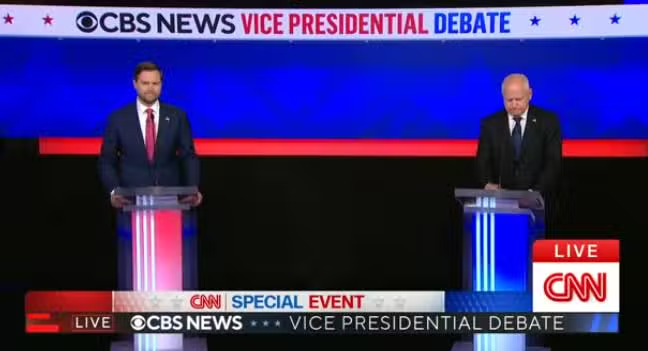
The CBS-hosted vice-presidential debate between Republican JD Vance and Democrat Tim Walz showcased sharp contrasts in policy perspectives, with both candidates focusing on divisive topics such as abortion, the economy, and immigration. The debate, held on October 1, 2024, marked a significant moment in the 2024 U.S. election, giving the audience a chance to assess the candidates’ visions for the future.
Abortion and family policy
One of the central topics of the debate was abortion. JD Vance, a staunch pro-life advocate, expressed his belief that Republicans need to rebuild public trust on this sensitive issue. Vance reiterated his opposition to late-term abortions and emphasized his desire to see policies that support families, including access to fertility treatments and affordable housing for young families. His stance reflects the GOP’s attempt to broaden its “pro-family” agenda by addressing practical challenges faced by American parents, such as affordability and housing.
On the other hand, Tim Walz countered by defending the right of women to make their own reproductive decisions, pushing back against what he saw as the Republican Party’s overreach into personal freedoms. He emphasized the importance of allowing states to set their own policies, a response to Vance’s critique of Minnesota’s abortion laws, which Vance described as too permissive in cases of botched late-term procedures. Walz refrained from detailing the specifics of Minnesota’s law during the debate but firmly maintained that reproductive rights should remain a private matter, free from governmental intervention.
Economic priorities
When it came to the economy, both candidates laid out starkly different paths forward. JD Vance positioned himself as an advocate for reducing taxes, stimulating small businesses, and creating an environment that fosters job growth. He underscored the need to eliminate bureaucratic red tape that, in his view, has hampered economic progress, particularly for the working class.
Tim Walz, however, highlighted the importance of investing in infrastructure and education as the keys to sustained economic growth. He argued that addressing inequality through targeted programs could spur long-term economic prosperity, particularly for marginalized communities. The debate revealed Walz’s focus on the social safety net and increasing public investment in critical areas such as healthcare and education, while Vance advocated for a leaner government with a focus on free market solutions.
Immigration and border control
Immigration was another focal point of the discussion. JD Vance took a hardline approach, arguing for stricter border control measures and a more aggressive stance on illegal immigration. He expressed concerns about the impact of lax immigration policies on national security and the job market, suggesting that stronger enforcement at the border is essential for protecting American workers.
Conversely, Tim Walz called for a more humane and comprehensive immigration reform. He suggested that addressing the root causes of migration, such as economic instability and violence in home countries, would provide a more sustainable solution. Walz advocated for policies that would offer pathways to citizenship for undocumented immigrants and improve the immigration system, focusing on compassion while still ensuring the nation’s security.
Key moments and rhetorical exchanges
The debate was punctuated by several memorable exchanges that highlighted the ideological chasm between the two candidates. Vance was questioned about his previous criticisms of Donald Trump, to which he admitted that his views had evolved. He attributed his past skepticism to media misrepresentations and acknowledged that his initial impressions of Trump were flawed. This moment reflected Vance’s current alignment with Trump’s policies and underscored his shift towards a more staunchly conservative platform.
Tim Walz capitalized on this moment to paint Vance as inconsistent, suggesting that his changing stance on Trump was indicative of a broader problem within the Republican Party’s leadership. Walz’s strategy throughout the debate was to present himself as a steady, principled leader who has remained true to his beliefs, contrasting with what he framed as Vance’s fluctuating positions.
Climate change and environmental policy
Climate change also featured prominently in the debate, with Vance and Walz presenting vastly different approaches to tackling the issue. JD Vance downplayed the urgency of sweeping climate regulations, arguing that over-regulation could harm the U.S. economy, particularly in the energy sector. He supported an “all of the above” energy strategy, which includes increasing the use of natural gas and other fossil fuels alongside renewable energy sources. His focus was on maintaining American energy independence and protecting jobs in industries like coal and oil.
In contrast, Tim Walz advocated for a transition to green energy, emphasizing the importance of addressing climate change through investment in renewable energy and sustainable practices. He positioned environmental policy as an opportunity to create jobs in emerging industries, such as solar and wind energy. Walz framed climate action not just as a moral imperative but as a practical economic strategy for the future, particularly in addressing the long-term effects of climate change on agriculture and infrastructure.
Closing statements and public reaction
As the debate concluded, both candidates made passionate closing statements aimed at galvanizing their respective bases. JD Vance reiterated his commitment to restoring traditional values and securing America’s borders, while Tim Walz called for a more inclusive, forward-thinking America that addresses inequality and environmental challenges.
Public reactions to the debate were mixed, with both sides claiming victory. Supporters of Vance praised his firm stance on immigration and his defense of conservative values, while Walz’s advocates appreciated his focus on social justice and economic equality. The debate underscored the stark contrast in visions for the country’s future, offering voters a clear choice in the upcoming election.
Conclusion
The CBS News vice-presidential debate between JD Vance and Tim Walz served as a microcosm of the broader ideological divides shaping the 2024 U.S. election. With critical issues like abortion, the economy, and immigration at the forefront, the debate offered voters a glimpse into the candidates’ contrasting visions for America. As election day approaches, the outcome of this debate may play a pivotal role in swaying undecided voters in what is shaping up to be a tightly contested race