
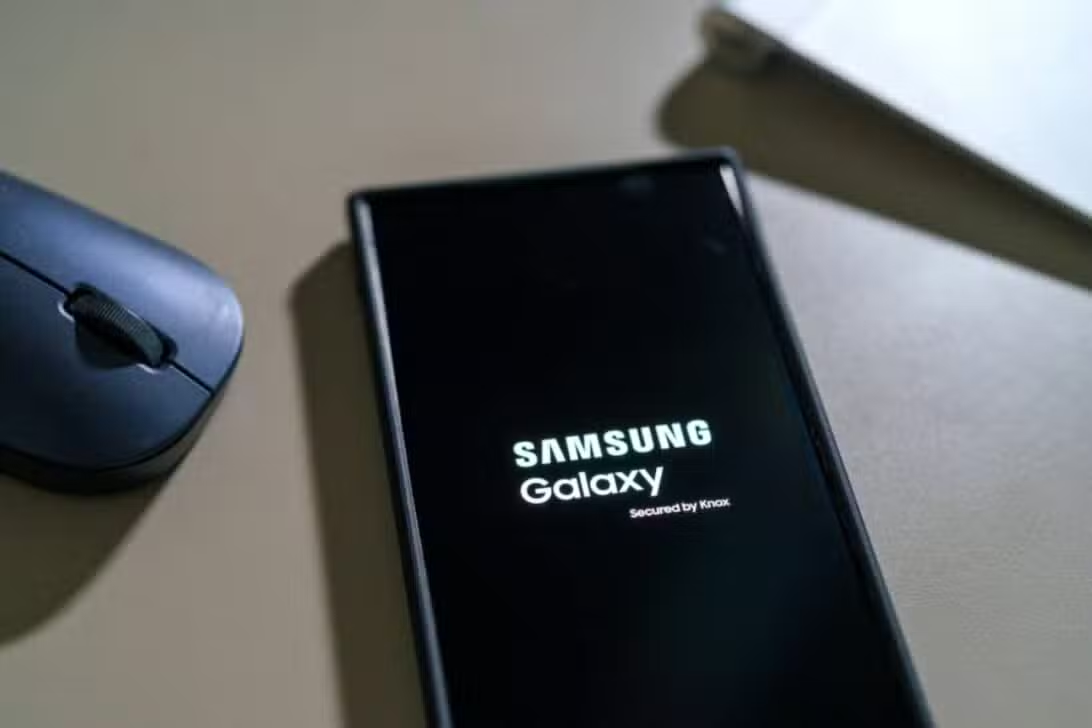
The rivalry between Apple and Samsung reached new heights in 2025 with the release of the iPhone 16 and the Samsung Galaxy S25, two flagship smartphones that promise cutting-edge performance, advanced cameras, and groundbreaking artificial intelligence (AI) features. Launched in September 2024, the iPhone 16 leverages the seamless integration of Apple’s ecosystem and the optimized A18 chip, while the Galaxy S25, unveiled in January 2025, shines with the Snapdragon 8 Elite processor and the AI-packed One UI 7 interface. Both devices boast vibrant displays, sleek designs, and long-lasting batteries, but they differ in critical areas like refresh rates, camera capabilities, and pricing, making the decision a matter of personal preference. With starting prices of $799 for the iPhone 16 and $899 for the Galaxy S25 in global markets, consumers face a tough choice: which device offers the best value for money? This in-depth comparison explores specifications, features, and practical tips to guide your decision, covering everything from design to gaming performance and everyday usability.
The iPhone 16 retains Apple’s signature aesthetic, featuring flat edges, a glass back, and Ceramic Shield protection, while the Galaxy S25 introduces a more compact design with no protruding camera module and Gorilla Glass Victus 2 durability. The S25’s 6.2-inch display with a 120 Hz refresh rate delivers smoother visuals compared to the iPhone 16’s 6.1-inch panel, which remains capped at 60 Hz, though it supports Dolby Vision for superior color accuracy.
Performance-wise, the iPhone 16’s A18 chip excels in single-core tasks, while the S25’s Snapdragon 8 Elite leads in multitasking and AI processing. Camera systems also spark debate: the S25 includes a telephoto lens with 3x optical zoom, whereas the iPhone 16 prioritizes color consistency and 4K cinematic video recording. These distinctions shape the user experience, catering to different needs and preferences.
- Smooth display: Galaxy S25 offers 120 Hz vs. iPhone 16’s 60 Hz.
- Versatile cameras: S25 includes telephoto; iPhone 16 excels in video.
- Performance edge: A18 shines in single-core; Snapdragon 8 Elite in multi-core.
- Pricing: iPhone 16 starts at $799; S25 at $899 globally.
Design and build: style meets durability
The Galaxy S25 showcases Samsung’s design evolution in 2025, with a sleek, compact form factor measuring 7.3 mm in thickness and weighing 168 grams. Its rear cameras are flush with the chassis, eliminating the traditional raised module for a modern, minimalist look. The aluminum frame, paired with a glass back and Gorilla Glass Victus 2, ensures resistance to drops and scratches. With an IP68 rating, the S25 withstands submersion in up to 1.5 meters of freshwater for 30 minutes. Available in subdued colors like Light Green, Navy Blue, Classic Gray, and Ice White, it appeals to users seeking understated elegance.
In contrast, the iPhone 16 adheres to Apple’s iconic design, featuring flat edges and a raised camera module. At 7.8 mm thick and 173 grams, it’s slightly heavier than the S25. The Ceramic Shield front and glass back, combined with an aluminum frame, provide robust durability, also backed by an IP68 rating. Vibrant color options, including Black, White, Pink, Green, and Blue, cater to those who prefer a bold aesthetic. The Dynamic Island, housing the front camera and sensors, remains a prominent feature but takes up more screen space than the S25’s centralized punch-hole.
Both smartphones prioritize ergonomics, but the S25’s lighter, slimmer build makes it ideal for one-handed use. The iPhone 16, however, integrates seamlessly with Apple’s ecosystem, supporting accessories like MagSafe cases for added convenience. Your choice hinges on whether you prefer the S25’s minimalism or the iPhone 16’s established Apple identity.
Display: fluidity versus visual precision
The Galaxy S25’s display is a standout, featuring a 6.2-inch Dynamic AMOLED 2X panel with Full HD+ resolution (2340 x 1080 pixels) and a variable refresh rate of 1 to 120 Hz. This ensures buttery-smooth scrolling, gaming, and animations. With a peak brightness of 2,600 nits, the screen remains visible in bright sunlight, and HDR10+ support delivers rich colors and deep contrasts. The Gorilla Glass Victus 2 protection enhances durability, and a 91.1% screen-to-body ratio minimizes bezels for an immersive experience.
The iPhone 16 sports a 6.1-inch Super Retina XDR OLED display with a slightly higher resolution of 2556 x 1179 pixels. However, its fixed 60 Hz refresh rate is a drawback in 2025, especially for a premium smartphone, resulting in less fluid transitions compared to the S25. The display reaches a peak brightness of 2,000 nits, sufficient for outdoor use, and supports Dolby Vision and HDR10 for cinematic visuals. The Ceramic Shield offers comparable durability to Gorilla Glass, but the Dynamic Island reduces the screen-to-body ratio to 86.8%.
For users prioritizing fluidity and brightness, the Galaxy S25 is the clear winner. However, the iPhone 16 excels for those who value precise color calibration and superior image quality for audiovisual content, particularly on platforms like Netflix and Apple TV+.

Performance: power and optimization
Equipped with the Snapdragon 8 Elite for Galaxy, a 3 nm processor with a clock speed of up to 4.47 GHz, the Galaxy S25 delivers exceptional performance. Paired with 12 GB of RAM and UFS 4.0 storage options of 128 GB, 256 GB, or 512 GB, it outpaces the iPhone 16 in multi-core benchmarks like Geekbench 6, scoring around 10,223 compared to 8,553. This advantage shines in multitasking, video editing, and AI-driven tasks. Running Android 15 with the One UI 7 interface, the S25 offers extensive customization and integrates Galaxy AI features, such as generative image editing and an advanced voice assistant.
The iPhone 16 is powered by the A18 chip, also built on a 3 nm process, with 8 GB of RAM and storage options of 128 GB, 256 GB, or 512 GB. In single-core tests, the A18 leads with 3,457 points compared to the S25’s 3,220, excelling in quick tasks like app launches and browsing. The iOS 18 operating system ensures smooth performance and tight integration with Apple’s ecosystem, though the Apple Intelligence suite, introduced in 2024, remains limited to English and lags behind Galaxy AI in functionality. For gaming, the iPhone 16 benefits from exclusive AAA titles on the App Store, like Resident Evil 4, optimized for its GPU.
Both devices handle daily tasks effortlessly, but the S25 is better suited for raw power and multitasking, while the iPhone 16 excels in optimization and exclusive gaming experiences. The decision depends on your preferred operating system and specific use cases.
- Snapdragon 8 Elite: Leads in multitasking and AI processing for the S25.
- A18 chip: Dominates single-core tasks and iOS integration for the iPhone 16.
- RAM advantage: S25 offers 12 GB vs. iPhone 16’s 8 GB.
- Operating systems: One UI 7 (Android 15) vs. iOS 18.
Cameras: versatility meets consistency
The Galaxy S25’s camera system features a 50 MP main sensor (f/1.8, OIS), a 12 MP ultrawide (f/2.2), and a 10 MP telephoto lens (f/2.4, 3x optical zoom). Its 12 MP front camera (f/2.2) produces sharp selfies. The S25 excels with its telephoto lens for zoomed shots and Nightography mode for low-light photography. The ProVisual engine balances colors, reducing the oversaturation seen in earlier models, though images lean toward warmer tones. It supports 8K video recording, ideal for content creators, and Galaxy AI-powered features like Object Eraser remove unwanted elements from photos with precision.
The iPhone 16 is equipped with a 48 MP main camera (f/1.6), a 12 MP ultrawide (f/2.2), and a 12 MP front camera. Lacking a telephoto lens, it offers 2x optical zoom and up to 10x digital zoom, maintaining quality in well-lit conditions. Known for consistent colors and sharpness, the iPhone 16 produces neutral-toned photos favored by professional photographers. Its 4K cinematic mode with adjustable depth is a standout for video, and advanced stabilization ensures smooth footage. While Apple Intelligence enables photo editing, it’s less sophisticated than Galaxy AI.
The S25 is the better choice for zoom and versatility, while the iPhone 16 leads in video recording and photographic consistency, making it ideal for social media and content production.
Battery and charging
The Galaxy S25 houses a 4,000 mAh battery, supporting 25W fast charging, 15W wireless charging, and 4.5W reverse wireless charging. In tests, it lasts up to 24 hours with moderate use, reaching 65% charge in 30 minutes. The Snapdragon 8 Elite’s efficiency ensures solid endurance, even for demanding tasks like gaming and streaming.
The iPhone 16 has a 3,561 mAh battery with 20W fast charging and 15W MagSafe wireless charging. Despite its smaller capacity, the A18 chip and iOS 18 optimization deliver up to 22 hours of usage, with 50% charge in 30 minutes. The lack of reverse charging is a notable drawback compared to the S25.
The S25 offers superior battery capacity and charging speed, while the iPhone 16 compensates with energy efficiency. For users needing fast charging, the S25 is more practical; for those prioritizing optimized battery life, the iPhone 16 suffices.
Artificial intelligence: Galaxy AI vs. Apple Intelligence
Galaxy AI, integrated into the S25, is a highlight, offering features like real-time Interpreter, Circle to Search, and generative image editing. The Object Eraser tool, for instance, removes people or objects from photos with realistic results, outshining the iPhone 16’s equivalent. Paired with Google’s Gemini AI, the S25’s assistant excels in tasks like summarizing emails and organizing files, providing a more intuitive experience.
Apple Intelligence, available on the iPhone 16, focuses on iOS 18 integration, offering photo editing, text summarization, and voice-activated settings adjustments. However, it’s still in early stages, limited to English, and lacks the breadth of Galaxy AI’s features. Future iOS updates may enhance its capabilities, but in 2025, Samsung holds the lead in AI functionality.
- Galaxy AI: More mature, with advanced editing and intuitive assistant.
- Apple Intelligence: Limited to English, focused on iOS integration.
- Features: S25 includes Interpreter and Circle to Search.
- Future potential: Apple Intelligence may improve with iOS updates.
Pricing and value for money
Globally, the Galaxy S25 starts at $899 (128 GB), $999 (256 GB), and $1,099 (512 GB), though discounts have brought it as low as $750 in some markets. The iPhone 16, launched at $799 (128 GB), $899 (256 GB), and $999 (512 GB), has seen faster depreciation, with prices dropping to $650 in promotions. The iPhone 16’s lower starting price and higher resale value make it attractive, but the S25’s superior specs, like 12 GB RAM and 120 Hz display, offer better value at similar price points.
The iPhone 16 benefits from up to six years of iOS updates, while the S25 guarantees seven years of Android updates. For cost-conscious buyers, the S25 provides more features for the price; for Apple ecosystem users, the iPhone 16 is the natural choice.
Tips for choosing between iPhone 16 and Galaxy S25
Selecting between the iPhone 16 and Galaxy S25 depends on your priorities. Here are some tips to guide your decision.
- Ecosystem: Choose the iPhone 16 if you use Apple devices like Mac or iPad.
- Smooth display: Opt for the S25 for gaming and scrolling with 120 Hz.
- Cameras: Pick the iPhone 16 for video; S25 for zoom and versatility.
- Budget: Compare deals, as both are priced similarly in 2025.
- AI features: Select the S25 for advanced AI capabilities.
Launch and update timeline
The releases of the iPhone 16 and Galaxy S25 marked key moments in the 2025 smartphone market.
- September 2024: iPhone 16 and iPhone 16 Pro Max launched.
- January 2025: Galaxy S25 series unveiled at Galaxy Unpacked.
- March 2025: Security patch update for Galaxy S25 rolled out globally.
- June 2025: Expected iOS 18 update with Apple Intelligence enhancements.
Unique advantages of each model
The Galaxy S25 stands out with features like DeX mode, turning the phone into a desktop, and Wi-Fi 7 support, faster than the iPhone 16’s Wi-Fi 6. The One UI 7 interface offers extensive customization, appealing to users who want a tailored experience.
The iPhone 16 includes the customizable Action Button for quick tasks and the Dynamic Island for interactive notifications. Its ecosystem integration, with features like AirDrop and iCloud, is a draw for Apple users. The iPhone 16 also delivers superior audio quality with stereo speakers and Dolby Atmos.
Impact on the smartphone market
The competition between the iPhone 16 and Galaxy S25 has driven significant sales for both brands in 2025. The Galaxy S25 series tripled sales compared to the S24 in its first month, while the iPhone 16, despite a 41.2% depreciation in value, retains a loyal customer base. These devices have raised the bar for premium smartphones, emphasizing AI and performance, prompting competitors like Xiaomi and Google to invest in similar technologies.
The choice between the two reflects not only technical preferences but also brand loyalty and specific needs, such as photography, gaming, or productivity. With competitive pricing and frequent promotions, the global market benefits from this rivalry.
- Record sales: Galaxy S25 triples S24 sales in first month.
- Depreciation: iPhone 16 loses 41.2% value in one month.
- Innovation: AI and performance redefine premium smartphones.
- Competition: Xiaomi and Google follow Apple and Samsung trends.