Verstappen matches Schumacher’s Ferrari podiums: Numbers reveal F1’s dominant eras

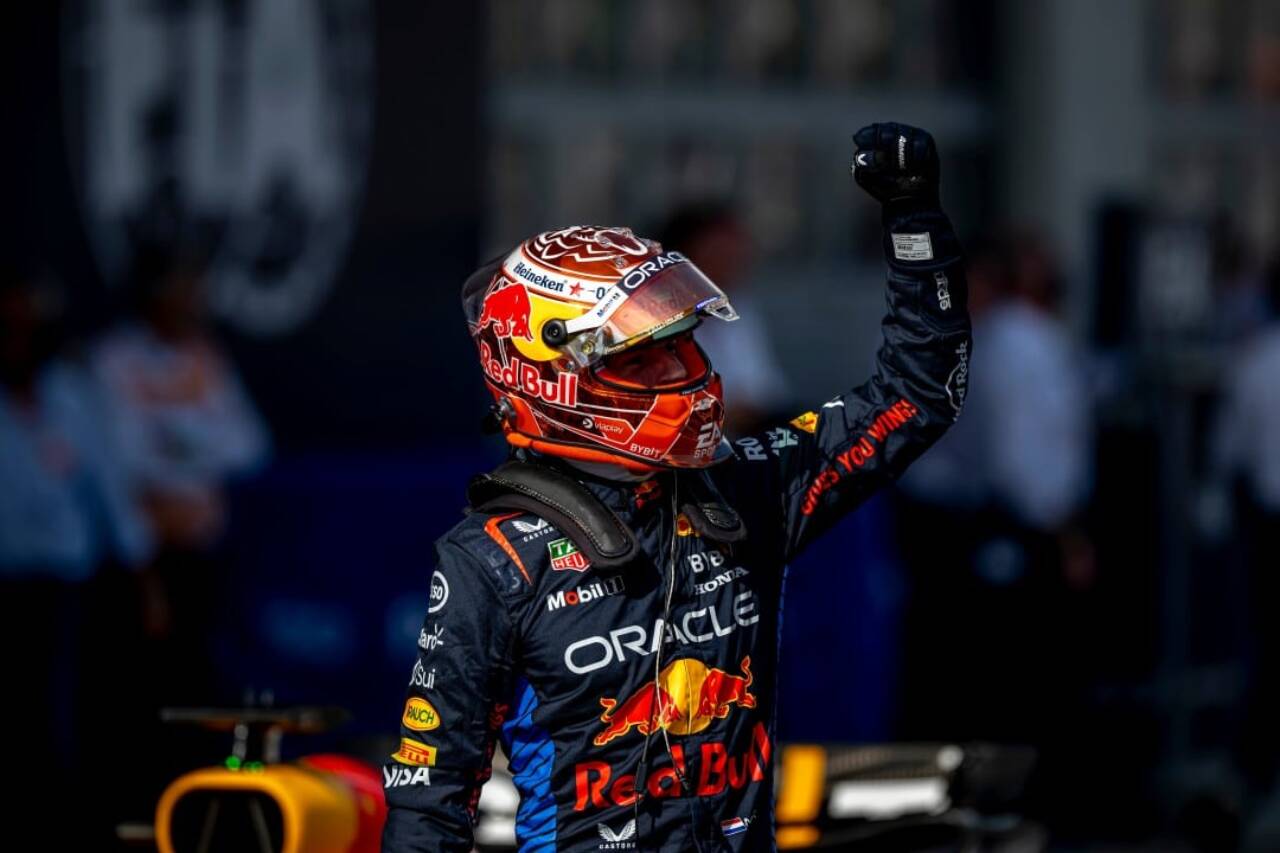
Max Verstappen’s victory at the Emilia Romagna Grand Prix, held in Imola, marked a historic moment in Formula 1. The Dutch driver secured his 116th podium with Red Bull, equaling the number of podiums Michael Schumacher achieved during his Ferrari tenure. This milestone underscores not only Verstappen’s consistency but also echoes the dominance of Schumacher’s era at Ferrari. Comparing the two drivers reveals striking parallels, yet differences shaped by distinct rules, contexts, and scoring systems.
At 27, the four-time champion Verstappen has built his career in a highly competitive era, with advanced cars and tighter grids. Schumacher, from 1996 to 2006, transformed Ferrari into a powerhouse, clinching five world titles. Both drivers share an ability to push their teams to new heights, setting benchmarks for excellence in the sport.
To grasp the significance of this podium tie, the numbers behind their careers are revealing. Key stats include:
- Wins: Schumacher amassed 72 victories at Ferrari, while Verstappen has 65 with Red Bull.
- Titles: The German secured 5 championships, compared to Verstappen’s 4 so far.
- Pole positions: Schumacher leads with 58, against Verstappen’s 43.
- Retirements: Verstappen has 26, while Schumacher faced 32.
These figures, while impressive, must be viewed through the lens of evolving F1 regulations, particularly in scoring systems.
Records across different eras
Comparing Verstappen and Schumacher requires understanding their respective eras. From 1996 to 2006, Formula 1 used a scoring system awarding 10 points to the winner, with points tapering down to the sixth-placed driver. Since 2010, the system shifted, granting 25 points to the victor, inflating point totals for modern drivers like Verstappen. This explains why Schumacher’s 988 points at Ferrari are remarkable, while Verstappen’s 3,085.5 points reflect longevity in a more generous system.
The number of races per season has also grown. In Schumacher’s era, championships featured 16 to 18 grands prix annually. Today, with calendars exceeding 20 races, Verstappen has more chances to rack up podiums and points. Yet, their success rates are comparable: Schumacher reached the podium in 64.8% of his Ferrari races, while Verstappen achieved 60.1% with Red Bull.
Car reliability is another factor. In the 1990s and early 2000s, mechanical failures caused frequent retirements. Schumacher had 32 retirements in 179 races, often due to technical issues. Verstappen, racing in an era of greater reliability, has only 26 retirements in 193 races. This technological progress boosts Verstappen’s stats but doesn’t diminish Schumacher’s impact in his time.
Schumacher’s defining moments
Michael Schumacher’s Ferrari journey was punctuated by trials that tested his resilience. In 1997, he sparked controversy at the European Grand Prix in Jerez. Trying to block Jacques Villeneuve, Schumacher veered into his rival’s car. The move backfired: Villeneuve finished third, clinching the title, while Schumacher was disqualified from the championship, losing all points for that season, though his wins and podiums still count.
In 1999, another setback struck. At the British Grand Prix in Silverstone, a brake failure caused Schumacher to crash into a tire barrier, fracturing his right leg. Sidelined for six races, he returned in October, racing in two more grands prix that year. These incidents highlight the challenges Schumacher overcame, unlike Verstappen, who has yet to face similar disruptions.
Schumacher’s challenges extended beyond the track. When he joined Ferrari in 1996, the team hadn’t won a drivers’ title since 1979. Alongside technical director Ross Brawn and team principal Jean Todt, Schumacher rebuilt Ferrari into a juggernaut, securing five consecutive titles from 2000 to 2004. His off-track leadership was as pivotal as his driving.

Verstappen’s meteoric rise
Max Verstappen entered Formula 1 as a prodigy. Debuting with Toro Rosso in 2015 at age 17, he showcased raw speed and aggression. In 2016, after just three races, he joined Red Bull and won the Spanish Grand Prix on his debut with the team. At 18, he became the youngest race winner in F1 history, a record he still holds.
Unlike the struggling Ferrari of 1996, Red Bull was already a top team when Verstappen arrived, having won four straight titles with Sebastian Vettel from 2010 to 2013. Verstappen elevated the team further, particularly since 2021, when he began contending for championships consistently. His rivalry with Lewis Hamilton that year, culminating in the controversial Abu Dhabi Grand Prix, ushered in a new F1 era.
Verstappen’s stats reflect his rapid ascent. In 193 races with Red Bull, he has 65 wins, 43 poles, and 34 fastest laps. His 33.7% win rate is close to Schumacher’s 40.2% at Ferrari, despite racing in more competitive fields. Since 2021, Verstappen has won 45 races, cementing his dominance in the modern era.
Scoring system differences
Formula 1’s scoring changes are key to understanding the drivers’ stats. Until 2002, winners earned 10 points, with 6 for second and 4 for third. In 2003, the system adjusted, awarding 8 points for second and 6 for third. Since 2010, the current system gives 25 points to the winner, 18 to second, and 15 to third. From 2019 to 2024, a bonus point was awarded for the fastest lap, but this was discontinued in 2025.
These changes explain the point gap. Schumacher earned 988 points in 179 races, while Verstappen has 3,085.5 in 193 races. If the 25-point system applied to Schumacher’s era, his totals would be much higher. Conversely, Verstappen benefits from longer calendars and higher points, amplifying his numbers.
Consider these comparisons:
- Schumacher in 2000: Won 9 of 17 races, earning 108 points in the old system. In today’s system, he’d have roughly 225 points.
- Verstappen in 2023: Won 19 of 22 races, totaling 575 points. In the old system, he’d have about 190 points.
- Races per season: Schumacher averaged 17 races per year, while Verstappen faces 22 or more.
These adjustments show that while raw numbers favor Verstappen, Schumacher’s efficiency was equally remarkable.
Team dynamics and success
Ferrari under Schumacher and Red Bull under Verstappen represent two models of F1 success. Schumacher’s Ferrari became nearly unbeatable from 2000 to 2004, with the German winning 72 races, including 11 in 2002 alone. However, Ferrari’s early years were plagued by reliability issues, leading to frequent retirements.
Red Bull, when Verstappen joined, was already a frontrunner. Designer Adrian Newey’s work crafted highly competitive cars, especially after the 2022 aerodynamic rule changes. Verstappen’s 19 wins in 2023, a single-season record, came with the dominant RB19 car. Unlike Schumacher, who faced strong rivals like McLaren and Williams, Verstappen competes against a more balanced field, including Ferrari, Mercedes, and McLaren.
Pit stop strategies have also evolved. In Schumacher’s era, refueling stops required complex planning. Today, with refueling banned, tire changes are quicker, often under two seconds, benefiting Verstappen. These differences highlight how each era’s conditions shape results.
Career-defining incidents
Schumacher’s career was rife with controversy and crashes. Beyond the 1997 Jerez incident, he faced scrutiny in 1994, colliding with Damon Hill in Australia to secure his first title. In 2006, at Monaco, he was penalized for allegedly stopping on track during qualifying to block rivals.
Verstappen, while less embroiled in scandals, has had tense moments. His 2021 battles with Hamilton led to crashes in Silverstone and Monza, with both drivers trading blame. In Saudi Arabia, Verstappen faced penalties for aggressive moves, but he clinched the title in Abu Dhabi. Both drivers, in pursuit of victory, pushed regulatory boundaries.
Notable incidents include:
- Schumacher, 1998: Lost the title to Mika Hakkinen after a start-line issue in Japan.
- Verstappen, 2021: Crashed out in Silverstone after contact with Hamilton but won the championship.
- Schumacher, 2003: Overcame a pit stop fire in Austria to finish third.
- Verstappen, 2020: Retired in Sakhir after a start-line crash but won the next race in Abu Dhabi.
These moments underscore their ability to rebound from setbacks.
Technological evolution in F1
Formula 1 has transformed between Schumacher’s and Verstappen’s eras. In the 1990s, cars used V10 engines with minimal electronics, demanding precise driving on less safe tracks. Schumacher excelled at circuits like Spa and Monza, where his skill shone. Today’s hybrid cars feature energy recovery systems and advanced aerodynamics, requiring different expertise.
Verstappen benefits from cutting-edge simulators, enabling precise strategy and track preparation. Schumacher relied on real-world testing, constrained by costs and rules. Safety has also improved: post-1994, after Ayrton Senna’s fatal crash, measures like the halo protected drivers, including Verstappen in his 2021 Silverstone crash.
Tracks have evolved too. Imola, where Verstappen won in 2025, is safer and wider than the version Schumacher raced. These changes show Verstappen operates in a more controlled environment, while Schumacher navigated riskier conditions.
Legacy of the two drivers
The Verstappen-Schumacher comparison transcends numbers. Schumacher redefined Ferrari, amassing a global fanbase and setting a dominance benchmark. His 72 Ferrari wins remain a historic milestone. Verstappen is crafting his legacy at Red Bull, with potential to break more of Schumacher’s records, like the number of titles.
Their popularity reflects their times. Schumacher was a near-mythical figure with limited media exposure. Verstappen, active on platforms like X, engages fans directly. While cultural contexts differ, their greatness is undeniable.
Verstappen’s future challenges include sustaining dominance in a tightening field, with McLaren and Ferrari gaining ground. Schumacher thrived against rivals like Hakkinen and Alonso, proving his adaptability. Their shared ability to evolve explains their stellar stats.
Records yet to be broken
While Verstappen matched Schumacher’s Ferrari podiums, other records of the German remain out of reach. Schumacher’s 91 career wins (72 at Ferrari) surpass Verstappen’s 65. His seven titles, tied with Hamilton, are a target Verstappen, with four, could hit in time.
Verstappen’s records, meanwhile, reflect the modern era. He’s the youngest to win a race, score points, and lead a grand prix. His 19 wins in 2023 are unmatched in a single season. With years ahead, Verstappen could eclipse more historical marks.
Key records include:
- Schumacher: Most wins in a Ferrari season (11, 2002).
- Verstappen: Most wins in a modern F1 season (19, 2023).
- Schumacher: Most consecutive titles (5, 2000-2004).
- Verstappen: Highest win percentage in a season (86.4%, 2023).
These stats show Verstappen’s progress, but Schumacher’s legacy remains a towering challenge.