Fifa slashes Club World Cup 2025 ticket prices to boost attendance
The 2025 Club World Cup, kicking off on June 14 in the United States, has seen sluggish ticket sales, prompting Fifa to slash prices by up to 80% for the opening match between Inter Miami and Al Ahly, set for this Saturday at Hard Rock Stadium in Miami. Tickets that once cost 359 dollars (about R$1,945) now start at 69 dollars (R$385), with students offered seats for as low as 20 dollars (R$111). The move aims to fill stadiums for the 32-team tournament, featuring Brazilian clubs Palmeiras, Flamengo, Fluminense, and Botafogo. Fifa’s strategy underscores efforts to ensure a strong turnout for a competition aiming to cement its place in global football.
Ticket sales have fallen short of expectations. For the opener featuring Lionel Messi, fewer than 20,000 tickets have been sold for a 65,000-capacity venue. Fifa has introduced promotions, including up to four complimentary tickets for local students.
- Key matches: Beyond the opener, games like Boca Juniors vs. Bayern Munich and Flamengo vs. Chelsea are drawing interest.
- Stadium sizes: The 12 venues, including MetLife Stadium for the final, range from 30,000 to 82,000 seats.
- Brazilian teams: Palmeiras, Flamengo, Fluminense, and Botafogo represent Brazil.
The price cuts come days before the tournament, running from June 14 to July 13, signaling a push to engage fans in a competitive US market.
Focus on the opening match
The Inter Miami vs. Al Ahly game on June 15 is Fifa’s priority to drive ticket sales. Hard Rock Stadium, with 65,326 seats, still has significant availability. Lionel Messi’s star power was expected to sell out the venue, but high initial prices deterred fans. Dropping the cheapest tickets from 359 dollars to 69 dollars—a 80% reduction—and offering 20-dollar seats to students aim to boost local attendance.
Fifa has also lowered prices for other group-stage matches, with no games sold out, per the official ticketing site. The tournament, hosted across 12 stadiums in 11 US cities like Atlanta, Seattle, and New York, targets both local and international fans, particularly from South America and Europe.
Pricing strategy shift
Fifa’s price reductions reflect an effort to align with the US market, where soccer competes with basketball, American football, and baseball. Initially, group-stage tickets ranged from 140 to 359 dollars, with final match seats reaching 4,000 dollars. After low sales, Fifa introduced cheaper options, with some sectors now 75% less expensive.
- Original prices: Group-stage tickets started at 140 dollars; finals reached 4,000 dollars.
- New prices: General admission starts at 69 dollars, with student tickets at 20 dollars.
- Average cuts: 70-80% reductions for group-stage games.
- Final tickets: Still pricey but discounted in select areas.
Promotional packages, like extra tickets for opening match buyers, aim to increase stadium occupancy.
Direction Los Angeles ! ✈️🇺🇸@qatarairways – @FIFACWC 🏆 pic.twitter.com/8JObY0WaZT
— Paris Saint-Germain (@PSG_inside) June 10, 2025
Challenges in the US market
Soccer’s growing popularity in the US, fueled by the MLS, still faces hurdles in drawing crowds for club events. The Club World Cup, a precursor to the 2026 World Cup, competes with established sports. High initial prices misjudged fan expectations, and the vast distances between host cities, like Seattle and Miami, complicate travel for multi-game attendees. Fifa is banking on local promotions and stars like Messi to shift the tide.
Fifa’s response to concerns
Fifa president Gianni Infantino, speaking Tuesday, dismissed worries about ticket sales, claiming Hard Rock Stadium will be full for the opener. He emphasized the participation of top clubs like Real Madrid, Manchester City, and Bayern Munich, alongside Brazilian teams, to highlight the tournament’s global appeal.
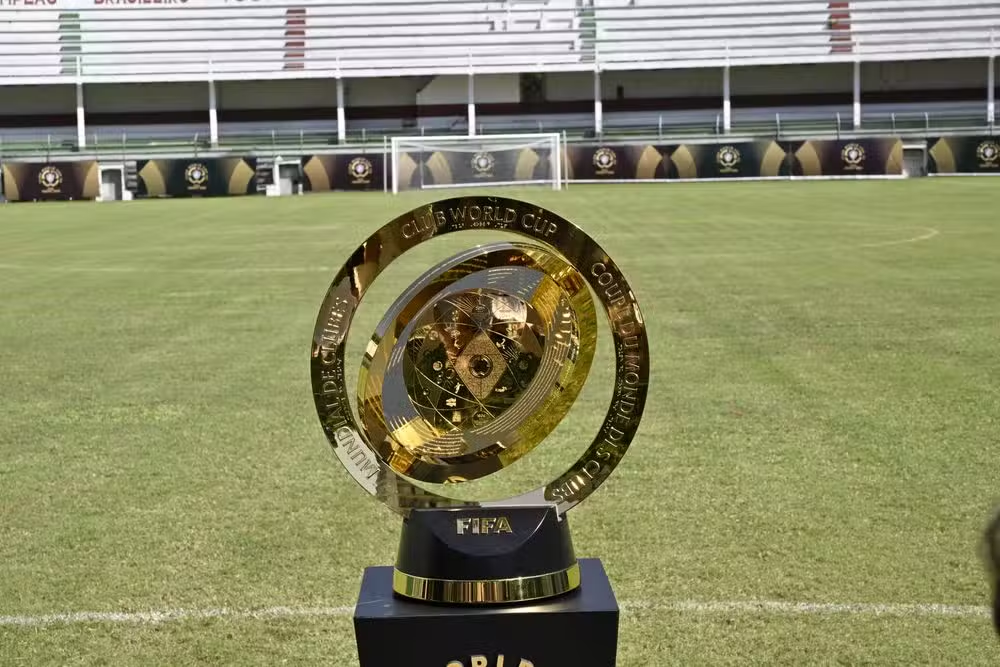
Yet, the price cuts tell a different story. Fifa has ramped up marketing, focusing on social media and university partnerships to reach younger fans. The tournament trophy, designed by Tiffany & Co., will tour cities like São Paulo and Rio de Janeiro to build excitement.


Brazilian clubs’ role
Brazil’s four representatives—Palmeiras, Flamengo, Fluminense, and Botafogo—have confirmed group-stage schedules. Palmeiras faces Porto at MetLife Stadium, while Flamengo takes on Espérance Tunis in Philadelphia. Fluminense and Botafogo play in major venues like Atlanta’s Mercedes-Benz Stadium and Seattle’s Lumen Field.
Low ticket sales could limit visibility for Brazilian clubs, which rely on large domestic fanbases and US-based expatriates. Fifa hopes cheaper tickets will draw South American supporters, especially for high-profile games like Flamengo vs. Chelsea.
Venue and logistics
The tournament spans 12 stadiums, five of which will host the 2026 World Cup. MetLife Stadium, set for the July 13 final, holds over 82,000 fans and has hosted events like the Super Bowl. Other key venues include the Rose Bowl in Los Angeles and Mercedes-Benz Stadium in Atlanta.
- Main stadiums: MetLife Stadium (final), Hard Rock Stadium (opener), Mercedes-Benz Stadium.
- Host cities: Atlanta, Charlotte, Cincinnati, Los Angeles, Miami, Nashville, New York, Orlando, Philadelphia, Seattle, Washington D.C.
- Average capacity: 30,000 to 82,000 per venue.
- Geographic spread: Most venues are on the East Coast, with a few in the West.
Fifa has secured training bases at universities and sports centers for team preparations.
Enhancing fan experience
Beyond price cuts, Fifa is improving the fan experience. The ticketing website has been streamlined, and hospitality packages are now more affordable. Fan zones and trophy displays are planned in host cities to draw crowds.
Stars like Messi, Rodrygo (Real Madrid), and others are central to Fifa’s promotional push. The organization expects lower prices and elite teams to drive attendance in the coming weeks.
Final preparations
With the tournament nearing, Fifa is finalizing details. A special transfer window from June 1-10 allowed clubs to register new players, with squads ranging from 26 to 35 athletes. Rules include a two-yellow-card suspension, reset at the quarterfinals.
The format features eight groups of four teams, with the top two advancing to the knockout rounds. The July 13 final aims to cap a tournament striving to become a premier club competition.
Prize money details
Fifa set a 1-billion-dollar prize pool (R$5.8 billion), with the winner potentially earning 125 million dollars (R$713 million). Brazilian clubs are guaranteed 15.21 million dollars (R$86 million) for participating, with more for advancing.
- Total prize pool: 1 billion dollars across 32 teams.
- Brazilian share: At least 15.21 million dollars per club.
- Winner’s prize: Up to 125 million dollars.
- Distribution: Based on continent and sporting/commercial rankings.
The financial incentives are significant, but Fifa’s focus is on global exposure for future growth.
Veja Tambem em EUA

Pesquisa no Texas aponta republicanos à frente para governador e procurador-geral, democratas em vantagem mínima no Senado

EUA atacam radares iranianos; Irã responde com mísseis a base americana no Kuwait, em nova escalada

Homem morre sete dias após ser baleado por proprietário em imóvel invadido em Oklahoma City, EUA

Incêndio devasta The Tiny Turtle e afeta dois negócios na Minutemen Causeway em Cocoa Beach

Diferença no benefício médio do Social Security entre 62, 67 e 70 anos chega a 60% em 2026

Pesquisa aponta que 69% dos trabalhadores nos EUA temem não economizar o suficiente para a aposentadoria

Gerenciamento de US$ 2 milhões a US$ 5 milhões em aposentadoria: milionários enfrentam desafios inesperados, revela análise

Agente do ICE, Christian Castro, é detido no Texas por tiroteio e falso testemunho em Minneapolis

Justiça federal condena ex-superintendente de Des Moines a 2 anos de prisão por falsa cidadania americana

M&M’s anuncia parceria com Love Island USA e lança pacotes interativos temáticos da série

Aumento da gasolina nos EUA: americanos ajustam rotinas, diminuem viagens e buscam alternativas para economizar