
Amazon boosts Kuiper Project with 27 new satellites launched into orbit
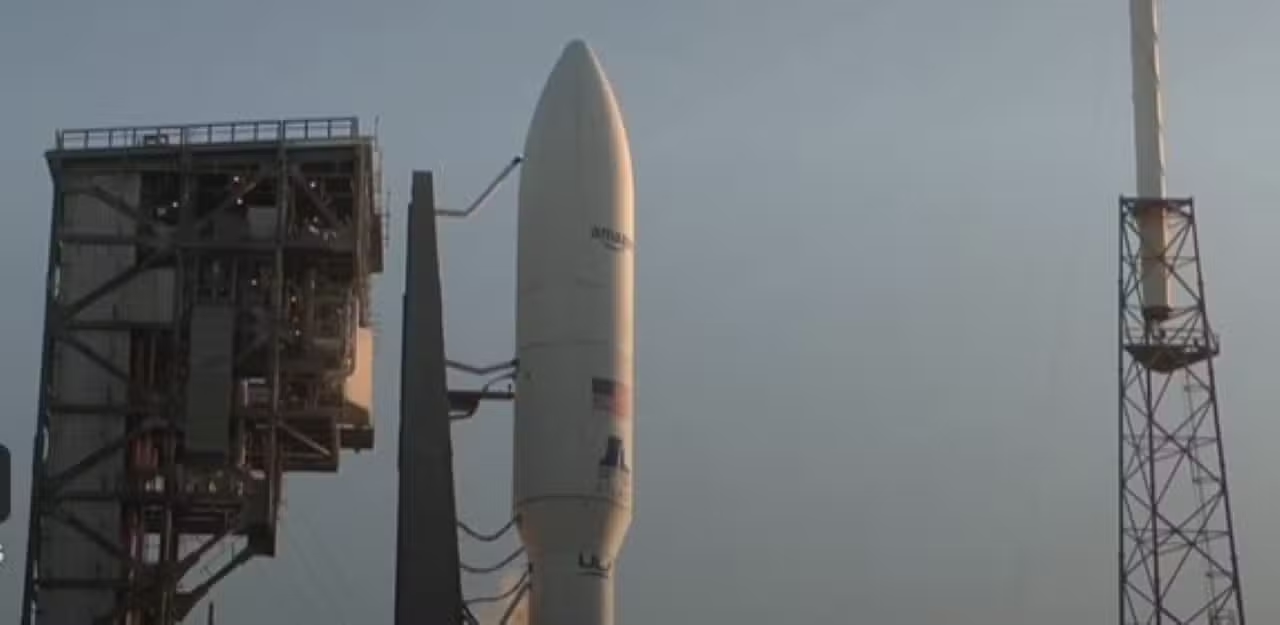
Amazon took a bold step in the race for global internet by launching, on June 23, 2025, the second batch of 27 satellites for its Kuiper Project megaconstellation from Cape Canaveral Space Force Station in Florida. The Atlas V rocket, operated by United Launch Alliance (ULA), lifted off at 6:54 a.m. EDT, marking progress in Jeff Bezos’ company’s plan to deliver high-speed broadband to remote areas. The project, set to compete with SpaceX’s Starlink and China’s Qianfan and Guowang constellations, aims to deploy over 3,200 satellites in low Earth orbit (LEO). The launch, delayed by a week due to technical issues with the rocket’s engine, underscores Amazon’s ambition to start services in 2025. The initiative promises to connect underserved communities but also reignites debates about the impact of megaconstellations on astronomy.
The Kuiper Project, announced in 2019, is one of Amazon’s biggest bets in the aerospace sector. With an estimated $10 billion investment, the company seeks to build a network capable of providing low-latency internet to consumers, businesses, and governments. The launch of 27 satellites is only the second of many planned, with ULA leading most missions. Amazon has secured 38 launches with the Vulcan Centaur, the Atlas V’s successor, alongside contracts with SpaceX, Blue Origin, and Arianespace.
- Key goals of the Kuiper Project:
- Connect areas without terrestrial infrastructure.
- Compete with Starlink, which operates over 7,600 satellites.
- Begin commercial services in 2025.
- Ensure global coverage with 3,236 satellites.
The project’s scale reflects the growing demand for global connectivity but also highlights the technical and regulatory challenges Amazon faces.
Space race for internet
The competition in the satellite internet market is fiercer than ever. SpaceX’s Starlink leads with over 7,600 satellites in orbit and 4 million global subscribers, as announced in September 2024. Elon Musk’s company has launched 55 missions in 2025 alone, solidifying its dominance. Meanwhile, China advances with the Qianfan constellation, which already has 54 satellites, and Guowang, planned for 13,000 units. Amazon, though lagging, bets on its expertise in cloud computing and consumer products to gain ground.

The Kuiper Project faces pressure to meet regulatory deadlines. The U.S. Federal Communications Commission (FCC) requires 50% of the constellation to be in orbit by 2026, with 90% by 2029. The recent launch shows progress, but the company must accelerate to meet these targets. Amazon also plans commercial tests soon, starting in countries like Argentina and Brazil.
Technology behind Kuiper
Kuiper satellites operate in low Earth orbit, between 500 and 600 km altitude, reducing data transmission latency. This feature is crucial for delivering fast internet, comparable to fiber optics, even in remote regions. Each satellite is equipped with multiple high-performance antennas and electric propulsion systems, enabling maneuvers to avoid collisions and controlled deorbiting at the end of their five-year lifespan.
Amazon has also developed compact, affordable ground antennas, cheaper than Starlink’s, which cost around $400 in Brazil, plus $46 monthly fees. The company promises competitive pricing, though details remain undisclosed. Integration with Amazon Web Services (AWS) cloud services is another edge, targeting corporate and government clients.
Technical challenges and delays
The June 23 launch was postponed from June 16 due to an issue with the Atlas V’s engine, highlighting the technical challenges of space missions. ULA, Amazon’s primary partner, quickly resolved the issue, ensuring a safe liftoff. This wasn’t the Kuiper Project’s first hurdle. In 2023, two prototypes were successfully launched but deorbited in 2024 after testing. The first operational batch, with 27 satellites, was sent up on April 28, 2025, marking the start of the constellation’s buildout.
- Kuiper launch timeline:
- October 2023: Two prototypes tested.
- April 2025: First batch of 27 satellites.
- June 2025: Second batch of 27 satellites.
- Coming years: About 80 launches planned.
Amazon must maintain a brisk launch pace to meet its goals, facing competition not only from SpaceX but also from rocket providers like Blue Origin and Arianespace.
Astronomy concerns in focus
Megaconstellations like Kuiper and Starlink raise concerns among astronomers. The sheer number of satellites in LEO interferes with optical and radio astronomy, creating reflections that disrupt night sky observations. A 2020 report by NoirLab and the American Astronomical Society warned that these constellations could hinder studies of asteroids and gravitational waves.

Justiça federal condena ex-superintendente de Des Moines a 2 anos de prisão por falsa cidadania americana

M&M’s anuncia parceria com Love Island USA e lança pacotes interativos temáticos da série

Aumento da gasolina nos EUA: americanos ajustam rotinas, diminuem viagens e buscam alternativas para economizar
Amazon, like SpaceX, has taken steps to mitigate these effects. Kuiper satellites use low-reflectivity coatings to reduce brightness. The company also collaborates with the scientific community to adjust orbits and minimize interference. Still, the proliferation of satellites remains a challenge, with about 9,700 operational units in orbit, 65% of which belong to Starlink.
Geopolitics and global competition
Amazon’s entry into the satellite broadband market carries geopolitical implications. China, with Qianfan and Guowang, aims to expand its influence, offering services in countries like Brazil, where SpaceSail signed deals with Telebras in November 2024. Qianfan plans for 14,000 satellites by 2030, while Guowang targets 13,000. These projects are part of the Belt and Road Initiative, expanding global digital infrastructure.
In Brazil, the Kuiper Project is in talks with the government, which seeks to diversify providers to avoid monopolies, especially after tensions with Starlink in 2024. Amazon plans to start operations in South America, beginning with Argentina, with expansion to Brazil and other countries. Telebras is also evaluating partnerships with SpaceSail, signaling a highly competitive market.
Supply chain and job creation
Building the Kuiper constellation involves a vast supply chain, generating thousands of jobs in the U.S. and Europe. Amazon notes that its launch agreements with ULA, SpaceX, Blue Origin, and Arianespace represent the largest commercial acquisition of launch capacity in history. Satellite production occurs in U.S. facilities, with rigorous testing to ensure orbital durability.
The partnership with ULA, in particular, strengthens the U.S. aerospace industry. The Vulcan Centaur, set to replace the Atlas V, is designed for more frequent and cost-effective launches, benefiting Amazon and other clients. Blue Origin, also owned by Jeff Bezos, will contribute with New Glenn rockets, enhancing Amazon’s vertical integration.
Push for global coverage
The Kuiper Project aims to offer initial coverage in 2025, starting with priority regions like South America. The constellation will be spread across multiple orbital layers, ensuring redundancy and efficient data transmission. Amazon already operates 12 ground stations for satellite communication, with plans to expand to meet growing demand.
The company leverages its cloud infrastructure to offer differentiated services, such as connectivity for aviation, maritime transport, and military operations. Starlink already serves these sectors, but Amazon believes its customer-centric approach can attract a diverse base.
Next steps for Kuiper
With the second batch of satellites in orbit, Amazon is gearing up to ramp up launches in the coming months. The company plans operational tests in 2025, focusing on validating connection quality in real-world scenarios. Countries like Brazil, Chile, and Peru are on the expansion list, where the lack of terrestrial infrastructure makes satellite internet a strategic solution.
Competing with Starlink, Qianfan, and Guowang will require constant innovation. Amazon is investing in technologies like inter-satellite optical communications to boost transmission speeds. The company also seeks partnerships with governments and organizations to accelerate Kuiper’s adoption, especially in underserved regions.
Veja Tambem em EUA

Bret Michaels cancela participação em ‘Freedom 250’ devido a ameaças; é o quinto artista a desistir

Estados Unidos detalha 5 benefícios essenciais da Previdência Social para aposentados em 2026: Social Security

Fogo em veículo de manutenção da Amtrak na Penn Station interrompe serviços e deixa 2 feridos graves

Pressão no Tesouro dos EUA busca cédula de 250 dólares com retrato de Donald Trump para 250 anos

Milhões de estudantes com empréstimos estudantis terão pagamentos alterados e mais caros a partir de 1º de julho

Trump emite passaportes; governo pressiona por nota de US$ 250 com rosto do presidente, diz jornal

Gronelandeses protestam contra EUA em Nuuk; Løkke e Rubio abordam tema Groenlândia em encontro

NYT Strands 816 de 28 de maio de 2026 lança desafio sobre vitória a jogadores no caça-palavras

Beneficiários da Previdência Social e SSI recebem pagamentos em junho de 2026: confira o cronograma

Calendário da Previdência Social: beneficiários nascidos após dia 20 recebem pagamentos em 27 de maio

Estados de Nova York e Nova Jersey investigam FIFA por preços “exorbitantes” de ingressos da Copa do Mundo
