Haddad seeks respectful talks with Trump to reverse 50% tariff on Brazilian exports
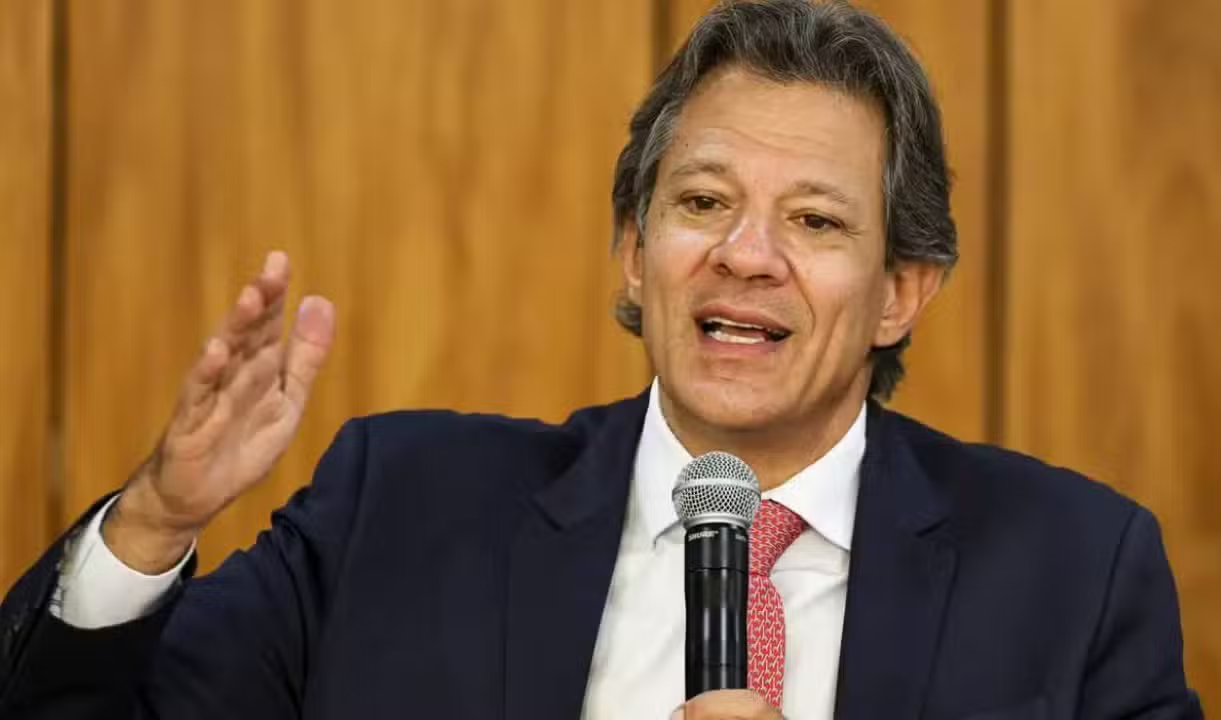
With just three days until the implementation of a 50% tariff on Brazilian products exported to the United States, announced by President Donald Trump, Brazil’s Finance Minister Fernando Haddad stated on Tuesday, July 29, 2025, in Brasília, that the country remains committed to pursuing respectful negotiations to reverse the measure. Set to take effect on August 1, the tariff impacts key sectors such as agribusiness, industry, and technology. The Brazilian government has intensified diplomatic efforts, with a delegation of senators in Washington and Foreign Affairs Minister Mauro Vieira in New York. The strategy blends dialogue with the U.S. and contingency plans to safeguard Brazilian companies and workers, while avoiding direct retaliatory measures.
Brazil has sent two letters to the U.S. government, one in May and another last week, demanding responses and proposing talks, but no official reply has been received. Haddad emphasized that Brazil will not abandon the negotiation table, even as the deadline approaches. Vice-President Geraldo Alckmin, also the Minister of Development, Industry, Trade, and Services, is coordinating with the private sector, while senators seek support from U.S. businesses to push for a tariff delay.
- Affected sectors: Agribusiness (beef, orange juice, coffee), industry (steel, aluminum), and technology (Embraer aircraft).
- Diplomatic efforts: Letters sent, meetings with U.S. officials, and a senatorial delegation in Washington.
- Critical deadline: Tariffs begin on August 1, with no confirmed postponement.
- Contingency plans: Measures to protect businesses and workers, still under review by President Lula.
Diplomatic push intensifies in Washington
The Brazilian government has escalated efforts to mitigate the economic impact of the 50% tariffs imposed by Trump. A delegation of eight senators, led by figures like Nelsinho Trad, is in Washington holding meetings with members of the Democratic and Republican parties. The goal is to rally support from the U.S. Congress and business sectors, such as the U.S. Chamber of Commerce, to press for a review of the measure. On Monday, July 28, the senators met with American business leaders to garner support for a letter requesting an extension of the tariff deadline.
Haddad noted that these actions aim to pave the way for a potential direct conversation between President Luiz Inácio Lula da Silva and Donald Trump. “When heads of state meet, there’s preparation beforehand,” the minister said, stressing the need for respectful dialogue that prioritizes the interests of both nations. Meanwhile, Mauro Vieira, in New York, signaled Brazil’s openness to negotiations, emphasizing the preservation of the longstanding U.S.-Brazil relationship.
The strategy also involves engaging U.S. businesses, as the tariffs could raise prices for American consumers on products like beef and coffee. Alckmin, who met with U.S. Commerce Secretary Howard Lutnick, described the discussion as productive, highlighting Brazil’s commitment to keeping communication channels open.
Economic sectors brace for imminent impact
The 50% tariffs threaten key Brazilian industries, which exported approximately 20 billion dollars to the U.S. in the first half of 2025. Agribusiness, particularly beef, orange juice, and coffee producers, faces significant losses, while the steel, aluminum, and technology sectors, led by companies like Embraer, risk losing market competitiveness. In the footwear industry, some input suppliers have already resorted to collective layoffs as a preventive measure.
- Agribusiness: Beef producers may lose market share in the U.S.
- Steel industry: Steel and aluminum face reduced profit margins.
- Technology: Embraer’s aircraft exports could be compromised.
- Local impact: Footwear input factories have paused production.
The Brazilian government is exploring options to redirect exports to markets like Asia and Europe, but industry leaders warn that immediate substitution is challenging. Countries like Japan and Vietnam, visited by Lula in March, have signed deals to purchase Brazilian beef and ethanol, but the volume falls short of replacing the U.S. market.
Contingency plans under Lula’s review
On Monday, July 28, Haddad and Alckmin presented President Lula with various response scenarios to the tariff. Among the options is a program similar to the Emergency Employment Maintenance Program used during the pandemic to preserve jobs. Haddad refrained from detailing the measures, stating that the final decision rests with Lula, who will determine the scope and timing of implementation.
The government is also considering the Economic Reciprocity Law, which would allow Brazil to impose tariffs on U.S. products, but Lula stressed this would be a last resort if negotiations fail by August 1. “We won’t retaliate in kind, but we’re prepared,” Haddad said, emphasizing Brazil’s preference for avoiding confrontation. Another option is filing a complaint with the World Trade Organization (WTO), potentially with support from other affected countries.



- Emergency measures: Job and business support programs inspired by pandemic-era policies.
- Reciprocity law: Potential tariffs on U.S. goods as a fallback.
- WTO action: Joint efforts with other nations to challenge U.S. tariffs.
Private sector collaboration strengthens strategy
Alckmin has spearheaded meetings with Brazilian agribusiness, industry, and technology representatives to assess the tariffs’ impact. On Monday, July 28, a consultative committee with business leaders was established to unite government and private sector efforts. The initiative reflects Lula’s view that the tariff issue is a national matter requiring collaboration across government, Congress, and businesses.
In these discussions, sectors like machinery and livestock raised concerns about competitiveness in the U.S. market. The National Confederation of Industry (CNI) warned that the interconnected Brazilian and U.S. economies could face disruptions, affecting supply chains. Alckmin stressed the importance of engaging U.S. businesses, as tariffs could raise costs for American industries like fast food, which rely on Brazilian beef.
Political backlash and national sovereignty
Trump’s tariffs have sparked significant political reactions in Brazil. The U.S. president justified the 50% tariff as a response to what he called judicial persecution of former Brazilian President Jair Bolsonaro, a defendant in the Supreme Federal Court for an alleged coup attempt. Lula responded in a national address, defending Brazil’s sovereignty and asserting that the country will not tolerate foreign interference. “Brazil is sovereign and will not be dictated to by anyone,” he stated, emphasizing the independence of the judiciary.
Haddad labeled Trump’s decision as “eminently political,” lacking economic rationale, given the U.S. trade surplus with Brazil since 2009. He criticized the influence of Brazilian far-right groups linked to the Bolsonaro family on U.S. policy but called for national unity to defend Brazil’s interests. “This is a time for unity in defending national interests,” he said.
- Trump’s rationale: Tied to Bolsonaro’s trial in Brazil’s Supreme Court.
- Lula’s response: Defense of sovereignty and judicial independence.
- Haddad’s critique: U.S. decision is political, not economically driven.
- National unity: Call for collaboration across government and sectors.
Global context and international pressures
Trump’s tariffs extend beyond Brazil, affecting countries like China, which imposed 84% retaliatory tariffs, and the European Union, which negotiated a reduction from 30% to 15%. Analysts suggest the U.S. measures are geopolitically motivated, targeting the Brics bloc, including Brazil, to counter efforts to challenge the dollar’s global dominance. Trump has threatened an additional 10% tariff on Brics nations.
Brazil, however, maintains a diplomatic stance, avoiding escalation. Coordination with other affected countries for a potential WTO action is under consideration. Domestically, the government monitors economic effects, such as falling food prices in Brazil due to reduced U.S. demand.
Next steps and outlook
With the August 1 deadline looming, Brazil remains hopeful for a U.S. response to its letters. Haddad expressed cautious optimism, citing signs of openness from U.S. business leaders who recognize the tariffs’ negative impacts. “There’s growing awareness that things may have gone too far,” he said, referencing feedback from U.S. contacts.
The committee led by Alckmin continues to explore alternatives, such as credit lines for affected sectors and new market opportunities. The senators’ meetings with U.S. lawmakers on Tuesday are seen as a critical step to advance negotiations. If no progress is made, Brazil is ready to implement contingency measures, though diplomacy remains the priority.
Veja Tambem em EUA
Pesquisa no Texas aponta republicanos à frente para governador e procurador-geral, democratas em vantagem mínima no Senado

EUA atacam radares iranianos; Irã responde com mísseis a base americana no Kuwait, em nova escalada

Homem morre sete dias após ser baleado por proprietário em imóvel invadido em Oklahoma City, EUA

Incêndio devasta The Tiny Turtle e afeta dois negócios na Minutemen Causeway em Cocoa Beach

Diferença no benefício médio do Social Security entre 62, 67 e 70 anos chega a 60% em 2026

Pesquisa aponta que 69% dos trabalhadores nos EUA temem não economizar o suficiente para a aposentadoria

Gerenciamento de US$ 2 milhões a US$ 5 milhões em aposentadoria: milionários enfrentam desafios inesperados, revela análise

Agente do ICE, Christian Castro, é detido no Texas por tiroteio e falso testemunho em Minneapolis

Justiça federal condena ex-superintendente de Des Moines a 2 anos de prisão por falsa cidadania americana

M&M’s anuncia parceria com Love Island USA e lança pacotes interativos temáticos da série

Aumento da gasolina nos EUA: americanos ajustam rotinas, diminuem viagens e buscam alternativas para economizar