

DJI announced the launch of the Mini 5 Pro, its latest compact drone designed to capture professional-quality aerial footage in an ultralight body. Weighing just 249 grams, the device integrates a 1-inch CMOS sensor for the first time in the Mini line, enabling 50-megapixel photos and 4K video at 120 frames per second. This advancement responds to the demand for portable equipment delivering cinematic results without compromising mobility.
This novelty arrives as compact drones gain traction among content creators and aerial photography enthusiasts. The Mini 5 Pro retains the foldable design characteristic of the series, with dimensions of 15.19 by 11.11 centimeters when folded, facilitating transport in backpacks or pockets. The company emphasizes that the model operates without registration requirements in several countries, thanks to its sub-250-gram weight, simplifying recreational or professional use in urban areas.
- Larger sensor captures more light, enhancing low-light scenes with 14 stops of dynamic range;
- HDR and D-Log M recording expand post-production options for video editors;
- 48mm medium-tele mode offers digital zoom with minimal quality loss;
- 42GB internal storage eliminates reliance on SD cards for extended sessions.
The focus on visual performance reflects DJI’s strategy to elevate the Mini line to premium equipment standards without increasing size or weight. Users report that previous models already transformed hobbies into professional productions, and this new addition promises to broaden that accessibility.
Advancements in image capture
The 1-inch sensor in the Mini 5 Pro marks a significant leap from the 1/1.3-inch sensor of the Mini 4 Pro, doubling the capture area and boosting resolution to 50 megapixels. This change allows the drone to record fine details in wide landscapes or close-ups of moving subjects, with notable noise reduction in low-light conditions. The f/1.8 aperture of the 24mm equivalent lens ensures proper exposures even at dusk, while the 48mm mode simulates a compact telephoto for versatile framing.
The stabilized gimbal now rotates up to 225 degrees, enabling native vertical filming ideal for social media or creative horizontal shots without manual adjustments. This free rotation, inspired by models like the Mavic 4 Pro, adds fluidity to aerial transitions, and the expanded ISO range up to 12,800 in normal mode ensures versatility across scenarios. Initial tests indicate that image processing avoids oversaturation in vegetation, a common issue in predecessors, resulting in more natural tones.
Recording at 4K/120fps enables smooth slow-motion, useful for sports or dynamic events, and the D-Log M profile preserves raw data for advanced color corrections. The drone stores up to 42GB internally, sufficient for hours of high-resolution footage, and transfers files via Wi-Fi 6 at 100MB/s, streamlining creators’ workflows in the field.
- 50MP photos with enhanced focus on close-range portraits;
- HDR video at 4K/60fps for high contrast in cloudy skies;
- Slow-motion support without loss of sharpness in fast actions;
- Onboard storage supporting multiple takes without interruptions;
- Fast transfers compatible with mobile editing apps.
These capabilities position the Mini 5 Pro as an accessible tool for videographers seeking quality without the bulk of larger drones.
Option 1: DJI Mini 5 Pro launches with 1-inch sensor and 52-minute flight in ultralight drone under 250g (93) Option 2: DJI Mini 5 Pro debut revolutionizes compact drones with 50MP camera and night LiDAR (87) Option 3: DJI Mini 5 Pro introduces 1-inch CMOS sensor and record battery in 249g portable model (86) Option 4: New DJI Mini 5 Pro combines 4K/120fps video and omnidirectional detection in lightweight drone (92) Option 5: DJI Mini 5 Pro innovates with 225-degree rotating gimbal and up to 52-minute flight time (88)
DJI announced the launch of the Mini 5 Pro, its latest compact drone designed to capture professional-quality aerial footage in an ultralight body. Weighing just 249 grams, the device integrates a 1-inch CMOS sensor for the first time in the Mini line, enabling 50-megapixel photos and 4K video at 120 frames per second. This advancement responds to the demand for portable equipment delivering cinematic results without compromising mobility.
This novelty arrives as compact drones gain traction among content creators and aerial photography enthusiasts. The Mini 5 Pro retains the foldable design characteristic of the series, with dimensions of 15.19 by 11.11 centimeters when folded, facilitating transport in backpacks or pockets. The company emphasizes that the model operates without registration requirements in several countries, thanks to its sub-250-gram weight, simplifying recreational or professional use in urban areas.
- Larger sensor captures more light, enhancing low-light scenes with 14 stops of dynamic range;
- HDR and D-Log M recording expand post-production options for video editors;
- 48mm medium-tele mode offers digital zoom with minimal quality loss;
- 42GB internal storage eliminates reliance on SD cards for extended sessions.
The focus on visual performance reflects DJI’s strategy to elevate the Mini line to premium equipment standards without increasing size or weight. Users report that previous models already transformed hobbies into professional productions, and this new addition promises to broaden that accessibility.
Advancements in image capture
The 1-inch sensor in the Mini 5 Pro marks a significant leap from the 1/1.3-inch sensor of the Mini 4 Pro, doubling the capture area and boosting resolution to 50 megapixels. This change allows the drone to record fine details in wide landscapes or close-ups of moving subjects, with notable noise reduction in low-light conditions. The f/1.8 aperture of the 24mm equivalent lens ensures proper exposures even at dusk, while the 48mm mode simulates a compact telephoto for versatile framing.
The stabilized gimbal now rotates up to 225 degrees, enabling native vertical filming ideal for social media or creative horizontal shots without manual adjustments. This free rotation, inspired by models like the Mavic 4 Pro, adds fluidity to aerial transitions, and the expanded ISO range up to 12,800 in normal mode ensures versatility across scenarios. Initial tests indicate that image processing avoids oversaturation in vegetation, a common issue in predecessors, resulting in more natural tones.
Recording at 4K/120fps enables smooth slow-motion, useful for sports or dynamic events, and the D-Log M profile preserves raw data for advanced color corrections. The drone stores up to 42GB internally, sufficient for hours of high-resolution footage, and transfers files via Wi-Fi 6 at 100MB/s, streamlining creators’ workflows in the field.
- 50MP photos with enhanced focus on close-range portraits;
- HDR video at 4K/60fps for high contrast in cloudy skies;
- Slow-motion support without loss of sharpness in fast actions;
- Onboard storage supporting multiple takes without interruptions;
- Fast transfers compatible with mobile editing apps.
These capabilities position the Mini 5 Pro as an accessible tool for videographers seeking quality without the bulk of larger drones.
Improvements in autonomy and speed
The standard intelligent battery offers 36 minutes of continuous flight, two minutes more than the Mini 4 Pro, without increasing total weight. With the extended battery option, available in select regions, flight time reaches 52 minutes, a record for DJI’s non-industrial drones. This duration allows extended sessions in remote locations, reducing pauses for battery swaps and maximizing efficiency in lengthy projects.
The drone achieves horizontal speeds of 68 km/h and a 10 m/s climb rate, doubling the agility of its predecessor in steep ascents. This power, combined with resistance to winds up to 10.7 m/s, ensures stability in adverse conditions, such as coastlines or mountains. The OcuSync 4 Plus transmission system extends the range to 20 km in FCC mode, maintaining 1080p/60fps video feeds without noticeable latency.
Automatic activation upon unfolding the arms simplifies setup, eliminating manual buttons, and night return uses route memory for safe landings without satellite signals. These optimizations make flying more intuitive, especially for beginners exploring unfamiliar terrains.
The design includes quick-release propellers, facilitating field maintenance, and ventilated motors for cooling during intense flights. Experienced pilots note that this combination of duration and performance reduces interruption risks, enabling seamless captures in complex visual narratives.
Enhanced obstacle detection
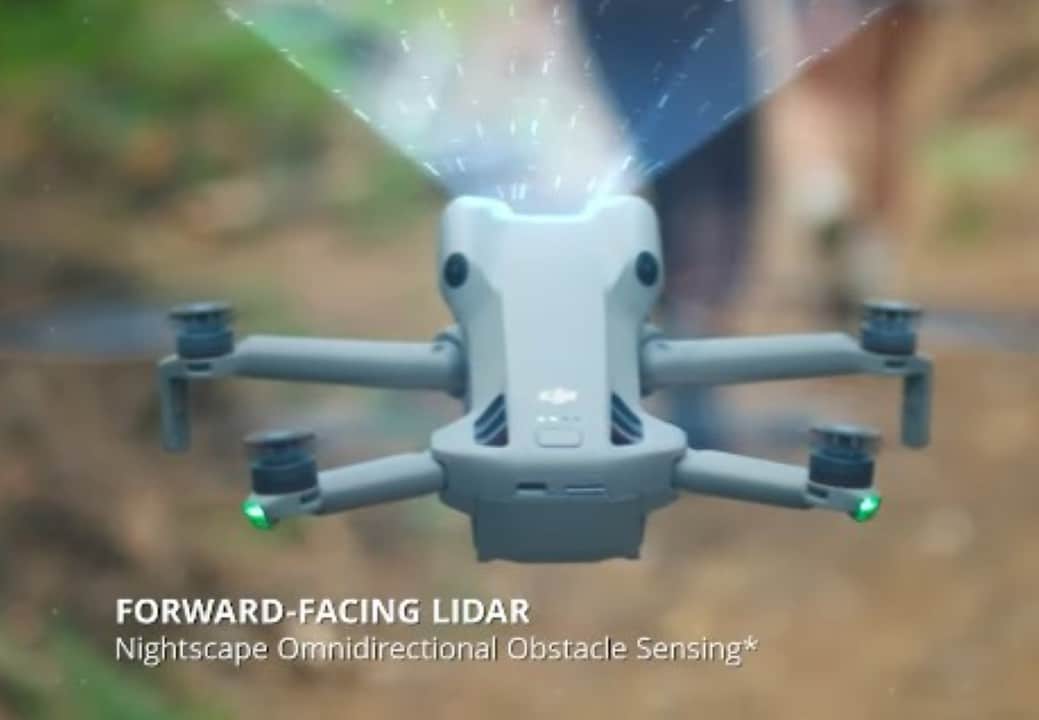
The Mini 5 Pro incorporates omnidirectional sensors with front-facing LiDAR, a first in the series that improves detection in low light. This laser measures distances with millimeter precision, enabling avoidance of obstacles invisible to traditional binocular vision, such as branches or wires at dusk. The system covers 360 degrees, including 3D infrared downward vision, and triggers automatic braking from 0.5 meters.
In complex environments, the drone switches to rear-tracking modes, maintaining focus on subjects while evading lateral obstacles. This intelligence, enhanced by ActiveTrack 360°, follows targets at speeds up to 15 m/s in open areas, dynamically adjusting altitude and distance. For sports like cycling, it detects scenarios and selects optimized modes, ensuring stable framing.
- LiDAR for night returns without GPS;
- Infrared sensors illuminating landings on uneven surfaces;
- Tracking balancing speed and safety in dense forests;
- Evasion mode prioritizing real-time alternative routes;
- Integration with Fly app for prior visual alerts.
These features elevate safety, allowing bold explorations without frequent collisions, common in simpler drones.
Integration with controls and apps
The Mini 5 Pro is compatible with RC-N3, RC 2, and RC Pro 2 controllers, offering built-in screens for real-time monitoring. The DJI Fly app, updated to version 1.18.0, manages updates and calibrations via Bluetooth, with fast file transfers even when the drone is off. This Wi-Fi 6 connectivity supports 100MB/s downloads, ideal for editors syncing clips directly to smartphones.
Functions like QuickShots require the remote for pre-programmed maneuvers, such as orbits or follows, but palm takeoff enables autonomous launches in minimal setups. The app’s interface includes heatmaps for route optimization and battery analysis across multiple flights, aiding professional planning.
Pilots report that this usability reduces the learning curve, with integrated tutorials guiding from pairing to advanced settings. Support for sports modes detects activities and adjusts parameters automatically, such as acceleration for races or smoothness for calm shoots.
- Controllers with 5.5-inch screens for clear visualization;
- App storing memorized routes for precise repeats;
- Remote calibration via Bluetooth without extra cables;
- Post-flight energy consumption analysis for future planning;
- Integration with editors like Premiere for direct exports.
This ecosystem makes the drone a natural extension of creative workflows, from amateurs to production teams.
Package and accessory options
Initial packages include the drone with remote control, battery, and case, starting at prices varying by region: around 769 USD in Canada, 689 GBP in the UK, and 798 EUR in Europe. Fly More Combo versions add extra batteries, charging hubs, and spare propellers, raising the set to up to 1,159 EUR. In Japan, the base price reaches 106,700 yen, reflecting local adjustments without steep increases from the predecessor.
Accessories like ND filters and propellers are not interchangeable with the Mini 4 Pro, but DJI recommends original batteries for full compatibility, though tests suggest partial use of older models. Quick-release propellers and custom cases complete the kit, with options for mounting microphones or LED lights for night recordings.
These bundles cater to casual users with the basic package and professionals needing battery redundancy for long shoot days. The company plans immediate global availability, except in restricted markets, with direct shipments from authorized resellers.
- Standard package with one battery and basic controller;
- Combo with three batteries and multifunctional charger;
- Optional accessories like filters for exposure control;
- Durable cases for air travel transport;
- Spare propellers for quick field replacements.
The modular structure encourages gradual upgrades, keeping the investment accessible over time.
Regulatory challenges in key markets
Restrictions in the United States prevent the official sale of the Mini 5 Pro, with no dedicated page on DJI’s local site or review units provided. Parallel imports via resellers like Adorama may occur but face risks of customs blocks due to tariffs and security audits. Spokesperson Daisy Kong confirms that warranties depend on purchase details, but the company commits to support where possible.
In Canada and Europe, the model launches without impediments, with the extended battery absent in the EU to comply with weight limits. In Brazil, Anatel homologation facilitates entry, aligning with local sub-250g drone regulations. These geopolitical obstacles contrast with enthusiastic reception in Asia and Latin America, where the drone fills gaps in lightweight equipment.
Regions like Japan and the UK see the launch as an opportunity for innovation in inspections and aerial tourism, without initial barriers. DJI monitors legislative developments, adjusting strategies to maintain global accessibility.
The Mini 5 Pro’s narrative highlights how technological advancements navigate varied regulatory contexts, prioritizing markets open to aerial innovation.