Starship Flight 11: Live Stream Shows Perfect Stage Separation in Texas Test

SpaceX began the 11th Starship test flight on Monday evening, October 13, 2025, at its Starbase facility in Texas. The launch occurred at 8:15 PM Brasília time, with all 33 Raptor engines on the Super Heavy booster firing without issues. The live stream, available on the company’s website and social media, tracks the mission’s ongoing progress, aiming to validate component reuse.
The event drew global attention for testing innovations like hot staging, a stage separation process with simultaneous ignition. So far, the booster completed its controlled descent into the Gulf of Mexico, while the upper stage continues its orbital trajectory. The operation proceeds without interruptions, focusing on reentry maneuvers planned for the Indian Ocean.
SpaceX engineers monitor real-time data. The flight marks the final use of the current Pad 1 configuration and Block 2 vehicle version. Online viewership exceeded 17,000 connections initially.
Engine Activation Ensures Precise Start
All engines fired in perfect sync. The vapor cone formed shortly after liftoff. Teams confirmed no propulsion failures.
Maximum aerodynamic pressure occurred without deviations. The booster, with 24 engines reused for the second time, maintained stability. Internal feeds captured views of Texas and Mexico below.

Stage Separation Proceeds Without Issues
Hot staging activated as scheduled. The upper stage engines relit immediately after the lower stage cutoff. Separation occurred precisely, generating additional thrust for acceleration.
Engineers observed the release of the separation ring, a disposable component in this mission. The process lasted seconds, with nitrogen purges ensuring safety. Aerial imagery showed the ring returning to the booster.
The maneuver avoided collisions, with the ring positioned below the main vehicle. This step concludes the use of the current design, paving the way for integrated versions.
Booster Achieves Controlled Water Landing
The booster relit 13 engines for deceleration. Grid fins adjusted vertical orientation. The vehicle hovered over the Gulf of Mexico before impact.
The descent maintained exact verticality. Water entered compartments upon contact, confirming flotation tests. The landing lasted under a minute, validating reuse.
Telemetry data indicates preserved structural integrity. This step supports ocean recovery goals for future missions.
- Super Heavy Booster: 70 meters tall, equivalent to a 30-story building.
- Raptor Engines: 33 total, with 24 reused.
- Trajectory: Initial ascent over Texas, separation at 70 km altitude.
- Monitoring: Internal cameras record pressures and flows in real time.
Upper Stage Continues to Planned Orbit
The Starship upper stage activated its three vacuum engines after separation. These larger engines optimize performance at high altitudes. The craft gains speed for orbital insertion, with relight tests scheduled.
Plans include simulated satellite releases and attitude maneuvers. The total journey estimates one hour until reentry. Teams track position via GPS and inertial sensors.


The design allows multiple space ignitions, crucial for interplanetary transfers. Telemetry confirms thermal stability and adequate propellant so far.
Technical Innovations Drive Current Flight
This mission tests hot staging at full scale for the first time. The process integrates ignition and separation, reducing disposable mass by 20% compared to cold methods. Engineers added pre-loads to joints for greater strength.
Improved drainage systems prevent propellant buildup. Raptor engines received efficiency upgrades, with 29 units reused in the booster. This approach cuts operational costs in subsequent tests.
The ring release marks the end of this configuration. Future versions integrate the element into the booster, eliminating separations. The flight validates these transitions in a real environment.
Data from prior flights, like the 10th in August, informed adjustments. That test achieved controlled reentry, serving as a foundation for this ascent.
Orbital Trajectory Demands Ongoing Precision
The craft reaches supersonic speed minutes after separation. Sensors monitor vibrations and thermal surface temperatures. Cryogenic propellant flows without detected leaks.
Correction maneuvers engage secondary thrusters. The suborbital trajectory tests altitude limits, with a peak expected at 150 km. Teams prepare for relight to de-orbit.
External camera imagery captures Earth’s rotation. The flight integrates laser communication experiments, transmitting data at high rates.
Final Preparations Ensure Total Safety
The FAA approved the launch after hardware reviews. Air exclusion zones cover the Gulf and parts of the Caribbean. Rescue teams are positioned along landing routes.
Weather conditions in Texas favored liftoff. Winds remained below 15 km/h. Environmental monitoring confirmed no anomalous emissions.
The event follows a 25-flight annual schedule, adjusted by prior test lessons. This mission advances toward full recovery in 2026.
Veja Tambem em Ciência

Noite de 31 de maio de 2026 une Lua Azul e Microlua no céu; astrônomo detalha fenômeno raro

Superlua de 2026 em novembro alcançará perigeu orbital, tornando-se a maior dos últimos anos com brilho intenso
Telescópio Gemini North revela estrutura assimétrica da nebulosa NGC 1514 e par binário

Estudo propõe nova formação planetária: maioria dos sub-Netunos não possui núcleo nem manto como a Terra
Eclipse solar total de 2027 terá duração excepcional e será o maior do século sobre a Terra

Chuva de meteoros de 2026 promete picos fortes com Geminídeas até 150 rastros por hora e Perseidas sem Lua

Telescópio James Webb confirma planetas JuMBO, antes considerados ilusão, desafiando modelos de formação planetária
Nasa detalha 3 missões robóticas à Lua para iniciar base permanente no polo sul

Fenômeno de microlente gravitacional revela objeto com 3 massas lunares na Grande Nuvem de Magalhães

Estudo da Johns Hopkins revela crise ecológica 30.000 anos antes de asteroide dizimar dinossauros
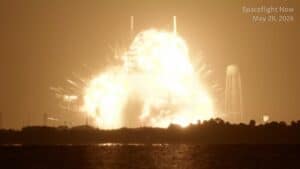
Explosão de foguete New Glenn da Blue Origin causa danos em plataforma na Flórida