Two asteroids collide with the Moon in 48 hours and generate flashes visible from Earth
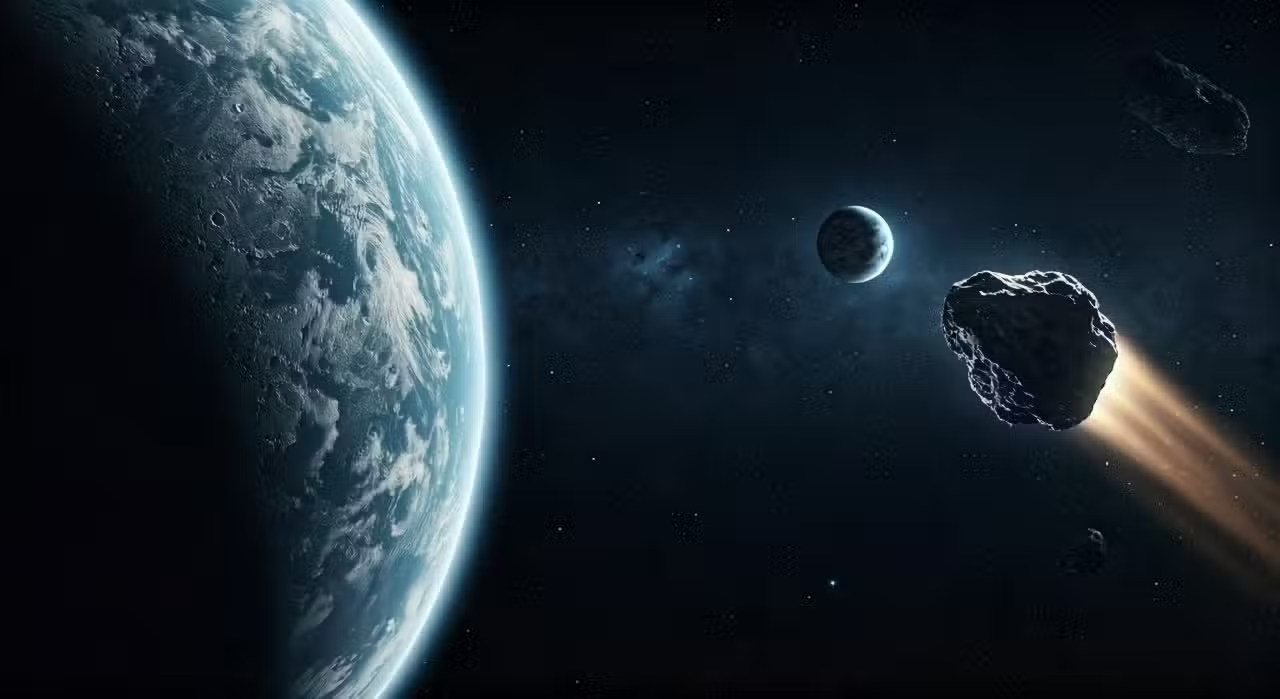
Two asteroids hit the Moon just 48 hours apart, producing bright flashes recorded by observers on Earth. The events occurred between the night of November 2nd and 4th, 2025 and were captured by high-precision amateur telescopes on different continents.
The collisions released energy equivalent to hundreds of kilograms of TNT each and occurred at speeds approaching 96,560 km/h. The impacts reinforce evidence that the Moon is constantly bombarded by rocky fragments from space.
- First flash: region close to the crater Gassendi (diameter 112 km)
- Second flash: Oceanus Procellarum area, largest lunar volcanic plateau
- Simultaneous observations in Brazil, Spain and Japan confirmed authenticity
Speed and energy of impacts
The two celestial bodies traveled at about 26.8 km per second as they came into contact with the lunar surface. This speed transforms small mass into explosions visible even from 384 thousand kilometers away.
The kinetic energy converted into light and heat reached 0.5 tons of TNT in the first event and 0.8 tons in the second. These values exceed iimpacts recorded in 2024, indicating possible passage of a dense swarm.
Precise location of collisions
The first impact occurred at 9:43 pm (Brasília time) on November 2, selenographic coordinates 17° S, 40° W. The point is on the southwestern edge of the Gassendi crater, a formation visible with ordinary binoculars.
The second reached Oceanus Procellarum at 7:12 pm on the 4th, coordinates 18° N, 57° W. The region is flat and dark, which facilitated the contrast of the magnitude 4 flash, visible in 8-inch telescopes.
Global monitoring confirms events
Lunar observation networks such as the Moon Impacts Detection and Analysis System (MIDAS) recorded the two flashes at seven different stations. The temporal and spectral coincidence eliminated the possibility of reflections or technical failures.
High-speed cameras operating at 25 frames per second captured each flash lasting 0.08 seconds. The data is now available for public analysis in the Brazilian Lunar Association database.
Relationship with Taurid meteor shower
The impacts coincide with the peak of the Taurídeas do Sul current, active between September and December. This cluster originates from Comet Encke and contains fragments up to tens of meters in size.


Astronomers estimate that 12% of lunar impacts detected since 2023 have a taurid origin. The current density suggests passage through a filament richer in large particles.
Data accumulated since 2005
More than 2,800 lunar flashes have been cataloged in 20 years of systematic monitoring. The average frequency is 180 events per year with sufficient magnitude for amateur telescopes.
The distribution shows concentration on the visible side of the Moon during terrestrial dawns. Maria regions receive 68% of the impacts recorded due to the lower reflectivity of the terrain.
Implications for Artemis missions
The collisions reinforce the need for micrometeorite shields in permanent lunar habitats. NASA requires protection against particles from 1 cm to 15 km/s in Artemis program projects.
Inflatable structures tested in Texas resist impacts of 0.3 g at 7 km/s. The new data will help calibrate a minimum thickness of 12 cm of compacted regolith on housing modules.
Observation remains essential
Brazilian programs such as the Minas Gerais Lunar Observatory maintain four dedicated telescopes 24 hours a day. The national network has recorded 42 impacts since January 2025.
Anyone with 150mm equipment can participate by uploading videos to collaborative platforms. The protocol requires recording in RAW format with GPS time inserted.
Veja Tambem em Ciência
Noite de 31 de maio de 2026 une Lua Azul e Microlua no céu; astrônomo detalha fenômeno raro
Superlua de 2026 em novembro alcançará perigeu orbital, tornando-se a maior dos últimos anos com brilho intenso
Telescópio Gemini North revela estrutura assimétrica da nebulosa NGC 1514 e par binário

Estudo propõe nova formação planetária: maioria dos sub-Netunos não possui núcleo nem manto como a Terra
Eclipse solar total de 2027 terá duração excepcional e será o maior do século sobre a Terra
Chuva de meteoros de 2026 promete picos fortes com Geminídeas até 150 rastros por hora e Perseidas sem Lua
Telescópio James Webb confirma planetas JuMBO, antes considerados ilusão, desafiando modelos de formação planetária
Nasa detalha 3 missões robóticas à Lua para iniciar base permanente no polo sul
Fenômeno de microlente gravitacional revela objeto com 3 massas lunares na Grande Nuvem de Magalhães
Estudo da Johns Hopkins revela crise ecológica 30.000 anos antes de asteroide dizimar dinossauros
Explosão de foguete New Glenn da Blue Origin causa danos em plataforma na Flórida