
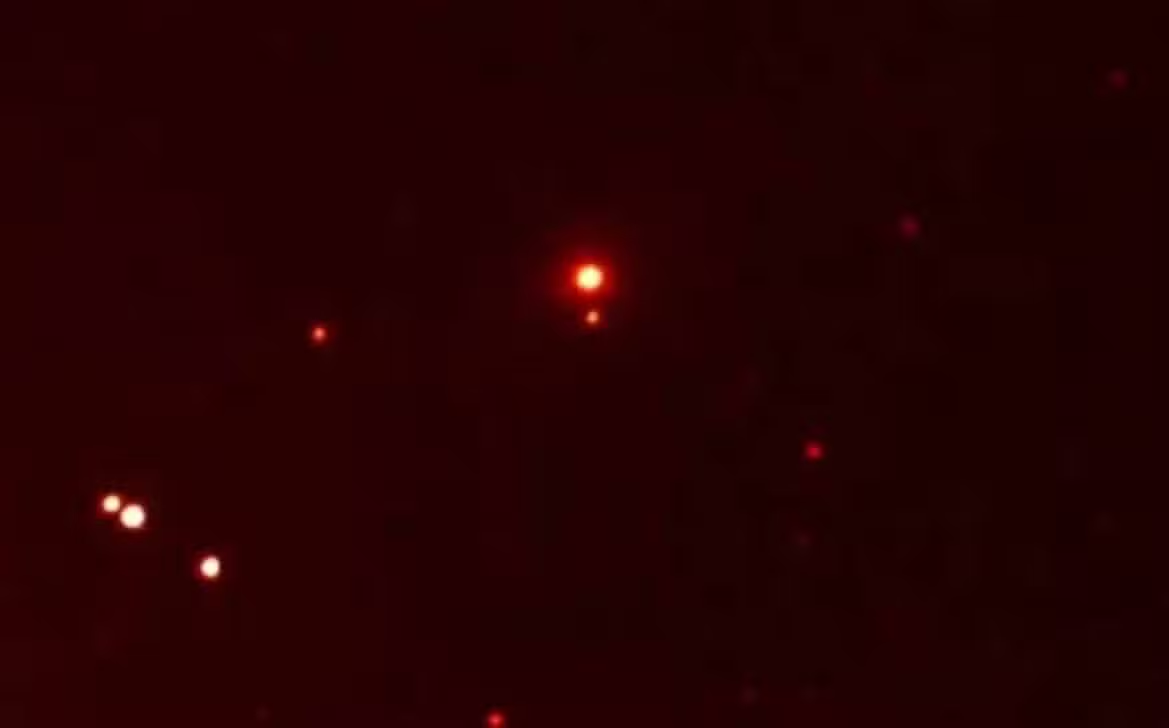
New image of interstellar comet 3I/ATLAS shows that its ionic tail continues to grow significantly. The capture was carried out by the Virtual Telescope Project in Italy, on November 11, 2025. The phenomenon indicates greater activity of the comet as it approaches the Sun.
The record combines 18 exposures of 120 seconds each, obtained by robotic telescopes in Manciano. Despite the 61% illuminated Moon and the low position on the horizon, the tail appears well defined.
- Bright nucleus surrounded by compact coma.
- Ion tail extends 0.7 degrees across the sky.
- Presence of faint dust tail.
Ion tail formation
The ionic tail appears when ultraviolet radiation from the Sun ionizes gases released by the comet. The solar wind pushes these ions, creating a bluish structure that points away from the Sun.
Different from the dust tail, which follows the orbit and has a yellowish tone. In the case of 3I/ATLAS, the growth suggests intense sublimation of volatiles such as CO₂.
Detailed notes
Astronomers recorded the image around midnight on November 11. The comet was 14 degrees above the eastern horizon.
Favorable climatic conditions made it possible to capture evolution in relation to previous records. The tail was more developed and structured.
3I/ATLAS Features
3I/ATLAS is the third confirmed interstellar object. Discovered after 1I/’Oumuamua in 2017 and 2I/Borisov in 2019.
Its luminosity allows detailed studies with terrestrial telescopes. This provides data on composition and origin outside the Solar System.
The nucleus presents a compact coma and increasing activity. Volatile gases sublime with greater intensity at perihelion.
Activity logged
Images from November 9 already indicated unusual structures on the tail. The Moon was 82% illuminated and the comet was 9-12 degrees high.
The increase in the ionic tail confirms the release of carbon dioxide and dust. This reveals characteristics of the origin star system.
Future monitoring
The Vir Telescope Projecttual plans to broadcast live on November 17th. The observation starts at 1:15 am on YouTube.
Astronomers follow the comet’s path through the inner Solar System. Records include recently detected natural radio signal.
The 3I/ATLAS heads towards exit after perihelion. Data collected contributes to understanding interstellar comets and their interaction with the Sun. The ionic tail remains visible under favorable nighttime observation conditions.