Super blood moon in 2025 promises 82 minutes of unforgettable lunar eclipse
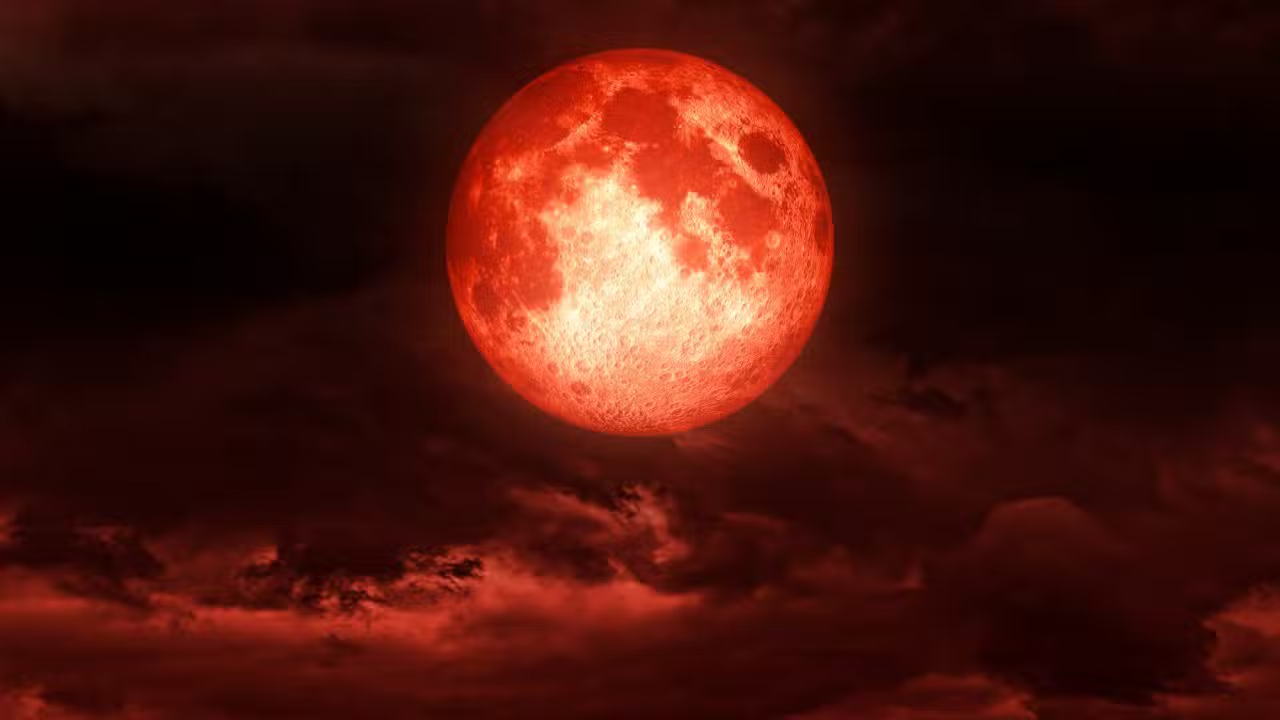
On the night of September 7th to 8th, 2025, a total lunar eclipse, known as a super blood moon, promises an 82-minute display of totality, the longest of the year. The phenomenon, which dyes the Moon red, will be visible in regions such as Europe, Africa, eastern Australia and New Zealand, but not in Brazil, where the Moon will be below the horizon. Astronomers and enthusiasts will be able to follow the event via live broadcasts on platforms such as YouTube, offered by institutions such as NASA and ESA.
The eclipse will begin at 12:28 pm and end at 5:55 pm Brasília time, with the peak between 2:30 pm and 3:52 pm. A supermoon occurs when the full Moon is at perigee, appearing up to 14% larger and brighter. The reddish color appears due to the dispersion of sunlight in the Earth’s atmosphere, creating a unique visual effect.
- Eclipse phases: Penumbral, partial and total.
- Recommended platforms: NASA, ESA, Time and Date.
- Total duration: About five and a half hours.
What makes the event special
The 2025 super blood moon stands out for its duration of 82 minutes of totality, the longest of the year. The Moon will be 2.7 days from perigee, which makes it appear larger in the sky. During totality, the Earth’s shadow will completely cover the Moon, intensifying the red hue. Atmospheric conditions, such as dust, can make the coloring even more vibrant.

How to follow in Brazil
Although Brazil does not have direct visibility, live broadcasts will allow the public to follow the eclipse. Platforms such as YouTube and astronomy websites will offer images captured by telescopes. The National Observatory and other Brazilian institutes plan lives with comments from experts. For a good experience, it is recommended to start viewing at 1:15 pm, Brasília time. A stable connection and a peaceful environment are ideal for enjoying scientific narrations.
The science of the phenomenon
The red tone of the super blood moon occurs due to Rayleigh scattering, when sunlight passes through the Earth’s atmosphere, filtering blue tones and highlighting red tones. The intensity of the color varies depending on the dust or clouds in the atmosphere. By 2025, 36% of the lunar diameter will be in the umbra, intensifying the effect. The precise alignment between Sun, Earth and Moon creates a unique visual spectacle. Photographers and astronomers eagerly await to capture the event.



Lunar eclipse steps
The 2025 eclipse will have six phases, starting with penumbral dimming, followed by partial, when the umbra covers part of the Moon. Totality, with the Moon completely red, lasts 82 minutes. After peaking, the Moon gradually returns to normal brightness, over a five and a half hour process.
For a memorable experience, choose a location with a good internet connection. Lives with experts offer learning about the cosmos. Saving images from broadcasts can be a way to record the moment.
Upcoming astronomical events
A total lunar eclipse on March 3, 2026 will be visible in Brazil, with 65 minutes of totality. Planning ahead will ensure an unforgettable direct observation.
Veja Tambem em Ciência

Superlua de 2026 em novembro alcançará perigeu orbital, tornando-se a maior dos últimos anos com brilho intenso
Telescópio Gemini North revela estrutura assimétrica da nebulosa NGC 1514 e par binário

Estudo propõe nova formação planetária: maioria dos sub-Netunos não possui núcleo nem manto como a Terra
Eclipse solar total de 2027 terá duração excepcional e será o maior do século sobre a Terra
Chuva de meteoros de 2026 promete picos fortes com Geminídeas até 150 rastros por hora e Perseidas sem Lua

Telescópio James Webb confirma planetas JuMBO, antes considerados ilusão, desafiando modelos de formação planetária
Nasa detalha 3 missões robóticas à Lua para iniciar base permanente no polo sul
Fenômeno de microlente gravitacional revela objeto com 3 massas lunares na Grande Nuvem de Magalhães

Estudo da Johns Hopkins revela crise ecológica 30.000 anos antes de asteroide dizimar dinossauros
Explosão de foguete New Glenn da Blue Origin causa danos em plataforma na Flórida

Portugal avança com primeiro porto espacial reutilizável da União Europeia nos Açores; ESA prevê pouso em 2028