

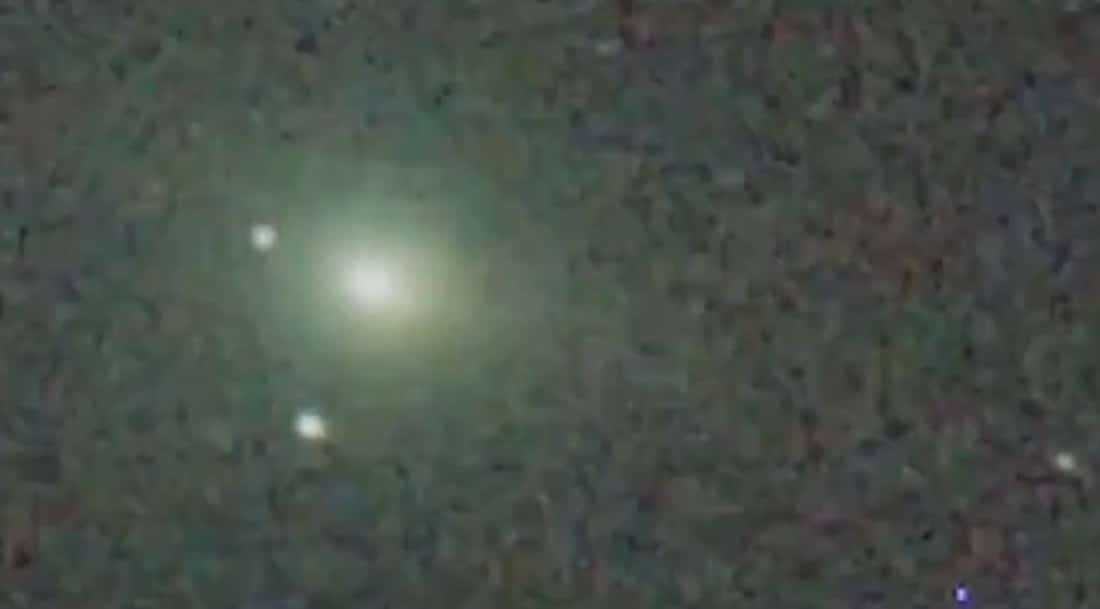
Recent images captured by amateur astronomers and space agencies show the interstellar comet 3I/ATLAS with characteristics that diverge from common celestial objects. The object, discovered in July 2025 by the Atlas telescope at Chile, has a sharp core and an irregular coma, with no detectable tail in some views. Essa passage occurs in the context of its hyperbolic trajectory, confirmed as an origin external to Sistema Solar by Nasa.
Astronomers observe the phenomenon from Hemisfério Sul, where the comet is positioned in the constellation of Virgem. The absence of a tail of dust and gas, expected in active comets at this distance from Sol, raises questions about its composition. Especialistas, Agência Espacial Europeia and Nasa coordinate analyzes to map their precise orbit.
Initial detection occurred on July 1, 2025, and the object reached perihelion on October 30, 1.4 astronomical units from Sol. Observações probes on Marte, like Maven, recorded close-up details during the October 3 approach, 29 million kilometers from the planet.
No mesmo tema: NASA releases detailed images of interstellar comet 3I/Atlas and rules out extraterrestrial ship theory in official announcement
Details of space observations
Nasa probes in orbit around Marte captured ultraviolet images of the comet in September and October 2025. The coma, an envelope of gas and dust around the nucleus, displays irregular rings of brightness, measuring between 30,000 and 45,000 kilometers in radius. Esses patterns suggest ejection of material such as silicate and organic carbon compounds.
The composition includes the release of carbon monoxide and carbon dioxide, with an ejected mass exceeding 10^9 kilograms. Telescópios Earthlings, like Gemini North in Havaí, recorded visions on November 26, confirming the circular symmetry of the coma. The high luminosity indicates sustained activity, different from local comets.
Chemical composition revealed
Spectroscopic analyzes point to a reflective surface with traces of pure nickel, estimated at 33 billion tons. Essa The isolated presence of iron is rare, as the elements generally coexist in natural alloys. Linhas of nickel plasma indicates active ablation, generating charged particles that form an inverted ionic tail.
The core, estimated to be 2 to 4 kilometers in diameter, may be double or slowly fragmenting. Magnetic Campos varies regularly, suggesting complex electromagnetic processes. Hydrogen emission, detected by Maven, reinforces the view of an unusual volatile composition for interstellar objects.
Anomalies in the structure of the nucleus
The nucleus appears pinpoint and bright in stacked images, contrasting with the diffuse appearance of typical comet nuclei. Medições from July’s Telescópio Espacial Hubble limit its size to less than 46 kilometers, with no clear resolution. Essa sharpness suggests a concentrated light source, possibly by viewing geometry or collimated ejection.
Mais sobre o assunto: Interstellar object 3I/ATLAS shows precise trajectory to the radius of Jupiter’s Hill in 2026
In captures from November 22 by independent astronomers, the nucleus maintains spherical symmetry, without asymmetric jets common in irregular sublimation. The brightness gradient is smooth, indicating micrometer-scale dust uniformity. Essas features defy models of fragmentation expected in heated comets.
The lack of curvature in the tail, observed in multiple views, ignores the solar wind pattern. Linear Estruturas, like parallel filaments, remain narrow without dispersion, with a minimum angle between rays. Essa fine collimation points to low dust-to-gas ratio or coherent flow.
Cobertura completa: News (EN)
Trajectory and non-gravitational accelerations
The hyperbolic orbit of 3I/ATLAS confirms its origin in the disk of Via Láctea, possibly from ancient stars. Acelerações detected deviations from pure gravity, similar to events on 1I/’Oumuamua, but without clear cometal activity. Triangulações between Terra and Marte, by Esa, improved positional accuracy by a factor of 10.
The object approaches Terra at 1.8 astronomical units, without risk of collision. Observações from ExoMars Trace Gas Orbiter, from October 1st to 7th, mapped its passage through the plane of Sistema Solar. Forças non-gravitational changes the trajectory, possibly due to asymmetric ejection of gases.
- Ejected mass: more than 10^9 kg of silicate and organics.
- Coma radius: 30,000 to 45,000 km.
- Main composition: CO, CO2 and hydrogen detected.
- Acceleration: deviations of 0.1% from the Keplerian orbit.
- Current brightness: magnitude 10, visible in amateur telescopes.
Intensification of recent activity
Photos from November 19 show a sharp hot spot facing Sol, with defined edges. The dusty tail remains thin and unaligned, with no clear ionic separation despite the luminosity. Textura smooth in the coma, without knots or streaks, indicates consistent ejection mechanism.
Saiba mais: Interstellar object 3I/ATLAS shows precise trajectory up to Jupiter’s Hill radius in 2026
On November 26, Gemini North recorded a symmetrical coma under clear skies in Havaí. The absence of a diffuse tail reinforces the material’s containment, with brightness that exceeds the expected solar reflection. Essas changes occur as the comet moves away from perihelion, maintaining high activity.
The object changes tones to bluish in recent images, suggesting chemical variation. Observadores global teams coordinate data to refine models, focusing on anomalous emissions. The monitoring campaign continues, with telescopes pointed at Virgem until December 2025.