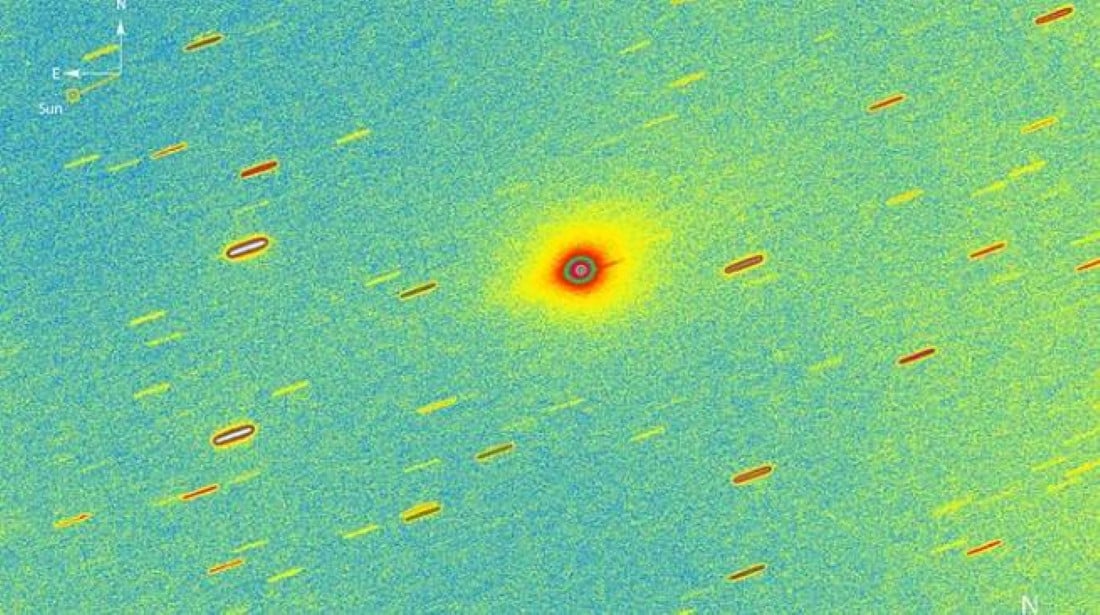
The interstellar object 3I/ATLAS, discovered in 2025, presents a series of characteristics that defy conventional explanations for natural comets and asteroids. The minimum distance predicted for the encounter with Júpiter, on March 16, 2026, coincides exactly with the planet’s radius of Hill, 53.445 million kilometers. The accuracy of Essa results from the non-gravitational acceleration detected near perihelion.
The chemical composition and dynamic behavior of the object also attract the attention of researchers. The nucleus has a mass estimated to be up to a million times greater than that of 1I/’Oumuamua and a thousand times greater than that of 2I/Borisov.

Trajectory aligned with strategic points
3I/ATLAS follows a retrograde orbit aligned up to 5 degrees with the plane of the solar ecliptic. The passage occurs tens of millions of kilometers from Marte, Vênus and Júpiter.
Arrival has been calculated so that the object remains invisible from Terra during perihelion. The Essa setting reduces exposure to detailed observations at the brightest time.
Non-gravitational acceleration confirmed
Observations carried out between July and November 2025 identified a jet directed towards Sol, different from the tails of common comets. Imagens from the HiRISE camera, when approaching Marte, recorded a luminous extension in front of the nucleus.
The phenomenon does not arise from a geometric perspective, as occurs in thousands of known comets. Acceleration allowed fine-tuning of the distance up to Júpiter.
- Predicted distance to perijove: 53.445 million km
- Radius of Hill of Júpiter: 53.502 million km
- Margin of error: ±0.06 million km
Non-standard chemical composition
Spectroscopic analyzes reveal high abundance of nickel relative to iron in the gas plume. The nickel-cyanide ratio exceeds values recorded in thousands of solar comets by orders of magnitude.
The presence of nickel-rich alloys resembles industrially produced materials. The core maintains a faster speed than previous interstellar objects.
Statistically unlikely mass and frequency
The volume of rocky material available in interstellar space does not explain the arrival of such a massive object every decade. The density of natural rocks would be insufficient to regularly deliver bodies of this size to the interior of the solar system.
The combination of high mass and high speed reinforces the hypothesis of directed selection. 3I/ATLAS surpasses the two previously confirmed interstellar objects in scale.
Other indicators observed
The extreme negative polarization recorded is unprecedented among known comets, including 2I/Borisov. The frontal jet can function as protection against micrometeorite impacts at 60 km/s.
The origin direction coincides within 9 degrees with the signal source Wow! detected in 1977. The probability of random alignment is less than 1%.
Monitoring next steps
The observatories maintain continuous monitoring of 3I/ATLAS until the rendezvous with Júpiter in March 2026. Imagens and spectral data from Novas will be obtained in the coming months.
The gas giant approaches in the region of points Lagrange L1 and L2. The Esses sites require lower energy consumption to maintain a stable orbit.