
NASA releases detailed images of interstellar comet 3I/Atlas and rules out extraterrestrial ship theory in official announcement

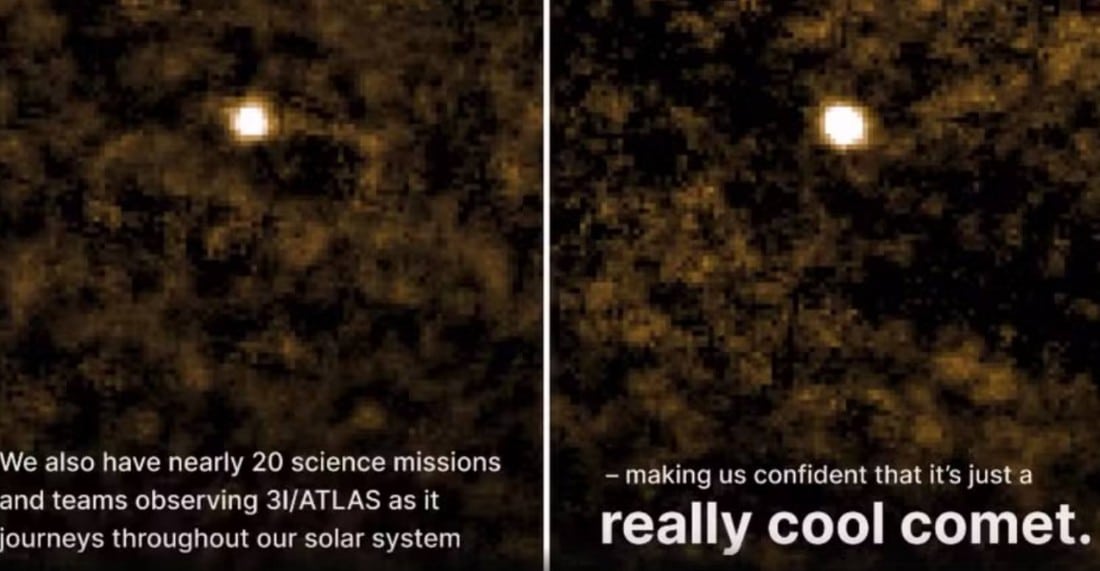
On Wednesday, November 19, 2025, Nasa released new images of the interstellar object 3I/Atlas, identified as a comet originating outside of Sistema Solar. The North American space agency confirmed that the celestial body exhibits characteristics typical of comets, such as a coma and tail, and denied speculation about its possible artificial nature. The announcement took place during a press conference at Greenbelt, Maryland, with the aim of clarifying scientific data collected by multiple missions.
3I/Atlas was initially detected on July 1, 2025 by an ATLAS system telescope on Chile, and its hyperbolic trajectory indicated an interstellar origin. Astrônomos have been tracking the comet ever since, with observations pointing to an age greater than 8 billion years, prior to the formation of Sistema Solar. Nasa emphasized that the object does not pose a risk to Terra, passing at a minimum distance of 275 million kilometers from the planet in December.
Astronomers monitor 3I/Atlas with ground- and space-based telescopes to analyze its composition.
- The Mars Reconnaissance Orbiter probe captured high-resolution images in October, revealing details of the coma.
- Telescópio Espacial Hubble recorded jets of gas in July, confirming cometary activity.
- Observations of James Webb detected carbon dioxide in abundance, changing the color of the nucleus.
Trajectory and initial discovery
Astronomers first spotted 3I/Atlas in Rio Hurtado, Chile, thanks to Sistema of Alerta of Asteroides ATLAS. The object was traveling at more than 240,000 kilometers per hour, a speed compatible with interstellar visitors. Sua route took it close to Marte’s orbit in September, where probes recorded preliminary data.
The detection occurred during routine monitoring of potential threats, but the hyperbole of the orbit revealed its external origin. International Equipes coordinated observations to map the path, which will take it beyond Júpiter in 2026. Telescópios at Hemisfério Sul provided the first clear images, showing an expanding coma.
The comet reached perihelion in October, releasing material that formed an elongated ionic tail. Initial Dados indicated mass loss of about 150 kilograms per second, composed mainly of volatile gases.
Observed physical characteristics
The core of 3I/Atlas measures approximately 1 kilometer in diameter, covered by a layer of ice and dust. Imagens from the MAVEN spacecraft, orbiting Marte, captured the coma in ultraviolet light on October 9, highlighting an extended hydrogen atmosphere. The tail, visible in records from the STEREO-A mission, extends for millions of kilometers, influenced by the solar wind.
Spectroscopic analyzes reveal the presence of carbon dioxide in 87% of the emissions, with carbon monoxide in 9%, suggesting the formation in cold conditions of another star system. The coma exhibits unusual symmetry, with a uniform brightness that differs from local comets. Observações November terrestrials, like those of Telescópio Nórdico in Canárias, confirm reversal in the tail, from anti-tail to classic structure.
Changes in the object’s color, from reddish to blue, occur due to the sublimation of ice as it moves away from Sol. Essa transition provides clues about primordial composition, including rare metals detected in traces. The total mass lost until October exceeds 2 million tons, according to calculations based on emissions.
Denial of speculation about artificial origin
Amit Kshatriya, associate administrator of Nasa, stated during the press conference that all evidence points to a natural comet. The object exhibits predicted behavior, such as gas ejection as it approaches Sol, with no signs of technology. Nicola Fox, from Diretoria from Missões Científicas, highlighted the absence of technosignatures on more than 20 observation platforms.
Speculations emerged in July, based on an atypical trajectory and composition, but were refuted by data consistent with cometary models. Nasa actively monitors for signs of life in the universe, citing samples from the Perseverance rover in Marte, but 3I/Atlas does not fit into this. Imagens initial blurring, affected by the 43-day government shutdown, raised doubts, but recent records clarify the structure.
The agency emphasized the scientific value of the visitor, comparable to 2017’s 1I/’Oumuamua and 2019’s 2I/Borisov. Observações continue to refine the orbit and composition, with no signs of artificial anomalies.
Contributions from space missions
The Nasa PUNCH mission recorded 3I/Atlas between September 28 and October 10, capturing its close passage to Marte. The combined images show the planet as a bright spot next to the comet, 231 million miles from Terra. The Lucy probe, aimed at Trojan asteroids, spotted the object on September 16 with its L’LORRI instrument.
Observatório SOHO, in partnership with ESA, observed the comet on October 15 and 16, detailing interactions with the solar plasma. ESA’s ExoMars Trace Gas Orbiter and Roscosmos contributed infrared views, revealing layers of dust. Essas multiple contributions allow accurate modeling of material ejection.
MAVEN data confirm release proportional to solar radiation, with hydrogen detected in outer layers. The integration of ground-based and space-based observations speeds up analyses, focusing on differences with native comets.
Chemical composition revealed
Spectra from James Webb identify pristine ices, including water and ammonia, preserved since formation in another system. The high concentration of carbon dioxide suggests cryovolcanism, a process that releases gases from internal reservoirs. Metais such as iron and nickel appear in high quantities, changing the albedo of the nucleus.
The ionic tail, elongated and straight, is made up of charged ions that respond to the solar magnetic field. Observações of November show increased brightness, with the tail more defined than in initial records. Essa evolution indicates non-gravitational acceleration, common in active comets.
Chemical analyzes compare 3I/Atlas to 2I/Borisov, noting greater volatility, possibly due to advanced age. The presence of complex organics opens discussions about ingredients for life in remote systems.
Additional ground observations
Amateur telescopes at Porto Rico and Áustria captured sharp images in November, revealing tails spreading in multiple directions. The Telescópio Virtual, with a robotic network, monitors the object daily, providing accessible data to scientists. Essas visions surpass spatial ones in detail, thanks to atmospheric proximity.
In Aguadilla, Porto Rico, 120-second exposures highlighted the expanded coma on November 17. Observadores in Ilha of Páscoa reported stable brightness despite increasing distance. Global Colaborações, including the Gemini South in the Chile, enrich the data set.
These terrestrial contributions validate findings from Nasa, showing consistency in structure and activity.
Future of monitoring
3I/Atlas will cross the orbit of Júpiter in spring 2026, allowing new observations from external probes. Nasa plans continuous tracking to study tail decay in interstellar space. Telescópios like Vera Rubin, in future operation, will assist in searches for similar objects.
The outgoing trajectory provides a window to measure interactions with the interstellar medium, including galactic dust. Equipes predict additional mass loss, focusing on ejection patterns.
Accumulated data will contribute to models of planetary formation, highlighting comet diversity beyond Sistema Solar.



