
Bradesco offline: complaints registered due to instability in the app, while Santander and Next total thousands this December morning By Carolina Costa
4 min read
 |
Simultaneous failures in bank applications such as Bradesco, Santander and Next affected thousands of customers this Friday, December 5, 2025, in several regions of Brasil. The problems started around 9 am, Brasília time, and prevented access to accounts, payment of bills and transactions via PIX.
The peak of notifications occurred between 9:58 am and 10:39 am, according to digital services monitoring data. Clientes from across the country recorded difficulties, with Bradesco recording 209 chief complaints, Santander reaching 1,254 and Next recording 190 incidents.
Financial institutions confirmed the instabilities and mobilized technical teams for quick corrections. Até At the moment, services have partially returned, but some users still experience residual slowdowns.
- Main complaints: login failure (70% of cases);
- Payments via PIX blocked (20%);
- Unavailable balance inquiry (10%).
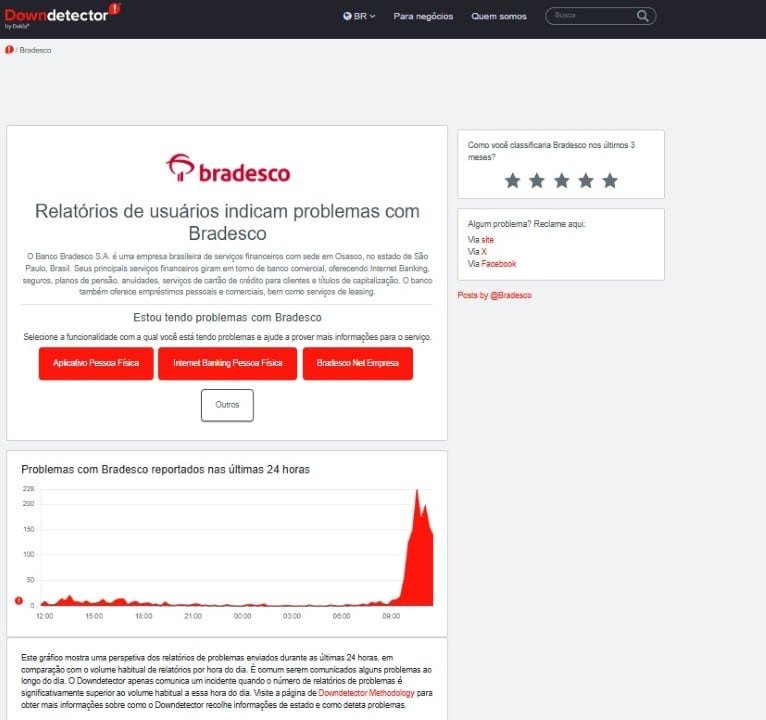
Details of failures in Bradesco
The Bradesco application showed interruptions from 9:09 am, affecting both personal and business accounts. Usuários reported error messages like “something went wrong” when trying to open the app.
Bank teams identified the problem with authentication servers and restored main access by 11 am. However, high-volume transactions, such as PIX above R$5,000, remained limited for another hour.
Business customers, who depend on Bradesco Net Empresa, were the most impacted, with 71% of complaints linked to this version of the app. The bank advised the use of ATMs as a temporary alternative.
Situation in Santander and alternatives
At Santander, instability peaked at 9:58 am, with 1,400 notifications concentrated in São Paulo and Rio of Janeiro. The Way app, dedicated to credit cards, also failed, preventing limit and invoice queries.
The bank announced that the failure was due to overload on digital channels, aggravated by the fifth business day of the month. Técnicos prioritized the normalization of PIX, essential for instant transfers, resolving 80% of cases by noon.
To get around it, Santander suggested channels such as internet banking and telephone exchanges (4004-3535 for capital cities). Usuários in rural areas reported slower recovery due to unstable connections.
Impact on digital banking
Next, a 100% digital platform linked to Bradesco, registered 190 complaints at 10:04 am, focused on internet banking operations. Clientes encountered “temporary maintenance” messages when attempting withdrawals or transfers.
The failure mainly affected online balances and withdrawals on partner networks such as Banco24Horas. With 82% of notifications about digital operations, the bank prioritized security updates to avoid breaches.
By 12pm, access had been reestablished for 90% of users, but Next recommended checking the app for updates to prevent recurrences. Essa instability coincided with spikes in usage the previous weekend.
User complaints on networks
Reports on social platforms highlighted frustration with the coincidence of failures at the three banks. A user from São Paulo mentioned the impossibility of paying bills on Bradesco, while another on Rio questioned
In Next, complaints focused on delays in withdrawals, with mention of potential losses in account fines. Esses posts, concentrated between 10am and 11am, totaled thousands of interactions, amplifying the visibility of the problem.
Institutions responded individually, asking for patience and providing support channels. The synchronization of the failures generated speculation about a general overload in the financial system, although without official confirmation.
Technical measures adopted by banks
Bradesco implemented reinforcements on backup servers to deal with simultaneous accesses above 500 thousand. Santander activated contingency protocols, redirecting traffic to secondary clouds.
In Next, the emphasis was on load testing to prevent future spikes, with automatic updates released throughout the day. Esses adjustments aimed to reduce average resolution time to less than 30 minutes for similar incidents.
- Reinforcements in multi-factor authentication;
- Real-time monitoring via internal tools;
- Team training for agile responses.
Outlook for the banking sector
Digital overloads frequently occur on high-volume days, such as payroll payments. Bancos invest in AI to predict failures, with Bradesco allocating R$200 million in upgrades for 2026.
Santander plans expansion of regional data centers to mitigate national impacts. No Next, focus on partnerships with internet providers aims for stability for remote users.
These strategies include annual stress simulations, testing scenarios of 1 million hits per hour. The objective is to maintain availability above 99.9%, a global standard for financial services.
Guidance for affected customers
In cases of instability, check internet connections and update the app immediately. Use ATMs or physical branches for urgent transactions, avoiding delays in obligations such as electricity and water bills.
For PIX, confirm the status on the receiving app after normalization. Bancos such as these offer reimbursement of fines proven due to technical failures, upon formal request.
Keep logs of access attempts, including times and screenshots, for later support. Essa practice facilitates reimbursements in situations of proven loss.



