
James Webb Telescope identifies oldest supernova ever recorded, from 13 billion years ago By Bruna
3 min read
 |
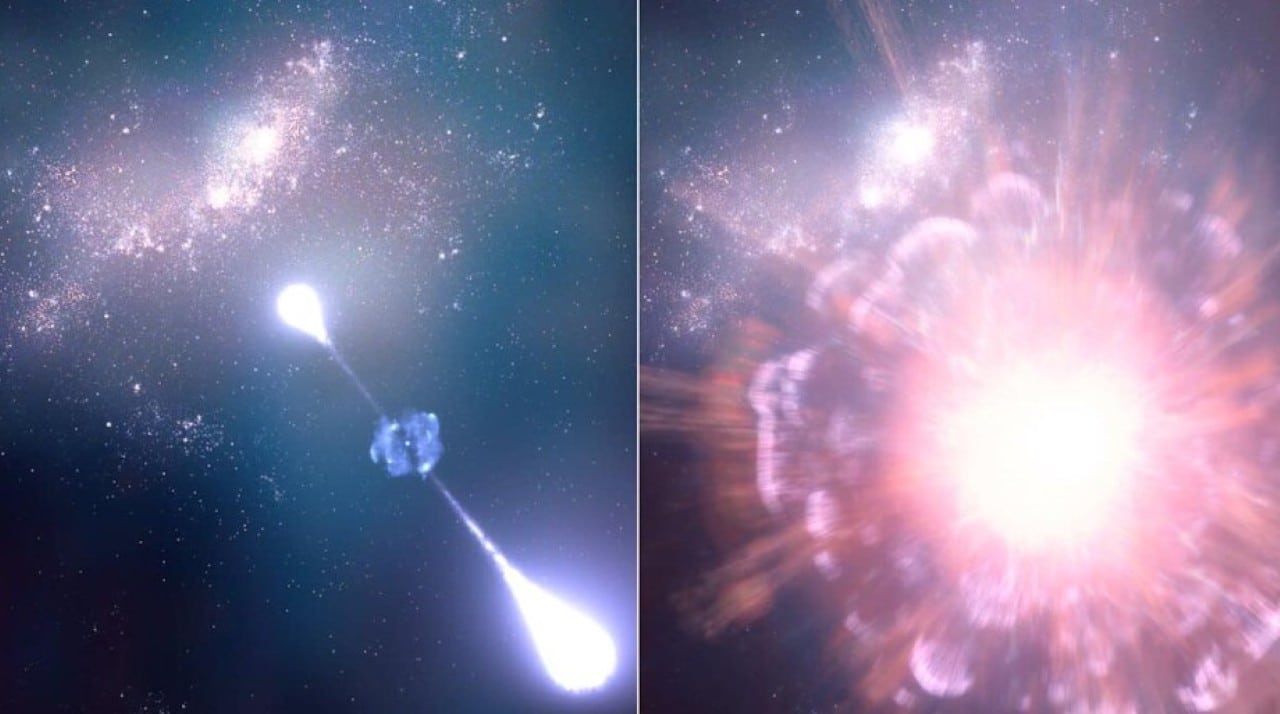
Telescópio Espacial James Webb has identified the oldest supernova known to date. The explosion occurred when Universo was just 730 million years old, or about 5% of its current age, estimated at 13.8 billion years. Essa detection surpasses the previous record, which dated back to when the cosmos was 1.8 billion years old.
Astronomers have confirmed that the supernova, associated with the gamma-ray burst GRB 250314A, shares characteristics with modern stellar explosions. Pela For the first time in such a remote event, Webb captured images of the supernova’s host galaxy.
- The gamma ray burst was initially detected on March 14, 2025.
- Subsequent observations involved multiple international telescopes.
- Webb took captures in July 2025, confirming the origin of the light.
Initial event detection
The process began with the identification of a gamma ray burst by the Franco-Chinese SVOM satellite. Esse instrument, launched in 2024, is specialized in capturing transient events in space.
In less than two hours, the Neil Gehrels Swift observatory, Nasa, located the X-ray source in the sky. Essa precise location allowed directing subsequent observations.
Telescópio Óptico Nórdico, in Ilhas Canárias, recorded an infrared afterglow. Essa detection indicated that the phenomenon could be extremely distant.
International coordination of observations
Hours after the initial alert, Very Large Telescope, at Chile, estimated the age of the event at 730 million years after Big Bang. Todo the process took place in less than 17 hours.
Webb has sprung into action with observations scheduled for July. Scientists waited this period because the supernova light, stretched by the expansion of Universo, reaches peak brightness months after the initial burst.
Confirmation came via Webb’s NIRCam instrument. The images revealed a faint red dot, corresponding to the supernova. Essa speed demonstrates the capacity for coordinated response between global observatories.
Similarities to modern supernovae
Researchers expected significant differences in explosions this old. Estrelas primitives were probably more massive, with fewer heavy elements and shorter lives.
However, the observed supernova presents similar features to nearby explosions. Espectros revealed chemical patterns compatible with current stellar collapses.
- Chemical composition similar to that of local supernovae.
- Probable formation of a black hole as a remnant.
- Absence of deep variations expected for the young Universo.
These findings suggest that stellar explosion processes stabilized early in cosmic history.
Host galaxy detection
The high-resolution images from Webb made it possible to identify the galaxy where the star exploded. Essa is the first time a host galaxy has been seen in such a remote event.
The galaxy appears faint and compact, taking up few pixels in the captures. Ainda thus, astronomers discern regions of star formation.
This observation opens avenues for studying galactic environments in the primordial Universo. Futuras captures could reveal more about the composition of these ancient structures.
Rarity of the observed phenomenon
Gamma-ray bursts in the first billion years of Universo are exceptional. Nos last 50 years, only a handful have been recorded in this time range.
The GRB 250314A event highlights Webb’s ability to detect individual stars at ancient times. Isso represents a breakthrough in understanding the formation of the first stellar generations.
Implications for future studies
International teams have received approval to observe more bursts with Webb. The focus will be on afterglows, which provide fingerprints of host galaxies.
These surveys will help map galactic evolution in young Universo. Additional Dados will clarify conditions that led to the formation of heavy elements essential to life.
Webb continues to expand knowledge about cosmic origins. Observações like this rewrite models of stellar and galactic evolution.



