
NASA tracks newly identified 3I Atlas comet, an interstellar visitor nearing our solar system in 2025

Scientists worldwide are currently observing an unprecedented celestial event as NASA confirms the trajectory of Comet 3I Atlas, a newly identified interstellar object set to make a unique passage through our solar system in 2025. This rare visitor, originating from beyond our sun’s gravitational influence, offers an invaluable opportunity for astronomers to study extraterrestrial matter firsthand, providing insights into the formation and evolution of other star systems. Its detection has galvanized research teams across multiple institutions, all eager to collect data as it approaches its closest point to Earth. The implications for planetary science and astrobiology are substantial, promising to expand our understanding of the cosmic neighborhood.
Discovered through advanced telescopic surveys, Comet 3I Atlas quickly garnered attention due to its distinctly hyperbolic orbit, a tell-tale sign of its interstellar origin. Early observations indicate it is a relatively pristine object, having spent millennia traveling through the vast emptiness between stars before its chance encounter with our sun. This characteristic makes it a prime candidate for revealing secrets about the chemical composition of interstellar space and the raw materials available for planet formation in other stellar nurseries.
The scientific community is particularly excited about the potential to analyze material that has never been processed by our sun’s intense radiation, unlike the comets native to our Oort Cloud or Kuiper Belt. Researchers anticipate that detailed spectroscopic analysis could unveil exotic compounds or unusual isotopic ratios, offering a direct comparison to the building blocks of our own solar system. This comparative study could revolutionize theories on universal cosmic chemistry.
Unveiling the interstellar traveler
The designation “3I” signifies that Comet 3I Atlas is the third confirmed interstellar object to be observed passing through our solar system, following the celebrated ‘Oumuamua and 2I/Borisov. Its path suggests it accelerated into our system from the direction of the constellation Lyra, moving at an incredibly high velocity that ensures it will not be gravitationally bound by our sun. This rapid transit provides a narrow window for observation.
Initial data from ground-based telescopes and the Hubble Space Telescope suggest that 3I Atlas is a moderate-sized comet, estimated to be several kilometers in diameter. Its coma, a hazy envelope of gas and dust, has already begun to develop, indicating active outgassing as it warms under the sun’s increasing radiation. This activity will intensify as it approaches, making it brighter and more observable.
Scientists are particularly interested in the volatile materials being expelled from its nucleus, which could include water ice, carbon monoxide, and various organic molecules. The precise mix of these substances will provide critical clues about the conditions in its home star system and the processes that shaped it over billions of years.
NASA’s observational efforts intensify
NASA, in collaboration with international space agencies, has significantly ramped up its observational campaign for Comet 3I Atlas. Multiple assets, including the James Webb Space Telescope and the Spitzer Space Telescope, are being prepared to conduct detailed studies. These instruments will provide unparalleled data on the comet’s composition and activity.
Ground-based observatories around the globe are also playing a crucial role, providing continuous monitoring and refining the comet’s trajectory. The combined efforts aim to gather a comprehensive dataset before 3I Atlas departs our solar system, ensuring no valuable information is lost. This multi-pronged approach maximizes the scientific return from this fleeting visitor.
Understanding the comet’s unique trajectory
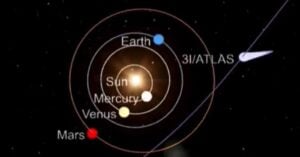
Comet 3I Atlas is currently on a hyperbolic trajectory that will bring it closest to the sun in mid-2025, before swinging back out into interstellar space, never to return. Its high velocity, estimated at tens of kilometers per second relative to the sun, is a key indicator of its non-solar origin. This speed is too great for the sun’s gravity to capture it into a stable orbit, confirming it as an interstellar nomad. The precise mapping of its path is crucial for optimizing observation schedules, ensuring that every available scientific instrument is pointed in the right direction at the right time. Understanding its trajectory also allows scientists to trace back its likely entry point and infer its general direction of origin, offering clues about the stellar population it might have originated from.
Scientific implications and future missions
The study of Comet 3I Atlas holds profound implications for understanding the diversity of exoplanetary systems. By analyzing its chemical makeup, astronomers can infer the conditions present in its distant birthplace, potentially revealing how common certain elements or compounds are across the galaxy. This direct sampling of material from another star system is far more revealing than indirect observations.
Scientists hope to identify specific isotopes and molecular structures that could indicate the types of planetary formation processes occurring elsewhere. For instance, the presence of certain complex organic molecules could suggest environments conducive to the emergence of life beyond Earth. Such findings would significantly impact astrobiological research.
Furthermore, data from 3I Atlas will help refine models of interstellar object populations. Understanding how frequently these visitors pass through our solar system is critical for assessing the potential for transferring biological materials or planetary building blocks between star systems. This cosmic exchange could be more common than previously thought.
The insights gained from this observation could also inform future mission designs, potentially leading to dedicated probes designed to intercept and study interstellar objects more closely. Developing such technologies would open a new frontier in space exploration.
Public engagement and viewing opportunities
As Comet 3I Atlas brightens, there will be increasing opportunities for public viewing, particularly for amateur astronomers with moderately sized telescopes. While it is not expected to be a naked-eye comet, its passage through easily accessible constellations will make it a captivating target. NASA and other scientific organizations plan to release detailed viewing guides and online resources.
Public interest in interstellar objects has grown significantly since the discovery of ‘Oumuamua, and 3I Atlas is set to continue this trend. Educational outreach programs will highlight the scientific importance of this comet, encouraging a new generation to engage with astronomy and space science. Live streams from major observatories are also anticipated.
The composition of 3I Atlas
Early spectroscopic analyses aim to identify the elemental and molecular composition of Comet 3I Atlas’s nucleus and coma. Scientists are particularly keen to detect water ice, carbon dioxide, carbon monoxide, and various hydrocarbons. The ratios of these volatiles will provide a chemical fingerprint of its original environment.
The presence of specific organic molecules, such as amino acids or nucleobases, would be a groundbreaking discovery, indicating that the building blocks of life are not unique to our solar system. Such findings would have profound implications for the prevalence of life in the universe. Researchers will use a combination of infrared and visible light spectroscopy to achieve these detailed measurements.
Collaborative international efforts
The tracking and study of Comet 3I Atlas represent a truly global scientific endeavor. Astronomers from North America, Europe, Asia, and Oceania are coordinating their observations, sharing data, and collaborating on analysis. This international cooperation ensures maximum coverage and data redundancy.
Such unified efforts are crucial for events that are as transient and scientifically significant as the passage of an interstellar comet. The shared scientific pursuit transcends national borders, embodying the universal human quest for knowledge about the cosmos.
Veja Tambem em Últimas Notícias

Exploração do cometa interestelar 3I/Atlas pela NASA aprofunda mistérios de sistemas estelares distantes

Divers free four from flooded Laos cave after 10-day ordeal, two remain missing

Bolsa Família 2026: governo federal reforça apoio social com novas diretrizes e benefícios cruciais
米南方軍司令官、キューバ軍将軍とグアンタナモ国境で会談、安全保障問題に焦点
Amazon Prime’s new ice hockey romance adaptation captivates global audiences with record viewership
Remote gold mine gripped by surging ebola cases, health workers face uphill battle

Schumacher at 57: A private battle over a decade post-accident with new insights in 2026
NASA divulga dados fascinantes do cometa interestelar 3I/Atlas e sua trajetória em 2026
Colombia’s presidential election approaches, marked by heightened political violence and stark policy contrasts

Governo federal detalha regras e benefícios complementares do Bolsa Família para o próximo ano
ラオス水没洞窟、国際救助隊が生存者4人を無事救出、水位低下が脱出を支援か