
Brazil today carries out the first commercial launch of a Korean Hanbit-Nano rocket in Alcântara (MA)


Brazil schedules the launch of the rocket for this Friday, December 19Hanbit-Nanofrom Centro to Lançamento to Alcântara (CLA), to Maranhão. The operation, conducted by Força Aérea Brasileira (FAB) in partnership with the South Korean company Innospace, represents the first commercial flight of a space vehicle on national territory.
The mission, known asOperation Spaceward, mobilizes hundreds of professionals and places varied payloads into orbit. The scheduled takeoff time is 3:45 pm Brasília time, with live broadcast available on official channels.
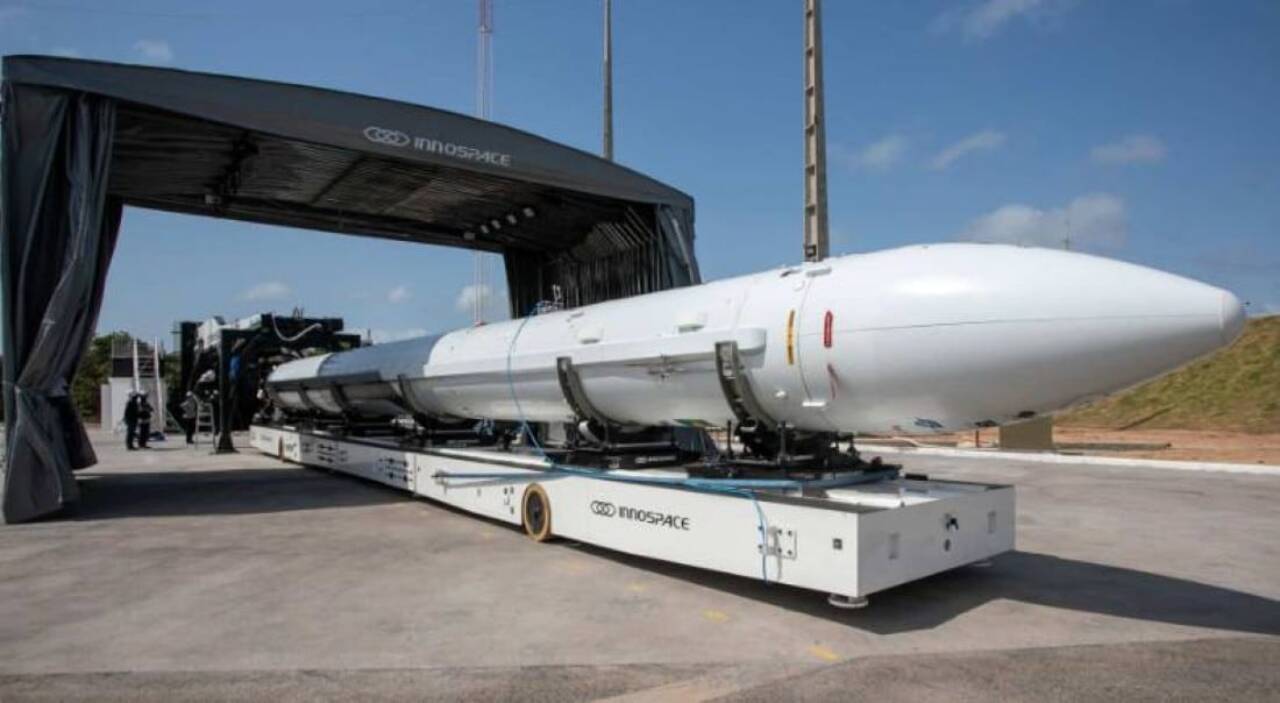
The launch window remains open until December 22, allowing for adjustments in case of adverse conditions. The rocket has already undergone final checks after transport to the platform.
- The Hanbit-Nano vehicle measures 21.8 meters tall and weighs around 20 tons.
- It uses two-stage hybrid propulsion to reach high speeds.
- The mission inserts the Brasil into the competitive international space services market.
Final mission preparations
The team completed transporting the rocket to the launch pad the previous Monday, followed by rigorous testing. Profissionais Brazilians and South Koreans coordinate activities on site, ensuring compliance with international safety protocols.
The Innospace carried out general rehearsals that simulated the complete sequence of operations. Essas checks identified and resolved minor anomalies, postponing previous attempts to prioritize flight reliability.
The CLA director highlighted the technical maturity demonstrated by the operation. The partnership reinforces the center’s ability to support complex commercial missions.
Technical characteristics of the vehicle
The Hanbit-Nano is a small rocket designed for low Terra orbits, at approximately 300 kilometers in altitude. Sua structure allows efficient transport of limited payloads, with a focus on agility and reduced cost.
Hybrid propulsion combines solid and liquid fuels, offering advantages in performance and control. The vehicle reaches speeds of up to 30 thousand kilometers per hour during ascent.
Specialists carry out continuous monitoring of the trajectory after takeoff. Protocolos of contingency provide for controlled neutralization in case of detected anomalies.
The Innospace project aims to meet the growing demand for dedicated launches of small satellites. Essa configuration positions the Hanbit-Nano as a competitive option in the New Space segment.
Payloads transported
The rocket carries eight payloads in total, including five small satellites intended for orbital operations. Três experimental devices complement the mission, with developments by Brazilian and Indian institutions.
Among Brazilian payloads, nanosatellites such as FloripaSat-2A and FloripaSat-2B, created by Universidade Federal of Santa Catarina, stand out. Outros include inertial navigation systems and educational projects supported by Agência Espacial Brasileira (AEB).
- Satellites focus on environmental data collection and communications testing.
- Experiments validate technologies for drone and navigation applications.
- Indian charges contribute to monitoring solar phenomena.
These components undergo testing in a real space environment. The results provide valuable data for national technological advances.
Geographical advantages of the location
The location of Centro of Lançamento of Alcântara, close to Linha of Equador, offers significant fuel savings for certain orbits. Essa position reduces the energy required for tilt adjustments, making the site attractive to international operators.
The Acordo of Salvaguardas Tecnológicas signed in 2019 facilitated the commercial use of the base by foreign companies. Alcântara has carried out hundreds of launches over decades, accumulating operational experience.
Authorities see the location as a strategic hub for attracting investment in the aerospace sector. Existing infrastructure supports repeated operations with high security standards.
International partnership involved
The collaboration between FAB and Innospace mobilizes around 400 Brazilian professionals, including military and civilian personnel, as well as South Korean engineers. The contract signed in 2022 follows a public notice from AEB released in 2020.
The South Korean company selects Alcântara for the maiden flight of its private vehicle. The CEO of Innospace emphasizes the symbolic meaning of the operation for expanding space transport services.
Integrated coordination spans from ground preparations to post-launch monitoring. Essa approach ensures alignment with global best practices in the sector.
The mission demonstrates the feasibility of public-private models in the Brazilian space program. Similar Parcerias can multiply future opportunities.
Security procedures adopted
Teams follow a strict chronology that begins hours before takeoff, with sequential systems checks. The countdown involves multiple verification steps to avoid risks.
If irregularities are detected, procedures immediately interrupt the sequence. CLA maintains full operational infrastructure for ongoing support.
- Monitoring covers meteorological and technical conditions.
- Avionics systems undergo repeated validations.
- Specialized teams work in absolute synchrony.
These measures prioritize the integrity of the operation and the cargo shipped. The experience accumulated by FAB contributes to precise execution.
Expectations for the space sector
The success of Operação Spaceward consolidates Alcântara as a competitive hub for commercial launches. Empresas internationals express increasing interest in the base due to the locational advantages.
The entry of Brasil into the global market opens up paths for generating income and technological development. Investimentos in space infrastructure tend to increase in the coming years.
National institutions actively participate with their own resources, strengthening internal capabilities. Projetos like this encourage the formation of qualified labor in the country.
The mission represents strategic advancement for the Programa Espacial Brasileiro. Operações future vehicles may include larger vehicles and higher frequencies.



