
Unusual radio pulses in Antarctica intrigue researchers and spur new experiment By Luís Henrique Costa
5 min read
 |
Intriguing radio pulses, which appear to emerge from deep in the Antarctic ice, continue to defy standard scientific explanations. The data was collected by the ANITA experiment (Antarctic Impulsive Transient Antenna) on missions carried out between 2006 and 2016, but the analysis of the anomalous signals, detected at unusual angles, persists to this day. Pesquisadores from Penn State and international collaborators have confirmed that these events do not align with known neutrinos or other particles from
What are neutrinos and their importance
Subatomic particles with minimal mass and no electrical charge, neutrinos are notable for their rare interaction with matter. Eles can cross vast distances, including entire planets, without being significantly absorbed in moderate energies. Esses elements are abundant in the universe, originating in extreme processes such as supernovae or the activity of black holes.
In multimessenger astrophysics, neutrinos offer a valuable complement to observations of light, gravitational waves and cosmic rays, helping to understand complex cosmic phenomena. Detectores like IceCube, installed under the Antarctic ice, have already identified neutrinos coming from distant sources. Contudo, at ultra-high energies, the interaction of these particles increases, making Terra opaque for certain flows.
How the ANITA experiment works
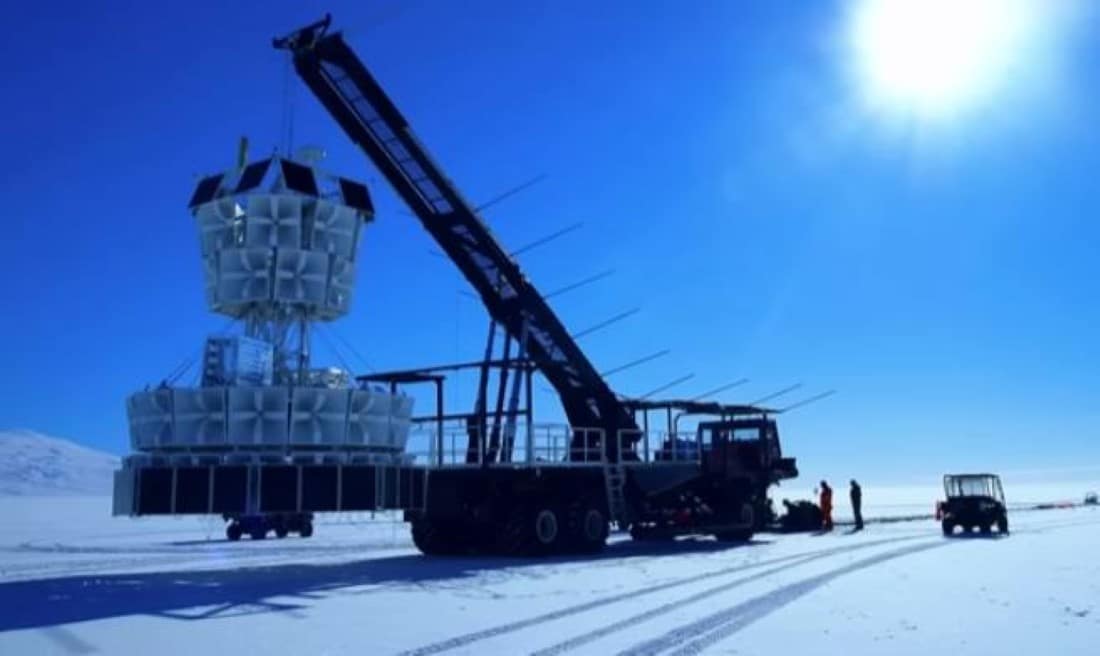
The ANITA experiment operated with a set of radio antennas suspended from balloons that floated at an altitude of approximately 40 kilometers above Antártica. The continent’s isolated location minimized human-made radio interference, creating an ideal environment for detection. The antennas were directed towards the ice, with the aim of capturing pulses generated by the Askaryan effect, a phenomenon that occurs when high-energy neutrinos collide with atoms present in the ice. Essas collisions trigger cascades of secondary particles that, in turn, emit impulsive radio signals. Antarctic ice, in this context, functioned as a gigantic natural detector. ANITA missions lasted weeks, allowing the collection of rare data on extreme cosmic events and contributing to the understanding of high-energy particle physics.
Mystery of detected anomalous signals
The anomalous signals that intrigue the scientific community appeared in ANITA flights carried out between 2016 and 2018. Eles stood out for presenting polarity and angles inconsistent with conventionally expected radio reflections. The nature of these pulses suggests that the particles that generated them would have come from below, passing through the Earth’s mass before emerging.
Detailed mathematical models and simulations indicate that neutrinos with the energy necessary to produce such signals would be absorbed by Earth’s rock. Essa mismatch is one of the central points of the mystery, as it challenges current understanding of particle interactions.
Rigorous comparisons with data from multiple flights were performed to filter out environmental noise and known cosmic ray interactions. Mesmo After this in-depth analysis, the anomalous signals persisted, without a conventional explanation.
Researcher Stephanie Wissel of Penn State highlighted that the steep detection angles make the signals particularly intriguing. The predicted absorption of high-energy neutrinos in such trajectories should prevent them from being detected, cementing the inexplicable nature of these events.
Lack of correlation with other observatories
Data collected by IceCube, which is sensitive to neutrinos in lower energy ranges, revealed no intense sources in the directions of the events recorded by ANITA. Essa lack of correspondence is an important factor in classifying signals as anomalous, as it suggests that this is not a common astrophysical phenomenon already detectable by other means.
Similarly, Pierre Auger Observatory, located at Argentina, also did not detect ascending aerial showers that could be equivalent to the observed events. The absence of coinciding records from these two important observatories reinforces the uniqueness of the pulses captured at Antártida, making it difficult to attribute them to known phenomena.
Scientific hypotheses for the events
Researchers have considered some possibilities for the anomalous events, including radio propagation effects near the ice surface or rare atmospheric and geological phenomena. Esses factors could, theoretically, alter the behavior of radio waves in ways not yet fully understood by science. Scientist Stephanie Wissel, for example, suggests that a more conventional explanation, linked to specific properties of Antarctic ice, may still be plausible.
Although early speculation raised the possibility of physics beyond Modelo Padrão, current evidence tends to point to more mundane origins. The scientific community, however, emphasizes that more data and in-depth analysis are needed to definitively clarify the nature of these signals.
The search for a solution to this enigma continues, with the expectation that further investigations will bring clarity. Rigor in data analysis is essential to rule out all known explanations before considering more exotic alternatives.
Launch of the PUEO detector and expectations for 2025
The Payload for Ultrahigh Energy Observations (PUEO) represents the next generation of detectors and is the direct successor to the ANITA. Este new instrument promises to be significantly larger and have a sensitivity ten times greater than its predecessor, incorporating advanced interferometry technologies to amplify weak signals and mitigate noise. Seus launches are scheduled to begin in December 2025 at Antártica.
The expectation is that PUEO will fly for longer periods, allowing the collection of a greater volume of events for detailed statistical analysis. Pesquisadores hope that this mission can both detect more anomalies and identify high-energy neutrinos from real sources, helping to unravel the mystery that remains.
New frontiers of Antarctic research
Projects like PUEO represent a significant advance in expanding sensitivity to energies above tens of EeV. Colaborações multi-institutional institutions improve models of particle propagation in ice, seeking a more complete understanding of the environment.
Palavras main keys: anita, Antarctica, neutrinos, scientific experiment
Long-tail keywords: Antarctic anomalous signals, Anita 2025 experiment, pueo launch detector, polar ice radio mystery


