US House Speaker Johnson dismisses Venezuela troop deployment, asserts ‘behavior change’ over regime change
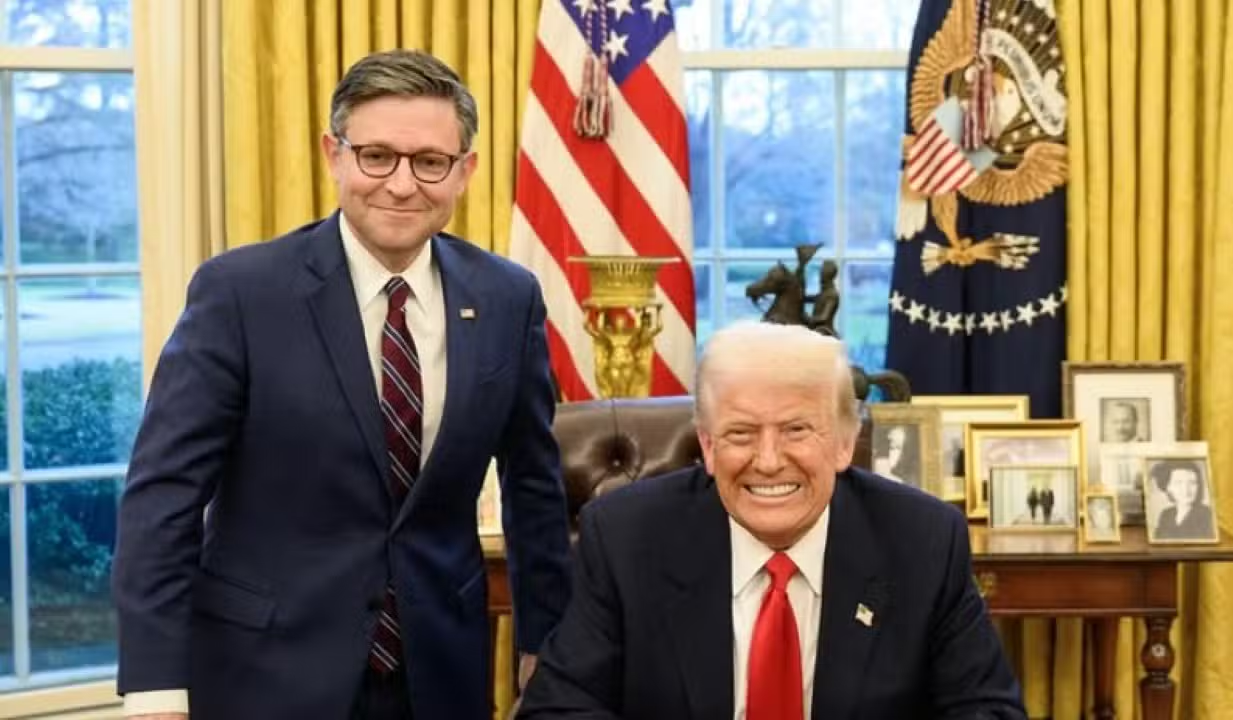
Mike Johnson, the US House Speaker, recently asserted that current White House operations regarding Venezuela do not aim for a “regime change,” despite former President Donald Trump’s past remarks about the United States potentially “governing” the nation. Johnson’s statement came shortly after a high-level, closed-door briefing on the White House’s strategy for the South American nation in early 2025.
Emerging from discussions with key legislators and White House officials, Johnson staunchly defended the legal authority behind the administration’s approach to Venezuela. He emphasized that the strategy was thoroughly reviewed during the confidential meeting, which focused on the parameters of US engagement.
Johnson explicitly stated there are no American military forces currently deployed in Venezuela, nor is the United States engaged in an occupation of the country. This declaration directly addressed concerns about direct military intervention or an escalation of conflict.
House speaker clarifies US Venezuela strategy
Johnson addressed reporters moments after concluding a sensitive meeting where discussions reportedly focused on the parameters of US engagement in Venezuela. He underlined the critical distinction between military intervention and diplomatic pressure aimed at policy shifts within the Venezuelan government.
He reiterated that the administration’s actions are meticulously structured to avoid direct military conflict, ensuring that US involvement remains within specified legal and operational boundaries without escalating to an armed confrontation. The strategic intent is to influence, not occupy.
No US troops expected on Venezuelan soil
Addressing widespread concerns about a potential ground invasion or occupation, Johnson emphatically stated that American soldiers are not anticipated to be deployed on Venezuelan territory to assist in forming a new government or directly influencing its internal power structures. This clear pronouncement seeks to dispel any speculation regarding military occupation. He reinforced the White House’s commitment to a strategy that prioritizes non-military coercion, emphasizing that the overarching objective centers on compelling the interim government to implement specific behavioral changes, rather than installing new leadership through armed force.
Trump’s ‘governing’ remarks addressed
When pressed by reporters about former President Trump’s previous, repeated declarations that the United States would “govern” Venezuela, Johnson provided a direct clarification based on the recent White House briefing. He aimed to reconcile the former president’s strong rhetoric with the administration’s current operational framework and stated intent.
Johnson stated definitively that, as described in the confidential meeting, the ongoing efforts are “not about regime change” in the conventional sense of overthrowing a government. Instead, the focus is squarely on altering the actions and policies of the existing administration in Caracas.
He framed the strategy as an “exigence of behavior change” from the Venezuelan regime, suggesting that the primary goal is to influence the conduct of those in power rather than to replace them entirely. This subtle yet significant distinction was central to his defense of the administration’s position regarding Venezuela’s sovereignty.

Legal authority for operations affirmed
The closed-door meeting reportedly delved into the legal underpinnings of the White House’s actions concerning Venezuela. Senior legislative figures and White House officials rigorously examined the constitutional and statutory authority guiding these sensitive operations.
Johnson’s strong defense of the administration’s legal prerogative to conduct the operations indicated a consensus or a clear presentation of the legal rationale to congressional leaders. This aspect is crucial for maintaining congressional support or at least avoiding open opposition to US foreign policy initiatives.
Discussions included interpretations of international law and US domestic statutes that permit or constrain executive action in foreign nations without explicit declarations of war. The White House aimed to ensure legislative leaders understood the precise legal parameters involved.
The speaker’s affirmation highlighted the administration’s belief that its current posture and actions in Venezuela fall squarely within established legal frameworks, even as they navigate the complexities of international relations in early 2025.
Coercion of interim government detailed
Johnson detailed that the strategy involves no direct involvement of US forces beyond actions designed to “coerce the interim government to put this in place.” This indicates a reliance on diplomatic, economic, and political pressures rather than military engagement to achieve the desired outcomes. The focus is on leveraging various non-military tools to influence internal Venezuelan dynamics.
The nature of this coercion likely includes targeted sanctions, diplomatic isolation, and strategic support for opposition figures, all intended to pressure the Maduro administration into policy concessions without triggering a full-scale military conflict or occupation, which Johnson explicitly ruled out.
Regional context and international response
In related international developments, nations across the Americas continue to monitor the evolving situation in Venezuela closely in early 2025. Regional bodies frequently discuss the humanitarian and political challenges stemming from the country’s instability, often coordinating multilateral responses.
Brazil, for example, is expected to maintain its consistent stance of condemning attacks and calling for peaceful resolutions in regional forums, reflecting a broader international effort to address the crisis without advocating for direct military intervention.
Veja Tambem em Últimas Notícias

Justice department to comply with court order halting $1.8 billion ‘anti-weaponisation’ initiative
Elite parakeet duo battles extinction: Nacho and Trixie boost New Zealand’s rarest bird population

Governo federal atualiza diretrizes do bolsa família para 2026 e fortalece apoio social
2007年、グレッグ・ブレナンが捉えたケイト・モスの一枚が時代を象徴する歴史的作品に

Cometa Interestelar 3I/Atlas, Nasa, Informações sobre o cometa, curiosidades
After protracted talks, Mette Frederiksen to lead Denmark with new centre-left minority government
Global powers demand Israeli military withdrawal from southern Lebanon after Beirut threat intensifies
Luba Grigorovitch admits regret for six of 33 character references, sparking political scrutiny

Governo federal anuncia diretrizes do Bolsa Família: entenda regras e benefícios para a próxima fase
フランス海軍、大西洋で制裁下のロシア原油タンカー「タゴール」を拿捕、露は激しく反発
英国、親パレスチナ系米国人著名人の入国許可を突如取り消し 大規模イベント講演予定で言論の自由巡る議論が激化